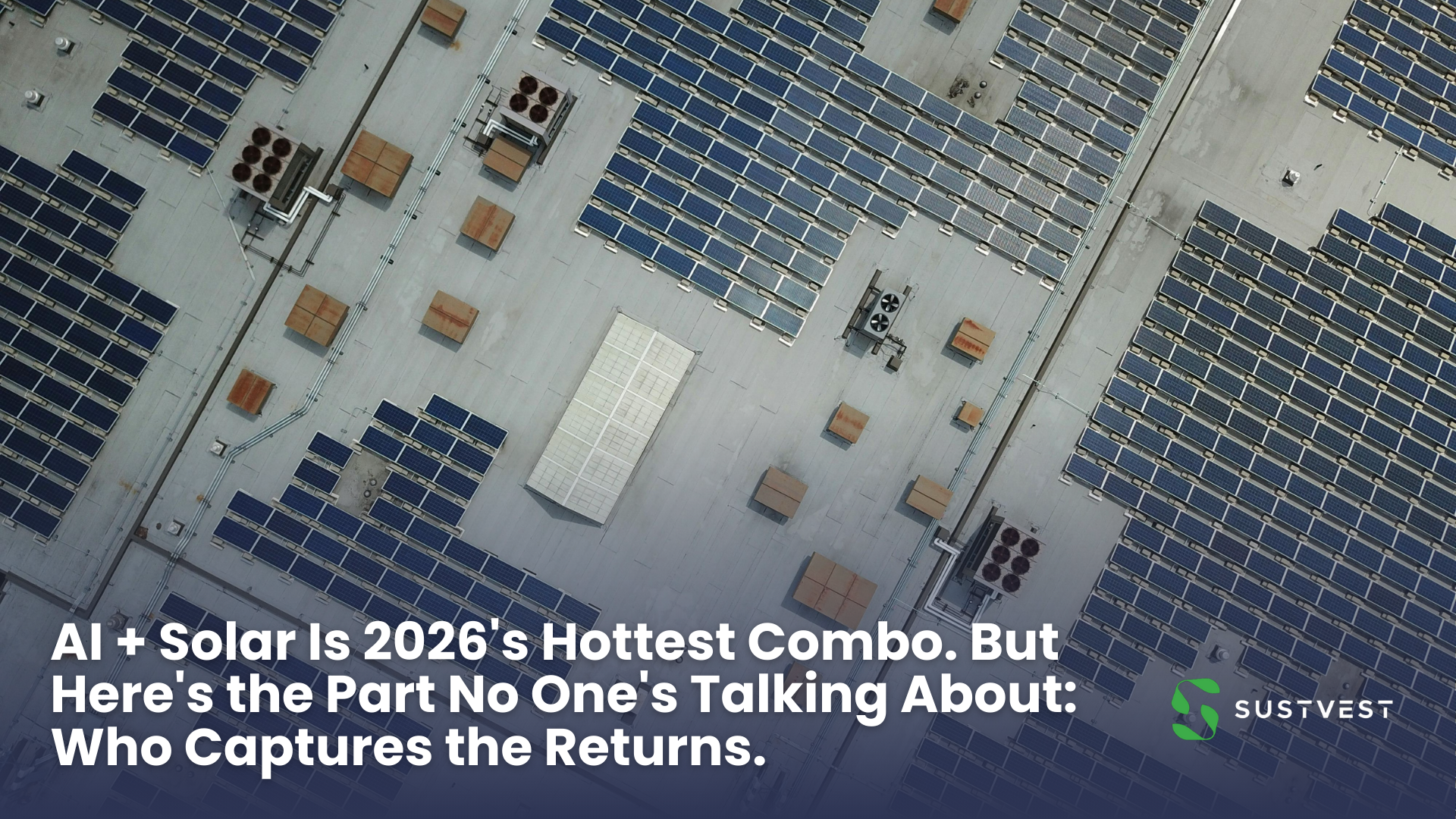
AI + Solar in 2026: Who Actually Captures the Returns?
By Hardik BhatiaPublished UpdatedArtificial intelligence is transforming renewable energy in 2026. MIT researchers say AI can optimize power grids in real-time, helping operators manage supply and demand more efficiently. The Department of Energy reports AI is accelerating innovation in solar technology and battery development. Industry blogs declare "AI is no longer just a futuristic concept—it is a fundamental part of the renewable energy value chain."
The headlines are everywhere: AI-powered forecasting, smart grids, predictive maintenance reducing costs by up to 40%, peer-to-peer energy trading, and machine learning optimizing every aspect of renewable operations.
It's all true. AI is making solar infrastructure smarter, more efficient, and more reliable. But here's the investor question buried beneath the technological excitement: does smarter technology mean better returns?
Or does old-fashioned contracted revenue—a 20-year power purchase agreement with a creditworthy utility—still generate better risk-adjusted returns than the most sophisticated AI-optimized trading platform?
What AI Actually Does for Solar
Before addressing who captures the returns, let's understand what AI actually delivers for renewable energy. The applications fall into three categories: forecasting, optimization, and maintenance.
Forecasting: AI analyzes weather patterns, historical generation data, and grid conditions to predict solar output more accurately. According to MIT researchers, these predictions help grid operators balance supply and demand, especially as renewable penetration increases. Better forecasting reduces the need for expensive backup power and allows more renewable integration without grid instability.
Optimization: AI algorithms determine optimal times to charge and discharge batteries amongst many other use cases. As one industry analysis notes, "Load balancing is optimized through AI. Demand response systems adjust consumption patterns in real time."
Predictive Maintenance: AI monitors equipment performance, detects anomalies before they cause failures, and schedules maintenance proactively. Industry data suggests AI-powered predictive maintenance can reduce costs by up to 40% compared to reactive maintenance approaches. Researchers have also developed AI software that predicts when grid components will fail, allowing repairs before problems occur.
These applications are real and valuable. AI genuinely improves renewable energy system performance. The question investors should ask isn't whether AI helps—it clearly does. The question is whether AI improvements translate into superior investment returns compared to traditional infrastructure approaches.
The Technology Doesn't Own the Revenue
Here's the uncomfortable truth technology enthusiasts often miss: AI optimization doesn't change the fundamental economics of who gets paid and how much.
Consider a solar farm with a 20-year power purchase agreement selling electricity at $0.05 per kilowatt-hour to a utility. AI-powered forecasting might improve capacity factor predictions by 2-3%, allowing more accurate revenue projections. AI optimization might increase battery storage efficiency by 5-7%, capturing more value from electricity price arbitrage. AI predictive maintenance might reduce annual O&M costs by 30-40%.
All valuable improvements. But they're incremental enhancements to an existing economic model, not revolutionary changes. The solar farm still generates revenue by selling contracted electricity. The investment return still depends primarily on PPA pricing, solar irradiance, equipment costs, financing terms, and offtaker creditworthiness.
AI makes the project better. It doesn't change what generates returns.
Compare this to data center operators deploying AI, who face a different reality. Data centers consume massive amounts of electricity to power AI workloads. According to recent industry analysis, data centers are "shifting from passive energy consumers to grid stakeholders" and "diversifying power strategies, blending renewables, natural gas, batteries, and emerging technologies."
The AI companies need electricity to function. Solar projects produce electricity that AI companies need. The leverage in that relationship flows to whoever controls the scarce resource—and in 2026, with electricity demand growing faster than supply, the renewable energy generators hold leverage, not the AI-optimized buyers.
Who Actually Captures Value From AI in Energy
When AI improves renewable energy performance, three parties potentially capture value: technology providers, project operators, and investors. Understanding who benefits most reveals which investment approach generates superior returns.
Technology Providers: Companies selling AI optimization software, forecasting tools, and predictive maintenance platforms capture value through licensing fees and service contracts. These businesses can be excellent investments if they achieve dominant market position. But they're software businesses, not infrastructure investments. Different risk profile, different return characteristics, and different investor requirements.
Project Operators: Developers and operators running solar farms benefit directly from AI improvements. Lower maintenance costs translate to higher margins. Better forecasting enables more profitable trading strategies. Enhanced reliability improves reputation and helps secure future contracts. Operators capture substantial value from AI adoption.
Infrastructure Investors: This is where the analysis gets interesting. Investors in renewable infrastructure benefit from AI indirectly through improved project performance. If AI reduces O&M costs 30-40%, cash distributions increase proportionally. If AI improves capacity factors 2-3%, revenue grows modestly. If AI predictive maintenance prevents catastrophic equipment failures, investor downside risk decreases.
But these benefits accrue regardless of whether investors understand AI technology. You don't need to comprehend machine learning algorithms to benefit from lower maintenance costs. You don't need to predict neural network advances to gain from improved forecasting. The infrastructure investment returns improve because the underlying asset performs better—but the improvement mechanism doesn't require AI expertise from investors.
The Data Center Paradox
The explosive growth of AI workloads creates unprecedented electricity demand. Data centers consumed less than 5% of global electricity in 2024, with projections showing dramatic increases through 2030. Recent analysis notes that "renewables currently supply about a quarter of the electricity consumed by data centers, mostly through wind, solar and hydropower sources."
This creates opportunity for renewable energy investors. AI's insatiable electricity appetite means hyperscalers like Microsoft, Google, and Amazon are signing long-term renewable PPAs to secure power supply. These contracts provide exactly the revenue certainty that infrastructure investors value—20-year agreements with investment-grade counterparties who desperately need electricity to run their businesses.
The paradox: AI creates massive electricity demand that drives renewable infrastructure returns, but the returns come from traditional contracted revenue, not from AI optimization of the infrastructure itself.
You don't need AI expertise to benefit from data centers needing power. You need renewable infrastructure positioned to capture long-term contracts with creditworthy offtakers who have no choice but to secure reliable electricity supply.
The technology hype focuses on AI optimizing solar performance. The investment opportunity is AI companies desperately buying solar electricity through 20-year PPAs because they can't grow without it.
What This Means for Investors
The AI revolution in renewable energy creates real value. Better forecasting, optimized operations, and predictive maintenance genuinely improve project economics. But these improvements benefit infrastructure investors through traditional mechanisms—higher cash distributions from lower costs, better capacity factors improving revenue, and reduced downside risk from prevented failures.
Investors don't need to understand AI technology to capture these benefits. You need to invest in well-structured renewable infrastructure operated by competent teams who adopt best available technology—whether that's AI-powered optimization or more conventional approaches.
The investment thesis remains unchanged: contracted revenue from creditworthy offtakers generates predictable cash flows over multi-decade holding periods. AI makes the projects better. It doesn't change what makes them good investments.
For investors evaluating renewable infrastructure opportunities in 2026, this clarity is valuable:
Focus on fundamentals: PPA pricing, offtaker creditworthiness, solar irradiance, financing terms, and operator quality matter more than whether the project uses cutting-edge AI optimization.
Value AI as enhancement, not transformation: AI improvements are real but incremental. A project with solid fundamentals and basic technology beats a marginal project with sophisticated AI.
Prioritize contracted revenue over merchant optimization: Long-term PPAs with creditworthy counterparties provide downside protection that AI-optimized trading strategies can't replicate.
Benefit from AI demand indirectly: The real AI opportunity in renewable infrastructure isn't optimizing solar farms—it's capturing long-term contracts with hyperscalers who need massive electricity to power their AI workloads.
Recognize geographic arbitrage: AI optimizations work globally, but solar irradiance, labor costs, and electricity prices vary dramatically by geography. A project in high-irradiance emerging markets with lower costs may generate better returns than an AI-optimized project in marginal developed market locations.
The Bottom Line: Technology Enables, Contracts Pay
AI is transforming renewable energy in 2026. The technology delivers real improvements in forecasting accuracy, operational efficiency, and maintenance costs. MIT researchers, the Department of Energy, and industry practitioners all confirm AI's substantial benefits for renewable infrastructure.
But when investment horizons span 20-25 years, contracted revenue from creditworthy offtakers generates more reliable returns than technological optimization strategies that may erode as competitors adopt similar approaches.
The solar farm with a 20-year PPA doesn't need cutting-edge AI to generate consistent 10-12% returns. It needs good solar irradiance, reasonable equipment costs, creditworthy offtakers, and competent operators. If those operators happen to use AI for predictive maintenance and forecasting? Great—margins improve slightly. But the core investment thesis depends on fundamentals, not technology.
Meanwhile, the real AI opportunity in renewable infrastructure isn't optimizing solar performance through machine learning. It's capturing the massive electricity demand AI workloads create through long-term contracts with hyperscalers who can't grow without power.
Everyone's talking about AI-powered solar optimization. Smart investors are capturing the returns from AI companies desperately signing 20-year renewable PPAs because they need electricity to survive.
Technology makes headlines. Contracts generate returns. In 2026, understanding the difference matters more than ever.
About Sustvest: Sustvest provides US accredited investors with access to solar infrastructure through SEC Regulation D offerings. While the industry debates AI optimization and smart grid technology, we focus on fundamentals: solar projects with contracted revenue from creditworthy offtakers, in markets with excellent irradiance and lower costs. Our in house built monitoring platform leverages AI to optimise the plant for meeting the needed outputs. Our India solar projects delivering 10-12% leveraged IRRs benefit from any AI improvements operators adopt—but the returns derive from 20-25 year PPAs with investment-grade utilities, not from technology sophistication. We handle cross-border complexity—FEMA compliance, currency management, project oversight—so you capture infrastructure returns from proven economic models, not technological speculation.
Ready to invest in renewable infrastructure where returns come from contracts, not code? Schedule a consultation to discuss why PPA-backed solar projects outperform AI-optimized merchant strategies, how geographic arbitrage amplifies technology benefits, and why the best AI opportunity in renewables is capturing demand from hyperscalers who need power to run their businesses.
Investment Disclosure: Renewable energy infrastructure investments involve risks including execution risk, offtaker credit risk, technology risk, regulatory changes, illiquidity, and potential loss of principal. International investments involve additional risks including currency fluctuation and political instability. AI technology benefits described may not materialize as expected or may become commoditized as competitors adopt similar approaches. Contracted revenue provides downside protection but may limit upside potential compared to merchant strategies in favorable market conditions. This content is for informational purposes only and does not constitute investment advice. AI applications and benefits cited for informational purposes from publicly available research and industry sources. Consult qualified legal, tax, and financial advisors before making investment decisions.
SEO Keywords: AI solar investment 2026, artificial intelligence renewable energy returns, AI powered solar infrastructure, smart grid investment opportunity, AI optimization solar projects, renewable energy AI technology, contracted revenue vs AI trading, solar PPA investment, AI data center electricity demand, hyperscaler renewable energy contracts, AI renewable energy who benefits, technology vs fundamentals solar investment