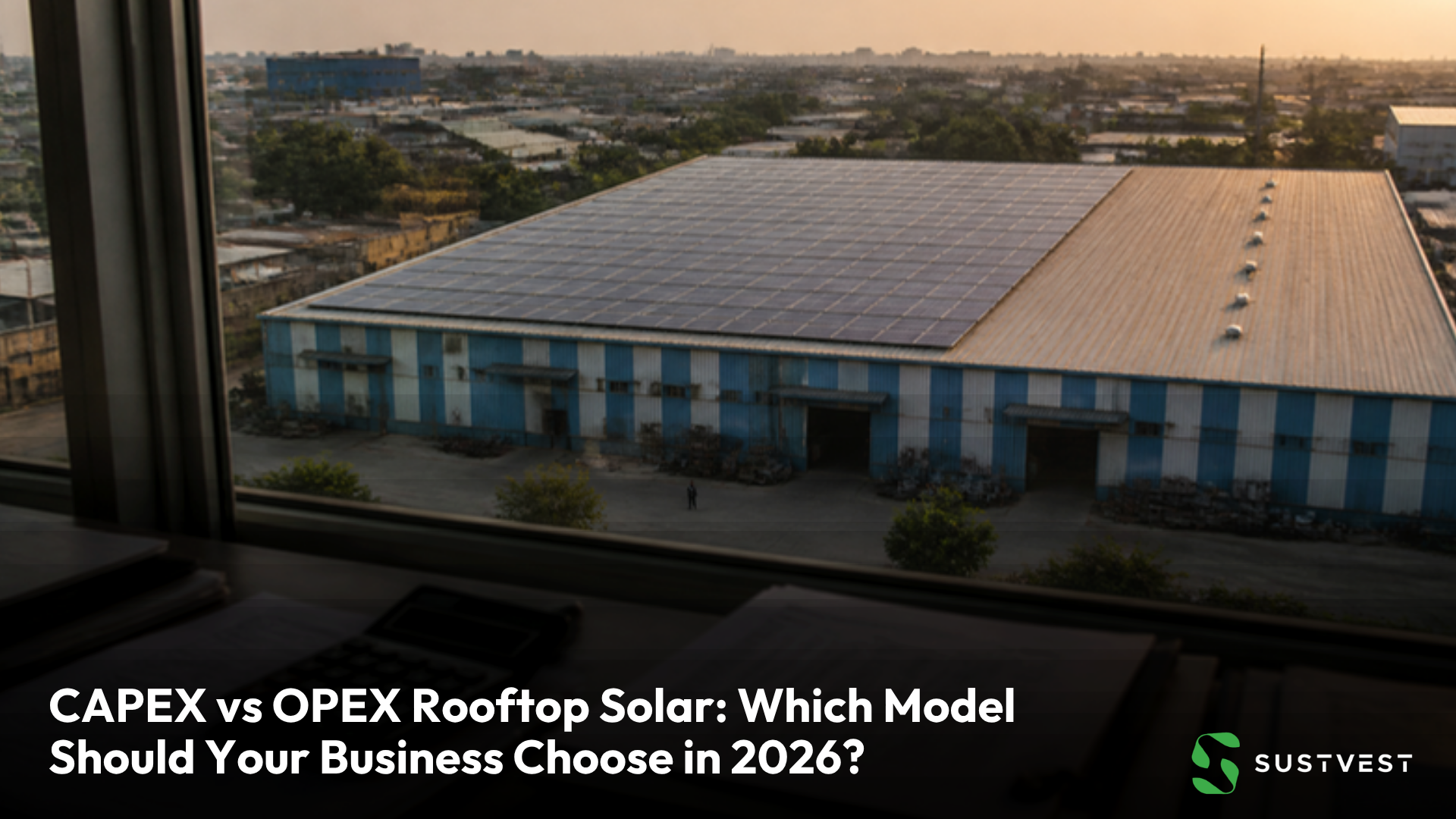
CAPEX vs OPEX Rooftop Solar: Which Model Should Your Business Choose in 2026?
Every rooftop solar decision comes down to one question before any panel is chosen: do you want to own the plant, or just buy its power?
Own it, and you take the larger savings along with the cost and the work. Buy the power, and someone else carries the investment while you take a smaller, simpler saving. Neither is the right answer for every business.
This guide gives you the numbers, the trade-offs and a simple way to decide.
What is the difference between CAPEX and OPEX rooftop solar?
In CAPEX (capital expenditure), you pay for the plant and own it. In OPEX (operating expenditure), a developer pays for and owns the plant, and you pay only for the units it generates.
OPEX is also called the RESCO (Renewable Energy Service Company) model. The contract behind it is a PPA (power purchase agreement), which fixes your per-unit tariff for a long term.
Think of it like buying a building versus signing a long lease. Both give you the space. Only one sits on your balance sheet as your own asset, with your own money tied up in it.
How do CAPEX and OPEX compare side by side?
CAPEX gives higher lifetime savings. OPEX gives immediate savings with no upfront cost. The figures below are published market examples, not quotes. Your numbers will depend on state, tariff, roof and plant size.
| Factor | CAPEX (you own) | OPEX / RESCO (developer owns) |
|---|---|---|
| Upfront cost | Full project cost: ₹60 to ₹80 per watt-peak in one 2026 guide | Usually zero or a small deposit |
| What you pay | Nothing per unit after payback, plus upkeep | Per-unit tariff, as you consume |
| Contract length | No power contract | Usually 10 to 25 years |
| Upkeep (O&M) | Your responsibility, or a paid contract | Developer's responsibility |
| Performance risk | Mostly yours | Mostly the developer's, since it earns only on generation |
| Tax depreciation | You can claim it | Developer claims it |
| Balance sheet | Asset, and debt if financed | Long-term contract, check with your auditor |
O&M stands for operations and maintenance: panel cleaning, inverter servicing, monitoring and repairs.
How much does a CAPEX rooftop solar plant cost in India?
Published figures for C&I (commercial and industrial) plants range from about ₹44,000 to ₹80,000 per kW. A Heaven Green Energy guide puts it at ₹60 to ₹80 per watt-peak for 2026. A SolarSquare example totals about ₹44 lakh for 100 kW.
That gap is wide, and it is a warning in itself. Quotes vary with module type, structure height, roof condition and who is responsible for approvals. Compare quotes line by line, not by the total alone.
GST (Goods and Services Tax) on solar devices was cut from 12% to 5% with effect from 22 September 2025. One installer guide puts the effective rate on a turnkey contract at about 8.9%, because services are taxed differently. Ask for the tax split on every quote.
How much can you save with each model?
On published 100 kW examples, CAPEX saves roughly twice as much as OPEX over 25 years. Two guides, using different assumptions, land in a similar place.
| Published 100 kW example | CAPEX | OPEX / RESCO |
|---|---|---|
| Heaven Green Energy | ₹3.2 to ₹3.8 crore over 25 years | ₹1.2 to ₹1.6 crore over 25 years |
| SolarSquare | About ₹14.2 lakh a year, net of O&M | About ₹5.4 lakh a year |
The bigger CAPEX number is not free money. It is the return on your own capital. To compare fairly, ask what that same money would earn elsewhere in your business. A factory that earns far more from new machinery than from a solar plant may be better off keeping its cash there and choosing OPEX.
How long is the payback on rooftop solar?
Published CAPEX payback estimates mostly range from 3 to 6 years. Tata Power says 4 to 6 years is typical in many C&I setups. SolarSquare says 3 to 4 years, and Heaven Green Energy shows 3.3 to 3.8 years after depreciation in its worked example.
With OPEX, the idea of payback mostly falls away. There is no large investment to recover, so savings start from the first bill, provided the tariff is below your grid rate.
Three things move your payback most:
- Your grid tariff. The higher it is, the faster solar pays.
- Your daytime use. Solar is worth most when you consume it on site, as state rules on exports differ and can be tight.
- Generation. Tata Power's guide uses around 4.2 units per kWp per day and about 330 generation days a year. Check any developer's claim against those figures and your own site.
Who gets the tax benefit, and how much is it worth?
The owner of the plant claims depreciation. Under CAPEX that is you, and under OPEX it is the developer. Published guides put accelerated depreciation (AD) on solar at 40% in the first year, on a written-down-value basis.
As an illustration, on a ₹1 crore plant, 40% depreciation is ₹40 lakh. At a 25.17% tax rate, that defers about ₹10.07 lakh of tax in the first year. It only helps if you have enough taxable profit to use it.
Timing matters too. The same guide says a plant used for fewer than 180 days in the financial year gets only half the rate, so 20% instead of 40%. Tax rules change, so have your chartered accountant confirm the current position before you rely on it.
Does the rising cost of loans change the choice?
It tilts the maths slightly, because financed CAPEX gets dearer when rates rise. Mercom reported that the RBI raised the repo rate by 25 basis points to 5.5%, which could raise borrowing costs for developers and manufacturers.
One guide lists bank and NBFC (non-banking financial company) solar loans at 9 to 12% a year for C&I systems. Another says lenders typically fund 70% to 90% of project cost over 3 to 7 years.
Developers borrow as well, so new OPEX tariffs could feel the pressure too. The difference is that once your PPA is signed, the tariff and escalation are set by contract.
Which model should your business choose?
Choose CAPEX if you have spare capital, strong taxable profit and a long stay on the site. Choose OPEX if capital is better used elsewhere or you do not want to run a power plant.
CAPEX usually fits when:
- You own the building and expect to stay for well beyond the payback period.
- You have profits that can use the depreciation benefit.
- You have people who can manage a contractor and watch plant performance.
- Your plant is small. Most RESCO developers focus on systems above 100 kW, according to one guide.
OPEX usually fits when:
- Your core business earns more on capital than a solar plant would.
- You want savings from day one, with no bank limit used up.
- You want the performance risk to sit with someone else.
- You run hospitals, hotels or multi-site operations where no one should be spending time on panels.
Rooftop capacity is growing quickly either way. Mercom counted 6.6 GW added in the first half of 2026, and 84% of Q2 additions were CAPEX. But residential made up 84% of that quarter's additions, so read that CAPEX share with care. It says little about what suits a factory.
What should you check before signing an OPEX deal?
Focus on the tariff path, the exit terms and the developer's staying power. OPEX looks simple, but you are entering a contract that could outlast your current leadership team.
- Escalation: one guide says escalation is typically 1% to 3% a year. Model the full term, not year one.
- Buyout: terms depend entirely on the contract. Get the price schedule for each year in writing.
- End of term: check who owns the plant when the PPA ends, and at what price.
- Generation shortfall: ask what happens if the plant under-delivers.
- Roof access and relocation: ask what happens if you repair the roof, expand or move.
- Developer track record: ask how many plants it runs, for how long, and who maintains them.
FAQ
Is CAPEX or OPEX better for rooftop solar?
CAPEX usually gives larger lifetime savings. OPEX needs little or no upfront money and passes most performance risk to the developer. The better choice depends on your cost of capital and taxable profit.
What is the RESCO model in solar?
A developer funds, builds, owns and maintains the plant on your roof. You pay a per-unit tariff under a long-term PPA.
Can I claim accelerated depreciation under OPEX?
No. The plant's owner claims it, which is the developer under OPEX. That benefit may be partly reflected in the tariff you are offered.
How long is a solar PPA in India?
Published guides put most at 10 to 25 years. Check the buyout and end-of-term terms before you sign.
What is the minimum plant size for OPEX?
It varies by developer. One guide says most focus on systems above 100 kW, so ask early.
About SustVest
SustVest (SolarGridX Ventures Pvt Ltd) is a CRISIL Top-10 rooftop solar project developer in India (#5, 2026), running 80+ distributed solar plants (about 30 MW) across 13 states for factories, hospitals, hotels, tea estates and institutions. It offers both routes: OPEX/RESCO, where SustVest funds, builds, owns and maintains the plant at zero upfront cost to you, and EPC (engineering, procurement and construction) projects for those who prefer CAPEX. Compare both for your site at sustvest.com.
Sources
- Heaven Green Energy: OPEX vs CAPEX solar India 2026 (updated 7 August 2026)
- Heaven Green Energy: Accelerated depreciation on solar (updated 2 October 2026)
- SolarSquare: RESCO vs CAPEX solar (updated 27 August 2026)
- Tata Power: What makes the CAPEX solar model a smart bet (1 June 2026)
- Mercom India: India added 6.6 GW of rooftop solar capacity in 1H 2026 (27 August 2026)
- Mercom India: What RBI's rate hike means for India's renewable energy industry (28 October 2026)
- Energetica India: GST on renewable energy devices cut from 12% to 5% (4 September 2025)