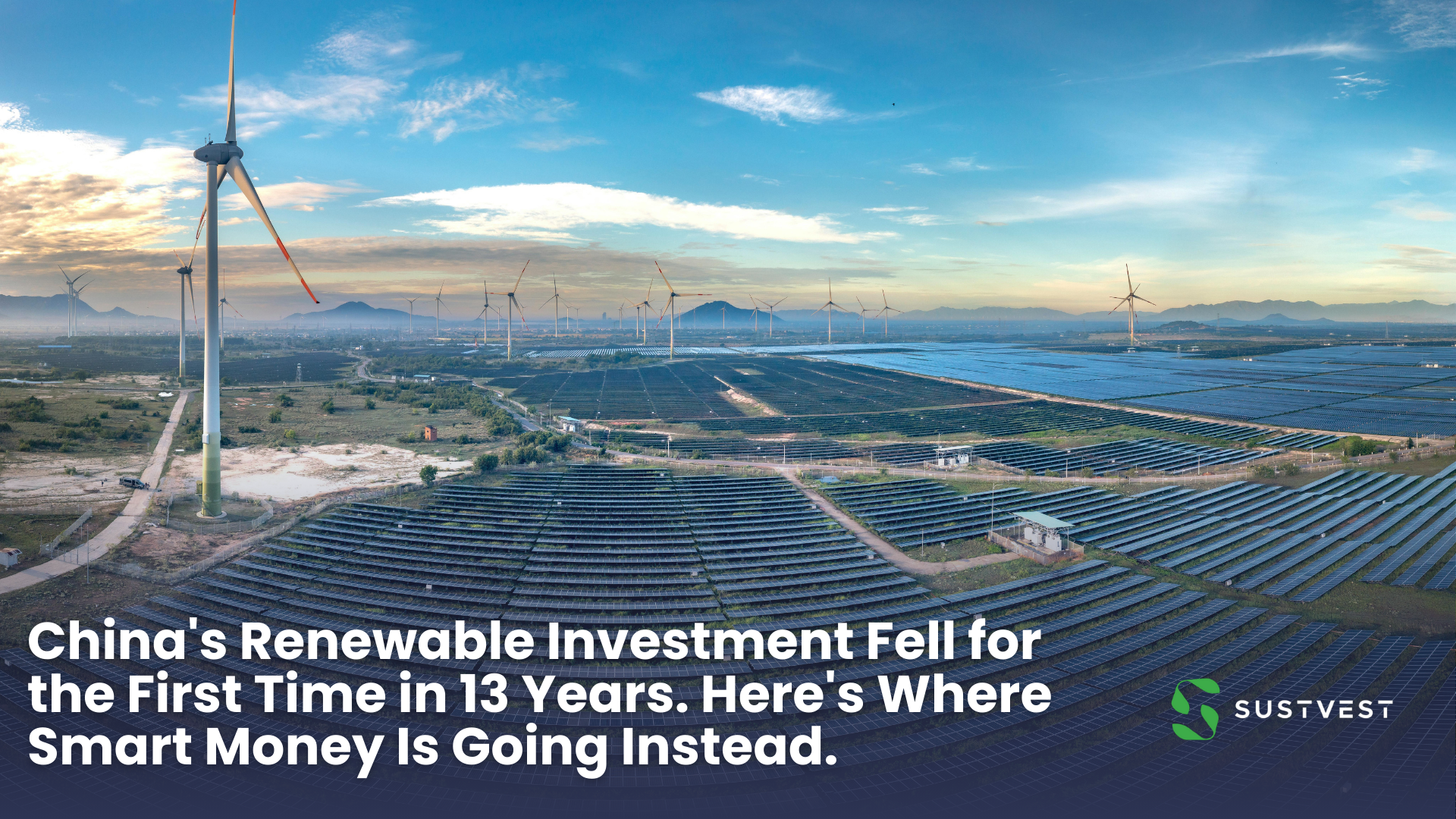
China's Renewable Investment Fell for the First Time in 13 Years. Here's Where Smart Money Is Going Instead.
The headline number looks impressive: global clean energy investment hit a record $2.3 trillion in 2025, up 8% from the previous year. Media outlets celebrated the milestone. Industry groups issued congratulatory press releases. Politicians claimed credit.
But buried in the BloombergNEF report released in January 2026 is a number that matters far more than the headline: China's renewable energy investment fell as well - the first decline since 2013.
For thirteen consecutive years, China poured more money into renewables annually. Through policy shifts, economic cycles, and global disruptions, Chinese investment in wind and solar climbed relentlessly upward. Until 2025.
The money didn't disappear. It redirected. And for investors paying attention to where capital actually flows rather than where headlines point, the shift creates exceptional opportunity.
India's renewable investment climbed 15% to $68 billion in 2025. That's not coincidence. That's capital reallocation in real time.
What Actually Happened in China
China remains the world's largest clean energy investor by total volume—$800 billion across all clean technologies in 2025. But within that total, renewable energy specifically (wind and solar generation projects) declined for the first time in over a decade.
The cause: "changing power market regulations in China introduced new uncertainty," according to BloombergNEF's analysis. This understated language masks significant policy shifts that fundamentally altered project economics for developers.
China's renewable energy sector had operated under mandates requiring new wind and solar projects to pair with battery storage regardless of grid needs or economic justification. In 2025, the government pivoted toward market-driven mechanisms where storage makes economic sense rather than regulatory sense. Sounds logical. But transitions between policy frameworks create exactly the uncertainty that freezes investment decisions.
Developers who had planned projects under old rules suddenly faced new questions: Would projects approved under mandates be honored? What would market-based pricing look like? How would grid access priorities change? When policy foundations shift beneath you, the safest response is waiting for clarity before committing capital.
China's renewable investment decline isn't a rejection of clean energy—it's a pause while the market figures out new rules. But pauses create opportunity gaps.
Where the Capital Went
India's 15% investment increase to $68 billion isn't spectacular in isolation. It's spectacular in context: while the world's largest renewable market contracted, India expanded.
The divergence reveals something fundamental about how sophisticated capital allocates: it flows toward execution certainty, not toward potential that remains unrealized.
India offers what China temporarily lacks: stable policy frameworks, clear grid integration plans, and predictable project economics. The 500 GW renewable capacity target by 2030 enjoys bipartisan support and survived multiple election cycles. The transmission infrastructure buildout provides specific engineering plans with funding commitments. The auction mechanisms for renewable projects follow established procedures that developers understand.
This stability matters more than investors often recognize. Renewable energy projects require years from initial planning through commissioning. Capital committed tday generates returns beginning 2-3 years forward and continuing for 20-25 years beyond. That timeline demands confidence that the rules won't change midway through.
China's policy shift—rational though it may be for long-term market development—introduced exactly the uncertainty that makes capital hesitate. India's policy consistency—maintaining frameworks even through political transitions—creates the certainty that makes capital commit.
The $68 billion flowing into India in 2025 isn't just about solar irradiance or labor costs or manufacturing capacity (though all contribute). It's about investors believing that projects financed today will operate under known conditions throughout their lifetime.
The Broader Pattern: Resilience Despite Headwinds
The $2.3 trillion global clean energy investment occurred despite extraordinary headwinds in multiple major markets.
The United States saw the Trump administration systematically dismantle climate policies, impose tariffs reaching 3,500% on certain solar imports, and elevate fossil fuel advocates to senior energy positions. Yet US investment still grew 3.5% to $378 billion—slower than historical growth but positive nonetheless.
Europe faced political pressures around energy costs, competitiveness concerns with Chinese manufacturers, and the always-complex coordination challenges of 27 member states with different priorities. Yet European investment surged 18% to $455 billion, contributing significantly to the global increase.
These resilient numbers reveal why the China decline matters differently than it might have a decade ago. The global renewable market has matured beyond dependence on any single geography. When one major market pauses, capital redirects to others offering better risk-adjusted returns at that moment.
Albert Cheung, BloombergNEF's Deputy CEO, summarized it directly: "Despite policy and trade headwinds, the global energy transition is resilient and provides a number of opportunities for investors."
That resilience isn't ideological. It's economic. Renewable energy costs have fallen to the point where projects compete favorably against fossil alternatives in most markets globally, regardless of subsidies or mandates. Policy support accelerates deployment, but absence of support no longer prevents it entirely.
For investors, this transition from policy-dependent to economics-dependent returns fundamentally changes the risk profile. Earlier renewable investments required betting that supportive policies would persist. Current renewable investments require believing that cost-competitive electricity finds buyers—a much lower bar.
What the Shift Means for Different Investors
The China-to-India capital reallocation creates different implications depending on how you invest.
For Portfolio Diversifiers:
Geographic concentration creates vulnerability. Investors who built renewable exposure exclusively through Chinese markets (either via Chinese developers operating domestically or through funds concentrated in Chinese projects) discovered this risk when policy shifts froze deployment.
India provides geographic diversification that isn't just different flag on the map—it's fundamentally different regulatory environment, different political system, different grid structure, and different demand drivers. When one market pauses, the other continues.
This isn't theoretical diversification that shows up in correlation matrices but proves illusory during stress. It's real operational diversification: policy changes in Beijing have zero direct impact on whether projects in Rajasthan secure PPAs and commence construction.
For Return Seekers:
Capital redirecting from China to India creates pricing dynamics that favor early movers. When investment dollars chase limited high-quality project opportunities, valuations compress and returns decline. When investment capital suddenly discovers new markets with abundant opportunities, early investors capture better economics before competition intensifies.
India's renewable sector can absorb substantially more capital before reaching saturation. The country needs to add 45-50 GW of renewable capacity annually through 2030 to meet targets—requiring roughly $24 billion per year in project financing. The $68 billion invested in 2025 included supply chain, manufacturing, and other categories beyond just generation projects. The pure project financing market remains undersupplied relative to need.
This supply-demand imbalance for capital—abundant opportunities, insufficient capital to fund everything simultaneously—is exactly the environment where infrastructure investors achieve superior returns. Project developers compete for financing by offering better terms, improving economics for investors.
For Risk Managers:
China's policy shift offers valuable lesson: even the world's most committed renewable energy market can introduce uncertainty that freezes deployment temporarily. Investors who assumed Chinese renewable growth would continue indefinitely discovered that policy frameworks matter as much as economic fundamentals.
The lesson isn't to avoid China—Chinese market will likely resume strong growth once new frameworks stabilize. The lesson is to avoid concentration in any single market regardless of how compelling current conditions appear.
Building renewable infrastructure exposure across multiple geographies with different regulatory systems provides the resilience that diversification promises. When China pauses, India accelerates. When US faces political headwinds, Europe surges. The offsetting dynamics create portfolio-level stability that single-market concentration cannot.
The India Execution Story
India's ability to absorb capital redirecting from China stems from execution capability developed over the past decade.
The country built nearly 500,000 circuit kilometers of transmission infrastructure, creating grid capacity to integrate renewable generation at scale. It established competitive auction mechanisms that allocate projects transparently and lock in long-term PPAs. It developed domestic solar manufacturing capacity reaching 144 GW—eliminating import dependence that creates tariff exposure.
Most importantly, India demonstrated policy consistency. The 500 GW renewable capacity target survived two general elections, multiple state government changes, economic disruptions from COVID-19, and global supply chain chaos. When governments maintain policy frameworks through political transitions and economic shocks, it signals genuine commitment rather than expedient positioning.
This execution track record is why capital can redirect to India confidently. Investors aren't betting on potential that might materialize—they're deploying into proven systems with operational history demonstrating that projects move from planning to commissioning predictably.
The contrast with markets where renewable policy remains aspirational couldn't be sharper. Some countries announce ambitious renewable targets, establish supportive frameworks, but lack transmission infrastructure, procurement mechanisms, or manufacturing capacity to translate ambition into operational projects. Capital eventually loses patience with gaps between promise and execution.
India closed that gap. The infrastructure exists. The procurement works. The execution happens. Which is precisely why investment grew 15% while the world's largest market contracted.
Why This Matters More Than Headlines Suggest
Media coverage of the BloombergNEF report focused almost exclusively on the $2.3 trillion headline—the largest annual clean energy investment in history, up 8% year-over-year, proving resilience of the energy transition despite political headwinds.
All true. All important.
But the China decline and India surge tell a more sophisticated story that matters more for investors: capital flows toward execution certainty and redirects away from policy uncertainty faster than many realize. Geographic diversification provides real resilience. And markets that deliver on promises attract capital from markets that don't.
The Forward Look: Where This Goes
BloombergNEF projects that under base-case scenarios, average annual global energy transition investment will reach $2.9 trillion over the next five years. That's $600 billion more annually than 2025's record level—substantial capital deployment creating sustained opportunity.
But that $2.9 trillion won't distribute evenly across all markets. It will flow toward markets offering the best combination of policy stability, execution capability, return potential, and risk management.
China will remain the largest single market by total investment—the manufacturing capacity, domestic demand, and government commitment ensure continued leadership. But China's share of marginal new investment may decline as capital diversifies toward markets like India, Europe, and eventually other emerging economies developing renewable capabilities.
India specifically should continue capturing disproportionate share of new capital deployment. The $68 billion invested in 2025 represented roughly 3% of the global total—far below India's share of global GDP, energy demand, or renewable potential. As the execution story becomes better understood by institutional investors, capital allocation should increase substantially.
For accredited investors, this creates multi-year opportunity window. The capital shift from China to India (and other emerging markets demonstrating execution capability) is beginning, not concluding. Early movers capture better project economics before competition intensifies and returns compress.
The pattern repeats across infrastructure cycles: Initial deployment phase offers exceptional returns. As capital discovers the opportunity and floods in, returns normalize to utility-like yields. The transition from "discovery" to "maturity" typically takes 5-10 years.
India's renewable infrastructure is having its discovery moment right now. The $68 billion invested in 2025 represents capital finally recognizing what project-level developers have known for years: the infrastructure exists, the projects work, and the returns justify allocation.
The Bottom Line: Follow the Capital
Headlines celebrated the $2.3 trillion. That's the number designed for press releases and political speeches.
Investors should focus on the number buried in the report: Global renewable energy investment fell 9.5% in 2025, largely driven by new uncertainty in China, which saw its first decline in renewable funding since 2013. That money redirected somewhere. India's 15% increase to $68 billion shows where sophisticated capital went.
This isn't just a China-to-India story, though that's the clearest example. It's a broader pattern: capital flows toward execution certainty and away from policy uncertainty with remarkable speed. Markets that deliver on commitments attract investment from markets that don't.
For portfolio construction, the lesson is clear: build renewable infrastructure exposure across multiple geographies, prioritize markets demonstrating consistent execution, and recognize that policy uncertainty creates opportunity for patient capital willing to position during pauses rather than chasing momentum.
The energy transition isn't reversing—$2.3 trillion proves that. But within the overall growth, capital is becoming more sophisticated about where it deploys. Markets that built transmission infrastructure, established transparent procurement, developed manufacturing capability, and maintained policy consistency are capturing disproportionate share of new investment.
India did all of those things. Which is why investment grew 15% while the world's largest market contracted.
Smart money is following the pattern. The question is whether you'll follow smart money while opportunity remains, or discover India's renewable infrastructure after everyone else arrives and returns normalize.
When the world's largest renewable market pauses and capital redirects to markets demonstrating execution, investors have a choice: follow the headlines celebrating aggregate numbers, or follow the capital flows revealing where actual returns are being generated.
The headlines will tell you clean energy is resilient. The capital flows will show you where to invest. Choose accordingly.
About Sustvest: Sustvest provides US accredited investors with access to India's renewable energy infrastructure through SEC Regulation D offerings. When BloombergNEF reports India's renewable investment growing 15% while China's contracts for the first time in thirteen years, it validates what we've known: capital rewards execution consistency, and India's proven track record attracts investment from markets facing uncertainty. Our focus on solar projects delivering 10-12% leveraged IRRs positions investors where capital is flowing—toward markets with transmission infrastructure built, procurement mechanisms working, and policy frameworks stable. We handle cross-border complexity—FEMA compliance, currency management, project oversight—so you capture returns from execution, not aspiration.
Investment Disclosure: Renewable energy infrastructure investments involve risks including execution risk, offtaker credit risk, technology risk, regulatory changes, illiquidity, and potential loss of principal. International investments involve additional risks including currency fluctuation and political instability. Investment trends and capital flows described do not guarantee future returns or predict future market performance. China's renewable investment decline may reverse as policy frameworks stabilize. Geographic diversification does not eliminate risk. Past capital allocation patterns do not guarantee future opportunities. This content is for informational purposes only and does not constitute investment advice. BloombergNEF data cited for informational purposes; Sustvest has no affiliation with BloombergNEF. Consult qualified legal, tax, and financial advisors before making investment decisions.
SEO Keywords: China renewable investment decline 2025, India renewable energy investment growth, $2.3 trillion clean energy investment, BloombergNEF renewable energy trends, where to invest renewable energy 2026, China policy uncertainty renewables, India solar investment opportunity, capital flows renewable energy, geographic diversification infrastructure, China to India investment shift, renewable energy market trends 2026, emerging market renewable investment, India vs China renewable energy