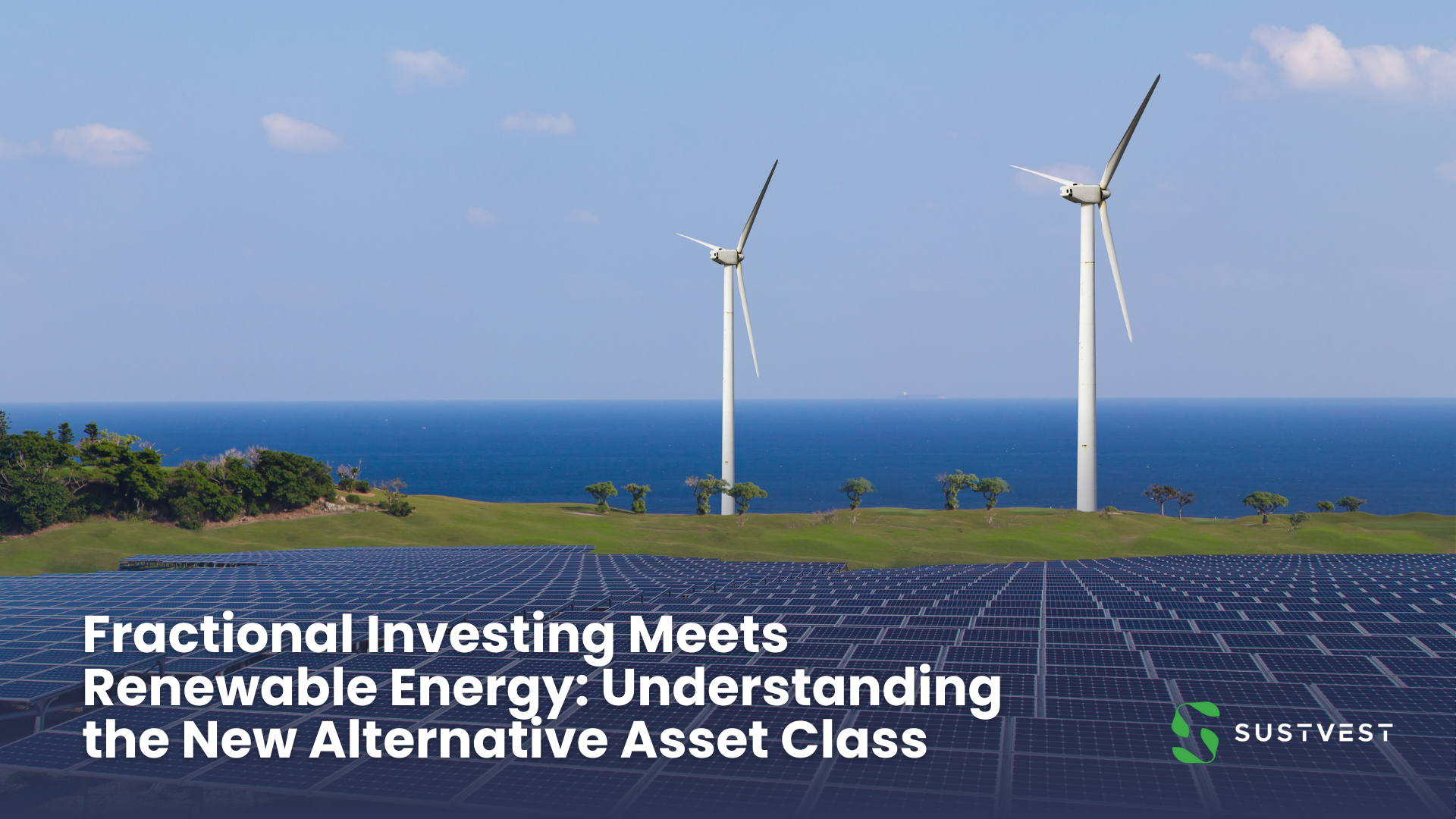
Fractional Investing Meets Renewable Energy: Understanding the New Alternative Asset Class
By Hardik BhatiaPublishedWhat if you could invest in utility-scale solar projects the same way you invest in fractional real estate - but with potentially higher returns and global impact?
The fractional investment revolution that democratized access to real estate, fine art, and private credit is now reshaping renewable energy. For US accredited investors, this convergence creates an entirely new category of alternative investments - one that combines institutional-grade returns with meaningful environmental impact.
Here's everything you need to know about fractional renewable energy investing, how it works, and why it's capturing attention from sophisticated investors.
What Is Fractional Renewable Energy Investment?
Fractional ownership means exactly what it sounds like: you own a fraction - or shares - of a solar energy project rather than the entire asset.
Think of it like fractional real estate platforms (Fundrise, Arrived) or fractional art investing (Masterworks), but instead of owning a piece of an apartment building or a Banksy, you own shares in operating solar farms in high-growth markets.
Here's how it differs from traditional renewable investment vehicles:
Traditional Renewable Energy Investment Options:
Publicly-traded REITs: You're investing in a diversified basket managed by others, with returns tied to stock market sentiment as much as project performance
Green bonds: Fixed income instruments with lower returns (3-5% typically) and no equity upside
Direct project ownership: Requires millions in capital, extensive industry expertise, and hands-on management
Renewable mutual funds/ETFs: Indirect exposure through manufacturing and utility companies, not actual projects
Fractional Renewable Energy Investment:
Direct ownership in specific solar projects
Lower minimum investments (accessible to more accredited investors)
Project-specific returns based on actual energy generation and revenue
Transparency into individual asset performance
No active management required - fully passive income
The Structure: How Reg D Makes It Possible
Sustvest operates under SEC Regulation D, specifically Rule 506(c), which creates the legal framework for fractional renewable investing.
Understanding Regulation D Rule 506(c)
Regulation D provides exemptions from SEC registration requirements for certain private securities offerings. Rule 506(c) specifically allows companies to:
Broadly solicit and advertise offerings to the public
Raise unlimited capital
Accept investments exclusively from accredited investors
This matters because traditional private placements under Rule 506(b) prohibited general solicitation - meaning investment opportunities could only be shared with people the sponsor already knew. Rule 506(c) opened the door for platforms like Sustvest to market opportunities to all accredited investors.
Recent 2025 SEC Guidance Makes This Even More Accessible:
In March 2025, the SEC issued new guidance significantly streamlining the accredited investor verification process for Rule 506(c) offerings. Previously, verifying accredited status required submitting sensitive financial documents like tax returns, bank statements, and third-party verification letters.
Under the new guidance, issuers can verify accredited investor status through:
A minimum investment threshold ($200,000 for individuals, $1 million for entities)
Written investor representation of accredited status
Confirmation that the investment isn't third-party financed
This makes the investment process significantly simpler while maintaining investor protection.
Who Can Invest? Understanding Accredited Investor Status
To participate in Regulation D offerings, you must meet the SEC's definition of an accredited investor:
Individual Accredited Investors must meet ONE of these criteria:
Net worth exceeding $1 million (excluding primary residence)
Annual income over $200,000 individually ($300,000 jointly with spouse) in each of the past two years with reasonable expectation of the same
Professional credentials: Series 7, Series 65, or Series 82 license holders
"Knowledgeable employees" of private funds
Entity Accredited Investors:
Entities with $5 million+ in assets
Entities where all equity owners are accredited investors
Investment advisers, broker-dealers, banks, insurance companies
According to recent data, there are approximately 13 million accredited investor households in the US - a growing segment seeking alternatives to traditional portfolios.
Investment Minimums and Holding Periods
Typical Investment Characteristics:
Minimum Investment: Often $25,000 for individual projects (though this varies by offering)
Holding Period: Generally 5-10 years (solar projects have 20-25 year operational lifespans)
Income Distribution: Quarterly or semi-annual distributions from electricity sales
Exit Opportunities: Sale of project, refinancing, or potential secondary market liquidity
Unlike publicly-traded securities, these are long-term, illiquid investments. However, unlike buying a rental property yourself, there's no tenant management, no maintenance calls, and no property taxes to manage.
Risk Factors: What You Need to Know
No investment is without risk, and accredited investors should understand the key considerations:
Project-Specific Risks:
Energy production variability (weather, equipment performance)
Off-taker credit risk (will the utility/buyer pay?)
Technology obsolescence (though solar panels have 25+ year lifespans)
Regulatory changes affecting incentives or electricity pricing
Market Risks:
Currency fluctuation (for international projects like India)
Political or regulatory instability
Changes to electricity market structures
Liquidity Risk:
These are long-term, illiquid investments
No guarantee of secondary market availability
Early exit may result in substantial discounts
The key is proper due diligence and portfolio allocation. Most advisors suggest limiting illiquid alternatives to 10-20% of investable assets.
Why Fractional Rather Than Direct Ownership?
If the returns are so attractive, why wouldn't you just buy an entire solar project yourself?
Barriers to Direct Ownership:
Capital Requirements: Utility-scale solar projects cost $50-200 million+
Expertise: Requires deep knowledge of energy markets, engineering, permitting, financing
Management: Full-time attention to operations, maintenance, offtake agreements
Geographic Limitations: Best projects are often in distant markets (like India)
Concentration Risk: All your capital in a single project with no diversification
Fractional platforms solve all these problems, allowing you to access institutional-quality projects with managed capital and no operational burden.
The Due Diligence Checklist
Before investing in any fractional renewable energy opportunity, evaluate:
Platform/Sponsor:
Track record and experience in renewable energy
Transparency of reporting
Fee structure and alignment of interests
Specific Project:
Location and solar resource quality
Offtake agreement (PPA) terms and counterparty credit
Technology and equipment quality
Expected returns and underlying assumptions
Developer experience and operational track record
Legal/Structural:
Entity structure and investor rights
Governance and decision-making
Exit provisions and liquidity options
Compliance with securities regulations
The Bottom Line: A New Portfolio Building Block
Fractional renewable energy investing represents an evolution in alternative investments offering:
✓ Institutional-grade returns previously inaccessible to individual accredited investors
✓ Passive income from tangible, productive assets
✓ Portfolio diversification uncorrelated with traditional markets
✓ Meaningful environmental impact
✓ Transparent, project-specific performance
As the alternative investment landscape grows increasingly competitive, renewable energy fractional investing offers something rare: genuine yield, portfolio diversification, and the opportunity to participate in the global energy transition.
The question isn't whether renewable energy will dominate the 21st century. The question is how you'll participate in that transition - and whether you'll do it with returns that matter.
About Sustvest: Sustvest provides US accredited investors with curated access to high-IRR solar projects in India through SEC Regulation D Rule 506(c) offerings. We handle all due diligence, structuring, and ongoing project management, delivering quarterly reporting and distributions to our investor community.
Interested in adding fractional solar to your alternative investment allocation? Schedule a consultation.
Keywords: fractional renewable energy, accredited investor opportunities, Regulation D 506c, alternative investments, solar investment, fractional ownership, private placement, passive income, renewable energy returns, solar IRR, clean energy investing