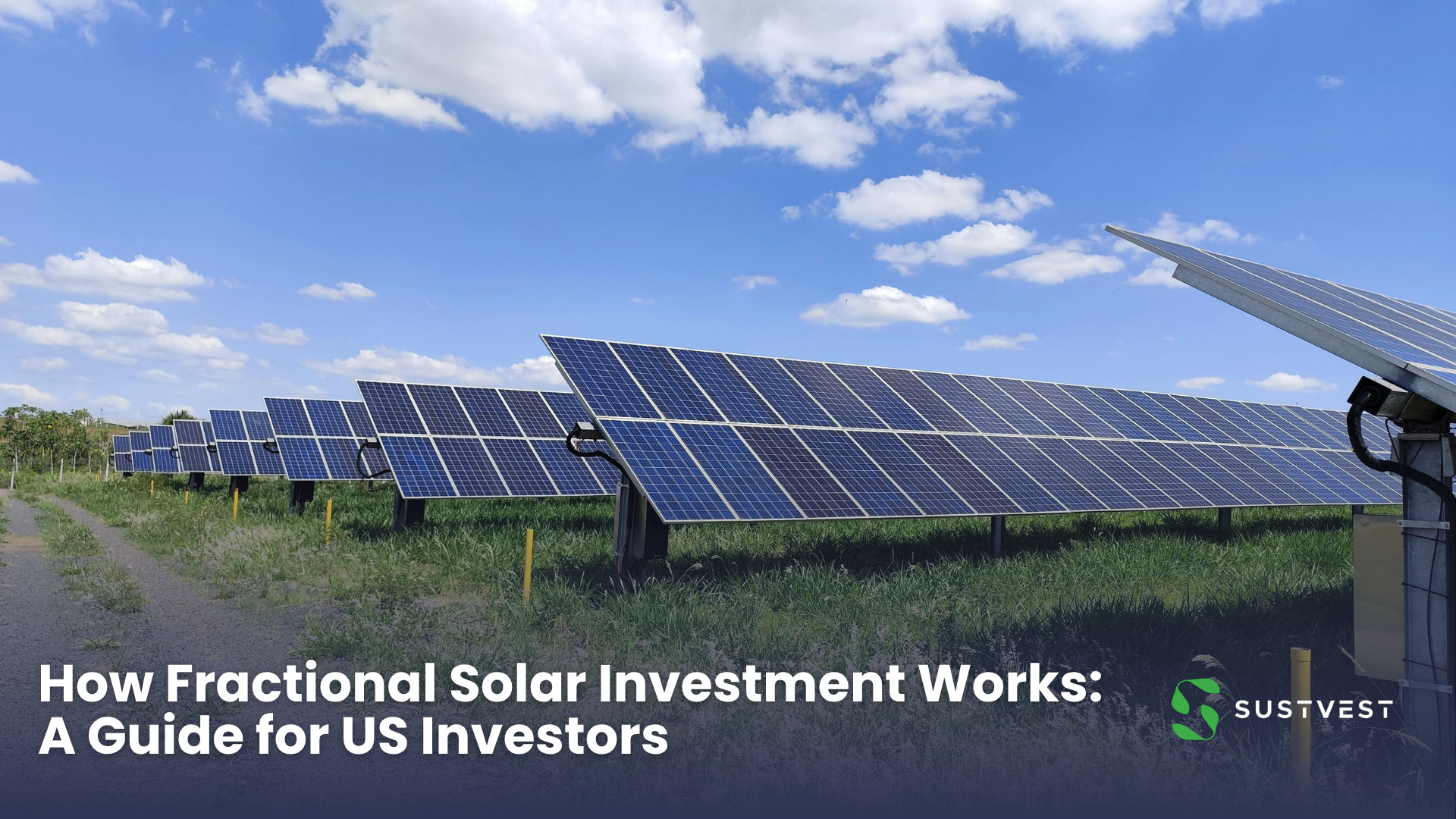
How Fractional Solar Investment Works: A Guide for US Investors
By Hardik BhatiaPublishedHow Fractional Solar Investment Works: A Guide for US Investors
Fractional solar investment is one of the fastest-growing segments of alternative energy investing, yet most US investors have never heard of it. Unlike buying shares of a solar ETF or a publicly traded utility, fractional solar ownership gives you a direct stake in real, operating solar projects — with monthly cash distributions tied to actual electricity sales.
This guide breaks down how fractional solar investment works, what returns look like, who qualifies, and how to evaluate platforms before committing capital. If you have been looking for an infrastructure-backed alternative to stocks and bonds, this is the asset class worth understanding.
What Is Fractional Solar Investment?
Fractional solar investment is a model where multiple investors collectively own shares of a commercial or utility-scale solar power project. Instead of one entity funding an entire solar installation, the project is divided into smaller ownership units that individual investors can purchase.
Each investor's share entitles them to a proportional slice of the project's revenue — typically generated through long-term electricity sales contracts known as Power Purchase Agreements (PPAs). The result is a real asset, producing real energy, generating real revenue, distributed monthly to investors.
This is fundamentally different from buying a solar stock or ETF. When you buy shares of, say, a renewable energy ETF, you own a financial instrument whose price is driven by market sentiment, earnings forecasts, and broader equity market movements. Fractional solar ownership, by contrast, is tied to the physical output of a solar plant. Your returns come from kilowatt-hours sold, not stock price appreciation.
The model has existed in various forms — community solar, solar cooperatives, crowdfunded solar — but the version gaining traction with US accredited investors involves structured ownership through SEC-registered private offerings, where investors purchase membership interests in a legal entity that owns the solar assets.
How Does Fractional Solar Ownership Work for US Investors?
The mechanics of fractional solar investing follow a clear chain: a legal entity owns the solar project, investors own units in that entity, and revenue flows from electricity sales back to investors as monthly distributions.
Here is how the structure typically works, using a cross-border solar investment as an example:
A US-registered entity — usually a Delaware LLC — is set up as the investment vehicle. This LLC owns 100% of an Indian Special Purpose Vehicle (SPV), which in turn owns the physical solar asset: the panels, inverters, mounting structures, and the grid connection. The SPV holds the PPA with a commercial or industrial electricity buyer, and revenue from that PPA flows up to the LLC and then out to investors.
When you invest, you purchase membership interests (units) in the LLC. Your share of monthly cash distributions is proportional to the percentage of units you hold. The offering is typically structured under SEC Regulation D, Rule 506(c), which means the issuer can publicly market the offering but must verify that every investor is accredited.
Each project page on a platform like Sustvest shows the exact site location, PPA terms, expected generation, and projected returns. The same details appear in the Private Placement Memorandum (PPM), along with all supporting legal documents. Investors can independently verify SEC filings through the EDGAR database using the issuer's CIK number or Form D filing number.
The key structural elements that protect investors include the PPA (which locks in revenue for 10–25 years), the SPV (which ring-fences each project's assets and liabilities), and the SEC registration (which provides regulatory oversight and disclosure requirements).
What Returns Can You Expect from Fractional Solar Projects?
Fractional solar projects targeting US accredited investors typically offer an expected XIRR (Extended Internal Rate of Return) in the range of 10–14%, with monthly cash distributions in USD.
These returns are driven by several factors. The PPA tariff — the price at which the solar project sells electricity to its buyer — is the single biggest driver. Indian commercial and industrial electricity rates are significantly higher than solar generation costs, which creates a healthy margin. The Capacity Utilization Factor (CUF) determines how much energy the plant actually produces relative to its theoretical maximum, and Indian solar irradiance levels (4–7 kWh per square meter per day across most of the country) are among the highest globally. Operations and maintenance (O&M) costs, insurance, and platform management fees are deducted before distributions reach investors.
To put this in context, here is how fractional solar compares to other common investment options:
Fractional Solar (India)
Typical Annual Return: 10–14% XIRR
Income Frequency: Monthly
Liquidity: Low (lock-in period)
Correlation to Stock Market: Very low
S&P 500 (long-term avg)
Typical Annual Return: ~10% annualized
Income Frequency: Quarterly dividends
Liquidity: High
Correlation to Stock Market: N/A (it is the market)
US Treasury Bonds (10Y)
Typical Annual Return: ~4.2–4.5%
Income Frequency: Semi-annual
Liquidity: High
Correlation to Stock Market: Low
REITs
Typical Annual Return: 8–12% total return
Income Frequency: Quarterly
Liquidity: High
Correlation to Stock Market: Moderate
High-yield savings
Typical Annual Return: ~4.5–5.0% APY
Income Frequency: Monthly
Liquidity: High
Correlation to Stock Market: None
The comparison is not perfectly apples-to-apples — fractional solar has a lock-in period and lower liquidity than public market instruments — but the combination of double-digit returns, monthly payouts, and near-zero correlation to equity markets makes it attractive as a portfolio diversifier.
One important distinction: fractional solar returns are driven by contracted energy sales, not market sentiment. A stock market crash does not reduce the amount of sunlight hitting a solar panel in Rajasthan, and it does not change the terms of a 15-year PPA. This structural independence from equity markets is a significant draw for investors looking to reduce portfolio volatility.
What Are the Risks of Fractional Solar Investing?
Every investment carries risk, and fractional solar is no exception. Responsible platforms are transparent about these, and smart investors evaluate them before committing.
Illiquidity is the most immediate risk. Unlike stocks or ETFs, you cannot sell your fractional solar holdings on a secondary market at will. Most offerings have a defined investment tenure — typically aligned with the PPA duration — and early exit options are limited or nonexistent. This is capital you should expect to have locked up for the stated period.
Currency risk applies to cross-border solar investments. If the underlying projects are in another country, revenue is generated in a different currency and converted to USD for distributions.
PPA counterparty risk is the risk that the electricity buyer defaults on payments or renegotiates terms. This is mitigated by the fact that PPAs are legally binding contracts, and well-structured projects select creditworthy commercial and industrial off-takers. However, it is not zero-risk — particularly in emerging markets where payment delays can occur.
Regulatory risk exists in both the US and the project's home country. Changes to SEC regulations, tax treaties, or energy policy in India could affect returns or the legal structure of the investment. India's solar sector has been policy-supportive in recent years — the country added 44.6 GW of solar capacity in fiscal year 2026 alone, reaching 150 GW cumulative — but regulatory environments can shift.
Project performance risk covers underperformance due to equipment failure, lower-than-expected irradiance, grid curtailment, or poor maintenance. Professional O&M contracts and real-time monitoring dashboards reduce this risk, but do not eliminate it entirely.
The right way to think about these risks is relative to the return being offered. A 10–14% XIRR on an infrastructure-backed asset with contracted revenue is a different risk profile than a 10% return on a growth stock. The risks are real, but they are also fundamentally different from equity market risk — which is precisely why fractional solar works as a diversifier.
Who Qualifies to Invest in Fractional Solar Projects?
Under SEC Regulation D, Rule 506(c), fractional solar investment offerings are limited to accredited investors. As of 2026, an individual qualifies as an accredited investor by meeting at least one of the following criteria:
An annual income exceeding $200,000 individually (or $300,000 jointly with a spouse or spousal equivalent) in each of the two most recent calendar years, with a reasonable expectation of earning the same in the current year. Alternatively, a net worth exceeding $1 million, either individually or jointly with a spouse, excluding the value of a primary residence. A third pathway, added by the SEC in 2020, allows qualification through holding certain professional certifications — specifically the Series 7, Series 65, or Series 82 licenses.
These thresholds have not been adjusted for inflation since 1982, which means a significantly larger pool of US households now qualifies. According to SEC data, approximately 19% of US households met accredited investor criteria as of 2022, up from around 1.8% in 1983.
A notable development in March 2025 made 506(c) offerings more practical for both issuers and investors: the SEC's Division of Corporation Finance issued a no-action letter clarifying that a minimum investment amount (such as $200,000 for individuals), combined with a written self-certification of accredited status, constitutes "reasonable steps" to verify accreditation. This simplified the verification process that had previously been seen as burdensome, making it easier for platforms to operate under 506(c) — which in turn allows them to publicly market their offerings, including through blog content like this.
Non-Resident Indians (NRIs) who hold US accredited investor status are also eligible and represent a growing segment of cross-border solar investors, given their familiarity with both the US financial system and India's energy infrastructure.
How Is Fractional Solar Different from Solar Stocks and ETFs?
This is one of the most common questions from investors exploring the space for the first time, and the distinction matters more than most people realize.
When you buy shares of a solar stock — say, a publicly traded panel manufacturer or a renewable energy utility — you are buying equity in a company. Your returns depend on the company's earnings, stock market conditions, analyst sentiment, and macroeconomic factors. A solar stock can drop 30% in a quarter even if global solar installations hit record highs, because stock prices reflect expectations, not just fundamentals.
Fractional solar ownership is a direct asset play. You own a piece of an operating solar plant. Your returns come from electricity sales under a fixed-rate PPA — not from stock price movements. There is no earnings call, no P/E ratio, and no market maker setting your share price based on trading volume.
For investors who already hold broad equity exposure through index funds, fractional solar offers something stocks and ETFs structurally cannot: a return stream that is uncorrelated with financial markets and backed by physical energy infrastructure with contracted revenue.
How to Evaluate a Fractional Solar Investment Platform
Not all platforms are created equal. Before investing, run through this due diligence checklist:
SEC filings and legal structure. Verify the issuer's Form D filing on SEC EDGAR. Confirm the entity is a registered Delaware LLC (or equivalent). Review the Private Placement Memorandum for clarity on investor rights, fee structure, and exit terms.
PPA terms. Examine the duration, tariff rate, escalation clause, and creditworthiness of the off-taker. A 25-year PPA with a large industrial buyer is materially different from a short-term agreement with an unrated counterparty.
SPV ring-fencing. Each project should be held in a separate SPV so that underperformance or legal issues at one project do not affect others in the portfolio.
O&M track record. Who maintains the solar plant? What are the contractual SLAs for uptime and performance? Is there real-time monitoring available to investors?
Monitoring and transparency. Look for platforms that provide live dashboards showing actual generation data, revenue, and distribution history. Opacity is a red flag.
Insurance coverage. Confirm that the solar assets are insured against natural disasters, equipment failure, and business interruption.
Currency and repatriation. For cross-border investments, understand how INR revenue is converted to USD, what exchange rate mechanism is used, and whether there are any repatriation restrictions.
Fee structure. Understand the management fee, performance fee (if any), and any charges for early exit. Fees should be clearly disclosed in the PPM.
If a platform cannot clearly answer every item on this list, that tells you something. Accredited investors have the financial sophistication to evaluate private offerings — use it.
Frequently Asked Questions
What is the minimum investment for fractional solar? Minimum investments vary by platform. Some platforms start as low as $100 (typically under Regulation A+ for non-accredited investors), while accredited investor platforms like Sustvest offer entry points starting at $500 per project.
Are fractional solar returns taxable in the US? Yes. Returns from fractional solar investments are generally treated as income for US tax purposes. The specific treatment depends on the legal structure of the offering and the investor's individual tax situation. Cross-border investments may also involve foreign tax considerations and applicable tax treaty provisions between the US and the project country. Consult a tax advisor for guidance specific to your circumstances.
Can NRIs invest in fractional solar projects? Yes. Non-Resident Indians who qualify as US accredited investors can participate in Reg D 506(c) offerings. NRIs represent a natural fit for India-based solar investments given their familiarity with the Indian market and existing financial relationships in both countries.
How long is the lock-in period? Lock-in periods are typically aligned with the underlying PPA duration, which can range from 10 to 25 years depending on the project. Some platforms may offer earlier exit windows, but investors should be prepared for the stated investment tenure.
How do I verify a platform's SEC filings? Search for the issuer's name or CIK number on the SEC's EDGAR database (sec.gov/cgi-bin/browse-edgar). Look for Form D filings, which disclose the offering terms, amount raised, and exemption type (506(b) or 506(c)).
About Sustvest
SustVest LLC is a Delaware-registered fractional solar investment platform offering SEC Regulation D 506(c) compliant investment opportunities in Indian solar energy projects. Through its US entity structure, Sustvest enables accredited investors and NRIs to own membership interests (units) in operating solar projects backed by long-term Power Purchase Agreements. Each project is held in a separate Indian SPV, with SustVest LLC owning 100% of each SPV. Investors receive proportional monthly cash distributions in USD, with a minimum investment of $500 and target returns of 10–14% XIRR. Project details, SEC filings, and real-time generation data are available at sustvest.com.
This content is for informational purposes only and does not constitute an offer to sell or a solicitation of an offer to buy any securities. Investments in private offerings under SEC Regulation D are speculative, illiquid, and involve a high degree of risk, including the potential loss of the entire investment. Fractional solar investments are available only to verified accredited investors as defined under SEC Rule 501(a). Past performance is not indicative of future results. Prospective investors should carefully review the Private Placement Memorandum (PPM) and consult with their own legal, tax, and financial advisors before making any investment decision. SustVest LLC does not provide investment, legal, or tax advice.
Sources:
SEC.gov — "Accredited Investors" — Rule 501(a) of Regulation D (sec.gov)
SEC.gov — "Rule 506 of Regulation D" — investor.gov
SEC Division of Corporation Finance — No-Action Letter on Rule 506(c) Verification, March 12, 2025
PV Magazine — "India hits 150 GW solar milestone" — April 10, 2026
JMK Research — India solar and wind installations data, FY2026
BloombergNEF — India solar capacity forecast, January 2026
Fidelity — "S&P 500 Historical Average Returns" — March 2026
SEC.gov — "Accredited Investor Net Worth Standard" — Dodd-Frank Act implementation
IRENA Renewable Energy Statistics 2025 — India global solar ranking