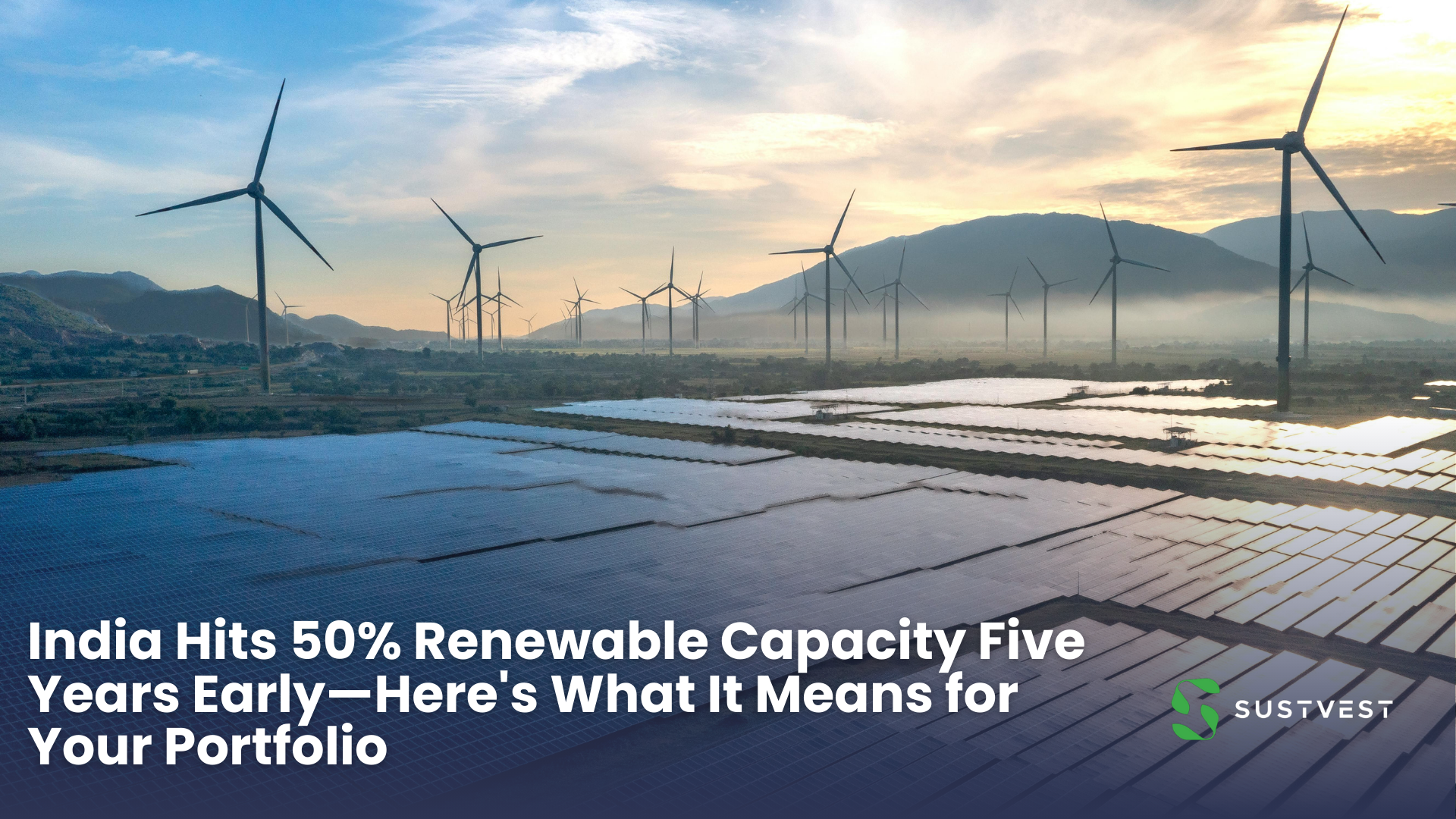
India Hit 50% Renewable Capacity 5 Years Early — Now What?
India just achieved a climate milestone that caught the world off guard: 50% of its power generation capacity now comes from non-fossil fuel sources—five years ahead of its Paris Agreement target. This isn't greenwashing or political theater. This is infrastructure buildout at unprecedented scale, creating one of the decade's most compelling investment opportunities.
For accredited investors seeking alternatives to compressed US yields, this milestone signals something critical: India's renewable energy transition has moved from aspiration to execution. And execution at this scale creates exceptional returns for those who position themselves before institutional capital fully arrives.
The Numbers That Matter
As of December 2025, India's total installed power capacity stands at 510 gigawatts (GW). Of this, 262 GW—51.4%—comes from non-fossil fuel sources, including 254 GW of renewable energy. The remaining 247 GW still relies on fossil fuels, primarily coal.
To put the 2025 performance in perspective, India added approximately 50 GW of renewable capacity in a single year, supported by nearly ₹2 trillion ($24 billion) in investment. Solar power led the expansion with 35 GW installed between January and November alone.
Union Minister for New and Renewable Energy Pralhad Joshi told the press that by December's end, India would reach 48-50 GW of new capacity for the year. His assessment: "The future is sunny and will be powered by renewables," with momentum expected to continue through 2026 and beyond.
This isn't incremental progress—it's exponential expansion. For context, India's renewable capacity has more than doubled since 2020, when the country had just 136 GW of total installed capacity.
Why Five Years Ahead of Schedule Matters
When countries overdeliver on climate commitments by half a decade, it reveals something investors should pay attention to: the infrastructure buildout is both economically sustainable and politically resilient.
India committed to this 50% target at the 2015 Paris Climate Conference, setting a 2030 deadline. Achieving it in 2025 demonstrates that renewable energy deployment in India isn't dependent on international pressure or subsidy-driven economics. The projects pencil on their own merits.
This policy resilience matters for investment returns because it de-risks long-term holdings. Projects financed in 2026-2027 can rely on stable regulatory support, predictable offtake agreements, and a government committed to reaching 500 GW of non-fossil capacity by 2030.
The math is straightforward: India needs to add another 238 GW of renewable capacity over the next four years. At the current run rate of 45-50 GW annually, the target is achievable. This sustained deployment creates a multi-year runway for investors to capture premium returns.
The Investment Thesis: A $366 Billion Opportunity
According to an IREDA (Indian Renewable Energy Development Agency) study, India will require investments of approximately ₹30.54 lakh crore ($366 billion) between 2023 and 2030 to meet its 500 GW target.
Public sector financial institutions have already deployed ₹10.79 lakh crore ($129 billion) into renewable projects since 2014, including ₹2.68 lakh crore ($32 billion) in fiscal year 2024-25 alone. This leaves roughly $237 billion in capital deployment needed over the next four years.
Industry estimates suggest capital costs of approximately ₹4 crore per MW ($480,000 per MW), implying ₹2 trillion ($24 billion) in investment for every 50 GW of capacity. With 45-50 GW being added annually, that's $24 billion in annual project financing—creating substantial deal flow for investors positioned to participate.
For accredited investors, this capital deployment cycle offers a rare combination:
Proven technology: Solar and wind aren't speculative. India's projects use established technology with 20+ years of operational history.
Contracted revenues: Power Purchase Agreements (PPAs) with state utilities and corporate offtakers provide 20-25 year revenue certainty.
Attractive returns: Well-structured projects in India deliver 10-12% leveraged IRRs, significantly above US renewable infrastructure (6-8%) and traditional fixed income.
Policy stability: India's 500 GW commitment enjoys bipartisan support and has survived multiple election cycles.
The Solar Dominance Story
Solar power continues to drive India's renewable expansion, accounting for 35 GW of the 50 GW added in 2025. As of November 2025, India's total solar installed capacity reached 111 GW, making it the world's third-largest solar market behind only China and the United States.
The solar growth trajectory is remarkable:
Solar capacity increased 39-fold since 2014
India added a record 24.5 GW of solar in 2024
2025 added another 35 GW (approximately)
Current capacity: 111 GW
2030 target contribution: 280+ GW (of the 500 GW total)
From an investor perspective, solar dominance in India's mix matters because it offers the most mature technology, the lowest costs, and the most liquid project pipeline. Solar projects in India benefit from:
High irradiance levels: India receives 5-7 kWh/m²/day of solar radiation, 30-40% higher than most US locations
Falling module costs: India's domestic manufacturing capacity hit 144 GW in 2025, reducing import dependence and tariff exposure
Land availability: Large-scale solar parks in Rajasthan, Gujarat, and Karnataka provide economies of scale
Grid connectivity: India added 180,000 kilometers of transmission lines over the past decade, addressing the bottleneck that plagues many markets
The solar economics are compelling. With module costs falling and PPA tariffs stabilizing around ₹2.50-2.70/kWh ($0.03-0.033/kWh), solar projects in India achieve attractive returns even as costs decline—a sign of healthy market dynamics.
Wind Power: The Underappreciated Opportunity
While solar dominates headlines, wind power quietly grew to 54 GW of installed capacity by November 2025, representing a 12.5% increase over 2024. India ranks fourth globally in wind power capacity, and the government targets 99.9 GW by 2029-30.
Wind's importance to the investment thesis extends beyond capacity numbers. Wind generation complements solar by producing power during evening and nighttime hours when solar output drops. This complementarity makes hybrid solar-plus-wind projects increasingly attractive to offtakers who need dispatchable renewable power.
Several states—including Tamil Nadu, Gujarat, Karnataka, and Rajasthan—offer exceptional wind resources. Gujarat's Khavda region, for example, hosts some of the world's largest renewable energy parks, with wind speeds averaging 8+ meters per second.
From a portfolio perspective, wind projects offer different risk-return characteristics than solar:
Higher capex per MW but better capacity utilization factors (35-45% vs 20-25% for solar)
Longer development timelines but superior long-term cash flow stability
Less commodity price exposure (no module cost fluctuations)
Complementary generation profiles allow hybrid projects to capture premium PPA pricing
The Hybrid and Storage Evolution
India's renewable sector is undergoing a critical evolution in 2026: the shift from vanilla solar to hybrid and storage-enabled projects. This transition fundamentally changes the investment opportunity.
Plain solar projects increasingly face grid integration challenges. When solar generation peaks during midday, many states experience curtailment—wasted energy that can't be absorbed by the grid. This creates price suppression during peak solar hours and limits project economics.
Hybrid projects (solar-plus-wind) and solar-plus-storage projects solve this problem by delivering dispatchable power—energy that can be delivered when needed, not just when the sun shines or wind blows.
The market is responding:
Hybrid project tenders jumped from 12% of total tenders in 2021 to 49% in 2024
Battery energy storage system (BESS) capacity is expected to increase nearly 10-fold in 2026, from 507 MWh in 2025 to around 5 GWh
Major projects commissioning in Q1 2026 include Adani's 3.5 GWh BESS (world's largest) and significant hybrid installations from ReNew, JSW Energy, and HG Infra
For investors, this evolution means:
Premium PPAs: Offtakers pay more for dispatchable renewable energy vs intermittent generation
Better grid integration: Projects with storage face less curtailment risk
Multiple revenue streams: Storage enables energy arbitrage, capacity payments, and ancillary services revenue on top of PPA payments
Technology differentiation: Projects with storage face less competition than commodity solar installations
The hybrid and storage transition separates sophisticated developers from commodity players—exactly the quality differentiation investors seek.
What This Means for US Accredited Investors
The 50% renewable milestone isn't just an environmental achievement—it's a validation of India's investment thesis for alternative infrastructure allocation.
Consider what this achievement demonstrates:
Policy Commitment That Survives Political Change India has delivered on its Paris Agreement commitments five years early despite two national elections, multiple state government changes, and a global pandemic. This policy resilience is rare in emerging markets and critical for infrastructure investments with 20-25 year horizons.
Economic Viability Beyond Subsidies India's renewable buildout accelerated even as subsidy support declined. Projects today compete on pure economics vs fossil generation—unlike many markets where renewables depend on ongoing government support. This sustainability of economics matters for long-term returns.
Execution Capability at Scale Adding 50 GW in a single year requires coordinated development across financing, permitting, construction, and grid integration. India's renewable sector has demonstrated this execution capability repeatedly. For investors, this reduces project completion risk—a major concern in emerging market infrastructure.
Institutional Capital Recognition Major institutional investors—including Morgan Stanley, J.P. Morgan, and sovereign wealth funds—are actively deploying capital into Indian renewables. However, the market remains undersupplied relative to opportunity. Retail accredited investors who enter before institutional capital fully saturates the market capture premium returns.
Currency and Macro Tailwinds The US dollar's 10% decline in 2025 creates favorable entry points for emerging market infrastructure. India's 7% GDP growth, combined with its investment-grade aspirations, provides macro tailwinds for USD-based investors. Projects contracted in USD or with currency hedging can deliver stable returns even with rupee volatility.
The Competitive Landscape
For US accredited investors, Indian solar infrastructure offers compelling risk-adjusted returns relative to alternatives:
vs. US Renewable Infrastructure:
India projects: 10-12% leveraged IRRs
US utility-scale solar: 6-8% leveraged IRRs
vs. Private Credit:
India solar: 10-12% with asset-backed collateral
Private credit: 10-14% with higher default risk
Comparable returns, superior collateral
vs. Real Estate:
India solar: Contracted 20-25 year revenues
US commercial real estate: Uncertain lease renewals, office sector headwinds
Infrastructure offers better cash flow visibility
vs. Public REITs:
India solar: 10-12% with monthly distributions
REIT dividends: 4-7% with equity market volatility
Superior yield with infrastructure-like stability
The return premium exists because:
Information asymmetry: US investors lack direct access to Indian project pipelines
Currency perception: Rupee volatility concerns are overweighted relative to actual USD-hedged returns
Distance: Physical distance creates perceived risk that exceeds actual execution risk
Regulatory complexity: Cross-border FEMA compliance and tax structures require expertise
These friction points create the return premium. For investors willing to work with platforms that solve these complexities, the risk-adjusted returns are exceptional.
Risks and Considerations
No investment thesis is complete without honest risk assessment. Indian renewable infrastructure faces several challenges:
Execution Risk: Land acquisition, right-of-way constraints, and delays in PPA finalization can slow project timelines. Mitigation: Work with experienced developers who have proven track records and established relationships with state utilities.
Offtaker Credit Risk: State distribution companies (DISCOMs) sometimes delay payments to generators. Mitigation: Focus on projects with credit-enhanced PPAs, payment security mechanisms, or corporate offtakers rather than DISCOM counterparties.
Currency Risk: Rupee depreciation can impact USD-denominated returns for projects with rupee revenue. Mitigation: Select projects with USD PPAs, natural hedges (imported equipment creates USD liabilities offsetting rupee revenues), or explicit currency hedging.
Grid Integration Challenges: Transmission infrastructure, while improving, still lags generation capacity in some regions. Mitigation: Favor projects in states with robust transmission infrastructure (Gujarat, Rajasthan, Karnataka) or projects with dedicated evacuation infrastructure.
Policy Changes: While renewable policy has been stable, subsidies and incentives can change. Mitigation: Underwrite projects assuming current incentives expire and focus on projects economically viable without subsidy support.
These risks are real but manageable through proper due diligence, developer selection, and portfolio construction. The key is working with platforms that have on-the-ground expertise and can distinguish high-quality projects from marginal ones.
The 2026-2030 Outlook
Looking forward, India's renewable expansion shows no signs of slowing. The government remains committed to 500 GW of non-fossil capacity by 2030, requiring sustained annual additions of 45-50 GW.
Key drivers supporting continued growth:
Manufacturing Capacity: India's domestic solar module manufacturing hit 144 GW in 2025, reducing import dependence and providing cost competitiveness.
Transmission Buildout: The National Electricity Plan targets 168 GW of inter-regional capacity by 2031-32, with 191,474 circuit kilometers of new transmission lines—addressing the grid integration bottleneck.
Corporate Demand: Major industrial consumers (data centers, manufacturing, steel) increasingly seek renewable PPAs for both cost savings and ESG compliance.
Green Hydrogen: India's National Green Hydrogen Mission creates additional renewable power demand, with projects awarded for 450,000 tons-per-annum of production capacity.
Energy Storage: Battery costs continue declining while storage tenders accelerate. The integration of storage transforms intermittent renewables into dispatchable baseload alternatives.
For investors, this outlook creates a multi-year window to capture premium returns before market maturation compresses yields. The pattern is familiar from US solar's evolution: early investors in 2008-2012 achieved exceptional returns, while those entering in 2018-2020 found mature markets with competitive yields.
India's renewable sector is having its 2010 moment right now. The 50% milestone marks the inflection point—when deployment acceleration becomes inevitable but valuations haven't yet priced in the coming growth.
The Bottom Line
India's achievement of 50% renewable capacity five years ahead of schedule isn't just a climate victory—it's a validation of the investment thesis for accredited investors seeking alternatives to compressed US yields.
The opportunity combines:
Proven technology and execution capability
$237 billion in remaining capital deployment through 2030
10-12% leveraged IRRs with contracted revenues
Policy support that has survived political transitions
Geographic diversification away from US-centric portfolios
Infrastructure-quality cash flows with alternative investment returns
For US accredited investors, the question isn't whether India's renewable buildout will continue—the data makes that clear. The question is whether you'll participate in this infrastructure cycle before institutional capital arrives in force and compresses returns to utility-like yields.
The 50% milestone is the wake-up call. The $366 billion opportunity is the prize. And 2026 is the window.
About Sustvest: Sustvest provides US accredited investors access to high-IRR renewable energy infrastructure through SEC Regulation D offerings. Our focus on Indian solar projects delivers 10-12% leveraged IRRs with monthly distributions and contracted revenues from investment-grade counterparties. We handle the complexity of cross-border investment so you can capture the returns without the execution risk.
Interested in exploring how India's renewable infrastructure fits into your alternative investment allocation? Schedule a consultation to discuss current project opportunities and portfolio construction strategies.
Investment Disclosure: Renewable energy investments involve risks including execution risk, offtaker credit risk, currency fluctuation, regulatory changes, illiquidity, and potential loss of principal. International investments involve additional risks including political instability and foreign exchange controls. Past performance and projections do not guarantee future results. This content is for informational purposes only and does not constitute investment advice. Consult qualified legal, tax, and financial advisors before making investment decisions.
SEO Keywords: India renewable energy investment 2026, solar investment India 50% milestone, accredited investor infrastructure India, India solar IRR returns, renewable energy alternative investment, cross-border solar infrastructure, India 500 GW target investment, hybrid solar storage India, emerging market renewable energy, USD India solar investment