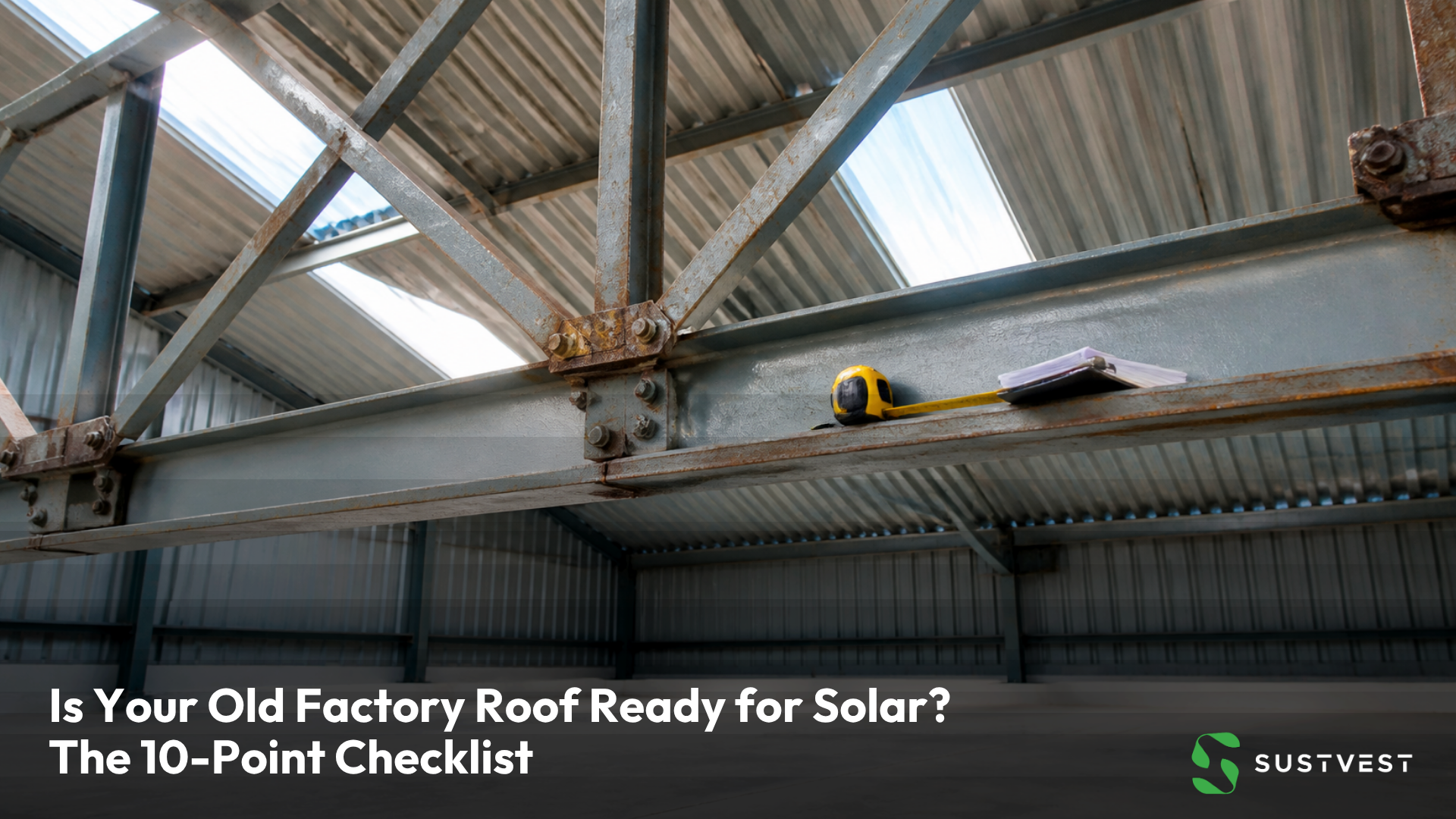
Is Your Old Factory Roof Ready for Rooftop Solar? A 10-Point Checklist
Your factory has a big, sunny roof. That is a great start, but it is not the whole story. A solar plant will sit on that roof for 25 years, through monsoons, cyclones and summer heat. If the roof cannot carry it, or will need replacing in five years, the project can turn from a saving into a headache.
This is a growing issue in older industrial clusters. Mercom India reported on 23 October 2026 that C&I (commercial and industrial) rooftop solar developers in Tamil Nadu face structural and electrical infrastructure constraints that limit the capacity they can install, even when there is enough roof space. Roof condition and electrical infrastructure, it noted, are shaping project sizing, costs and installation timelines.
Here is a practical checklist for plant heads and facility managers to run before talking to a solar developer.
Why does roof condition matter so much for rooftop solar?
Because a solar plant adds permanent weight and wind load to your roof for 25 years, and fixing a roof under a live solar plant is costly and disruptive.
Roof problems are a common cause of delays. Heaven Green Energy, an installer, says its internal data shows more than 20% of rooftop solar installation delays in India are caused by roof-related issues. A good structural check upfront avoids redesigns, extra steel and lost months later.
1. How much weight does rooftop solar add to a factory roof?
A typical flush-mounted rooftop solar system adds roughly 12 to 15 kg per square metre, according to installer Heaven Green Energy's 2026 field data. Ballasted systems, which use concrete blocks instead of fixings, can add 30 to 60 kg per square metre.
That difference is huge for an old shed. Concrete ballast blocks avoid drilling, but they can overload a light roof. Ask your developer to state the exact design dead load (in kg per square metre) of the system they propose, and check it against what your roof was designed for.
2. What type of roof do you have?
Roof type decides the mounting method, the extra weight and the risks. Know yours before anything else.
| Roof type | Common mounting | What to check
|
|---|---|---|
| Metal sheet (GI or colour-coated) | Clamps on the sheet profile or rails fixed to purlins | Sheet thickness, purlin condition, rust at lap joints |
| RCC (Reinforced Cement Concrete) flat roof | Elevated steel structures, anchored or ballasted | Slab design load, cracks, spalling, waterproofing |
| Asbestos cement (AC) sheet | Not suitable for direct mounting | Plan replacement or an independent structure |
3. Can you install solar on an asbestos cement roof?
Not directly. Asbestos cement sheets are brittle, lose strength with age, and drilling them releases hazardous fibres, as Heaven Green Energy points out.
The usual options are to replace the AC sheets with metal sheets before installing solar, or to build an independent steel structure that carries the panels without touching the sheets. Replacement adds cost upfront, but it also gives you a new roof that matches the 25-year life of the solar plant. Any asbestos removal must be done by trained contractors following safety rules.
4. Are your purlins and steel frames in good shape?
On metal sheds, the purlins (the horizontal steel members that hold the sheets) carry the solar load. Corroded purlins are the most common weak point.
Heaven Green Energy flags corroded purlins at sheet lap joints as the failure mode to watch, especially in coastal and humid chemical-industry areas. It lists corroded purlins, loose sheeting bolts and perforated sheets as common on metal sheds after 15 or more years.
Walk the roof with your maintenance team and look for:
- Rust flakes or holes on purlins, especially near joints
- Sagging sheets or visible dips between supports
- Loose, missing or rusted bolts
- Past patch repairs that suggest recurring leaks
Replacing a few purlins or adding intermediate ones is usually a modest job compared with the cost of fixing a roof after the plant is installed.
5. How many years of life does your roof have left?
Your roof should last as long as your solar contract. If you plan to re-roof or rebuild in the next few years, do that first.
Heaven Green Energy treats re-roofing or redevelopment planned within 5 years as a reason to hold off on solar. Removing and refitting a solar plant to replace the roof underneath costs money and lost generation. If your roof is near the end of its life, replacing it just before solar goes up is often the smartest sequence.
6. Do you need a structural stability certificate?
Often, yes. Many discoms (distribution companies) and lenders ask for a structural stability certificate for C&I rooftop solar, and it should come from a qualified structural or chartered engineer, not the installer.
Bridgeway Power lists a structural stability certificate from a Chartered Engineer among the documents for C&I rooftop approvals. Rules vary by state and discom, so check your discom's current requirements. For older buildings, a proper structural audit is worth doing even if it is not mandatory.
On cost, Heaven Green Energy suggests budgeting about ₹15,000 to ₹50,000 for a full industrial shed assessment, depending on span and complexity. That is small next to the value of a 25-year plant.
7. Is your site in a high wind zone?
The solar structure must be designed for your site's wind speed under IS 875 (Part 3), the Indian standard for wind loads.
Coastal districts face higher design wind speeds. Heaven Green Energy notes that coastal districts of Gujarat, Tamil Nadu and Odisha sit in higher wind zones under IS 875 Part 3. Wind does not just push panels: it also tries to lift them, and that uplift is strongest at roof corners and edges. Ask your developer for stamped structural calculations that state the design wind speed used.
8. Will drilling cause roof leaks?
It should not, if mounting is done right. Every fixing point needs proper sealing, or use non-penetrating clamps where the roof profile allows.
Heaven Green Energy says installers should use bonded sealant or flashing boots around every anchor point, and recommends writing this into the installation contract. On metal sheds, clamp-based mounting on the sheet profile can avoid drilling altogether. On RCC roofs, fix any existing waterproofing problems before installation, since brackets drilled into a damaged membrane create new entry points for water.
Fourth Partner Energy adds that penetrations not in line with the roof manufacturer's guidelines can affect your roof warranty, so check the warranty terms before work starts.
9. How much usable roof space do you really have?
Not all of your roof can carry panels. Usable area is typically 65% to 80% of the gross roof area, according to Fourth Partner Energy.
Skylights, turbo ventilators, exhaust fans, chillers, water tanks, shadows from taller structures and safety clearances near edges all reduce usable space. A good developer will map these with a site survey or drone survey and size the plant on usable area, not on the full roof.
10. Is your electrical setup ready for solar?
The roof is only half the check. Your sanctioned load, transformer capacity and LT (Low Tension) panel also limit how much solar you can connect.
Bridgeway Power notes that in most states the solar plant cannot exceed your sanctioned load, and that discoms often limit solar penetration based on local transformer capacity. Exact limits differ by state, so check your state's net metering or rooftop regulations. If your sanctioned load is low, a load enhancement may be needed before a bigger plant is approved.
Also plan for approval time. Bridgeway Power estimates that C&I rooftop approvals can take around 150 to 225 days in practice, against about 50 days in an ideal process. Starting the paperwork early helps.
What should you do if your roof fails the check?
A weak roof does not mean no solar. It usually means a different design, a smaller first phase, or a roof fix before installation.
- Lighter system: switch from ballasted to fixed mounting, or reduce the plant size on weaker bays.
- Strengthen: replace or add purlins, or reinforce the frame where the engineer advises.
- Re-roof first: replace AC or badly corroded sheets, then install solar on a roof that will last 25 years.
- Independent structure: carry the panels on a separate steel frame that does not load the old roof.
- Use other spaces: newer sheds, car parks or warehouses on the same site may be better candidates.
Under an OPEX (operating expenditure) or RESCO (Renewable Energy Service Company) model, the developer carries the structural design and long-term maintenance risk of the plant. Discuss upfront who pays for roof repairs or strengthening, and put it in the contract.
FAQ
How much load does rooftop solar add to a metal shed roof?
A typical flush-mounted system adds roughly 12 to 15 kg per square metre, according to installer field data. Ballasted systems can add 30 to 60 kg per square metre. Always confirm with a structural engineer.
Is a structural audit compulsory for rooftop solar in India?
It depends on your state, discom and lender. Many ask for a structural stability certificate for C&I systems. For older factories, an audit is strongly advisable either way.
Can solar panels be installed on asbestos roofs?
Not directly. Drilling asbestos cement sheets releases hazardous fibres and the sheets are brittle. Replace the sheets or use an independent structure.
Will solar panels damage my factory roof?
Not if the system is designed for your roof's load and wind zone, and every fixing point is properly sealed. Poor installation, not solar itself, causes leaks and damage.
How old is too old for a factory roof to take solar?
There is no fixed age. What matters is condition and remaining life. If you expect to re-roof within about five years, do it before installing solar.
About SustVest
SustVest (SolarGridX Ventures Pvt Ltd) is ranked #5 among India's Top 10 rooftop solar project developers in the Crisil Bridge to India India Solar Rooftop Map (June 2026). It runs 80+ distributed solar plants (30 MW+) across 13 states for factories, hospitals, hotels, tea estates and institutions, mostly on a zero-upfront OPEX/RESCO model, with an in-house EPC (Engineering, Procurement and Construction) and procurement team. Want to know if your roof is solar-ready? Reach us at sustvest.com.
Sources
- Mercom India: Old Industrial Building Structures Limit Rooftop Solar Sizing in Tamil Nadu (23 October 2026)
- Heaven Green Energy: How to Check Roof Structural Strength for Solar in India
- Heaven Green Energy: How to Inspect Your Roof Before Solar Installation
- Fourth Partner Energy: C&I Rooftop Solar, Overcoming Structural and Grid Challenges
- Bridgeway Power: Why C&I Solar Projects Get Stuck in Discom Approval in India