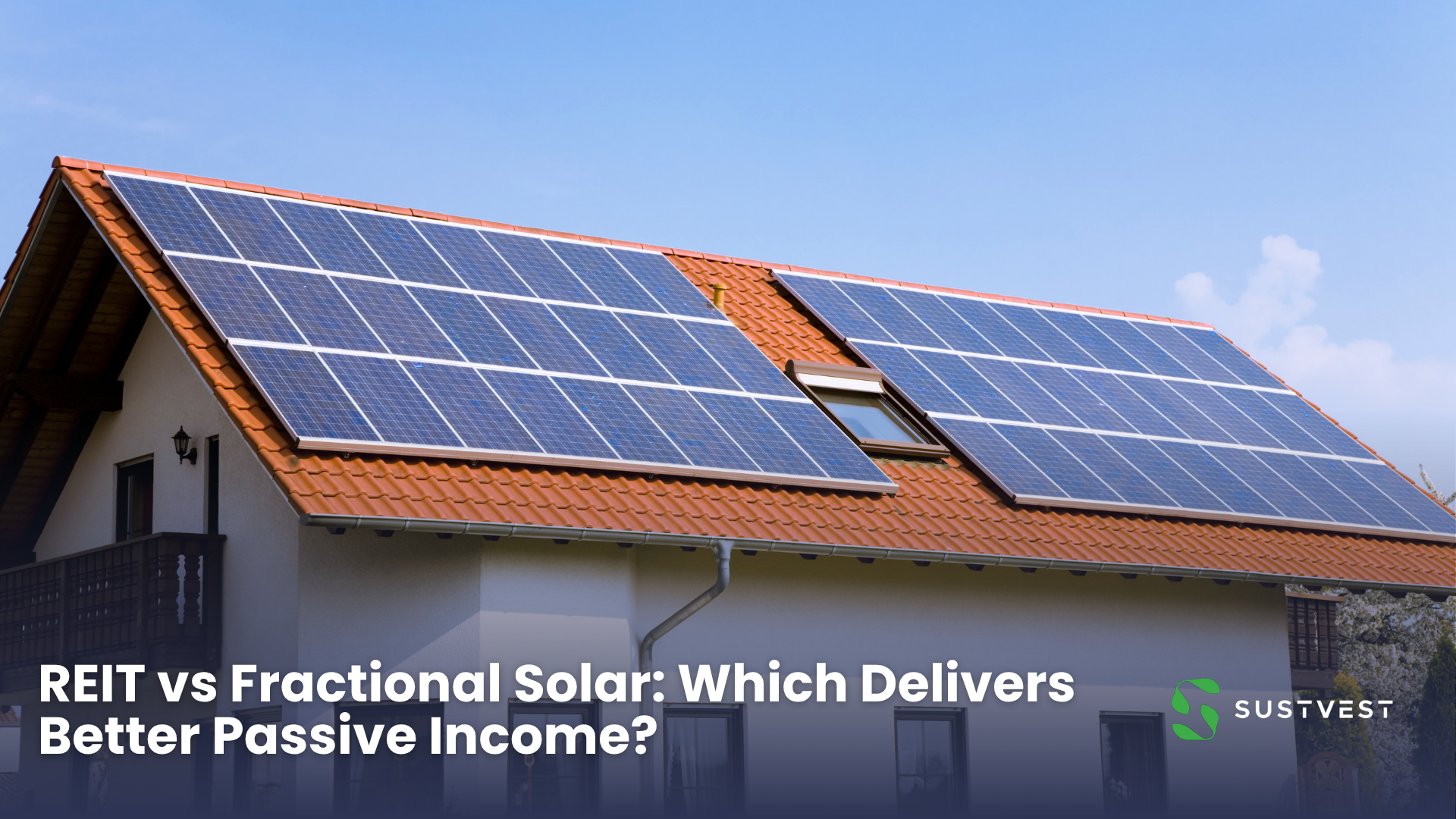
REIT vs Fractional Solar: Which Delivers Better Passive Income?
By Hardik BhatiaPublishedIf you are an accredited investor looking for passive income, you have almost certainly considered REITs. They are one of the most popular income-producing asset classes in the US - roughly 170 million Americans hold REIT exposure through retirement accounts and investment funds. The appeal is obvious: steady dividends, professional management, and the ability to buy and sell on a stock exchange.
But there is another asset class generating passive income from real-world infrastructure that most investors have never compared side by side with REITs: fractional solar ownership. Instead of owning shares in a company that manages real estate, you own membership units in a solar energy project that sells electricity under a long-term contract. The income comes not from tenants paying rent but from kilowatt-hours of electricity sold under a Power Purchase Agreement.
This blog puts both options on the table - income, risk, liquidity, tax treatment, and portfolio fit - so you can decide which one belongs in your portfolio. Or whether both do.
What Is the Difference Between a REIT and Fractional Solar Ownership?
The core structural difference is straightforward: a REIT is equity in a company, while fractional solar is direct participation in a physical asset.
A Real Estate Investment Trust is a company that owns, operates, or finances income-producing real estate. When you buy shares of a publicly traded REIT, you are purchasing equity in that company - not in any specific building. The REIT's management team decides which properties to buy, sell, or develop. Your returns come from the company's overall performance, distributed primarily as dividends. By law, REITs must distribute at least 90% of their taxable income to shareholders, which is why they tend to offer higher yields than most equities.
Fractional solar ownership works differently. When you invest through a platform like Sustvest, you purchase membership units in a Delaware-registered LLC that owns 100% of an Indian Special Purpose Vehicle (SPV). That SPV owns a specific, identifiable solar project - the panels, inverters, grid connection, and the Power Purchase Agreement with the electricity buyer. Your returns come from actual electricity sales under that PPA, distributed monthly in USD.
The distinction matters more than it might seem. With a REIT, your returns are influenced by the company's management decisions, its debt structure, stock market sentiment, and interest rate movements. With fractional solar, your returns are driven by how much sunlight hits the panels and whether the electricity buyer pays on time. These are fundamentally different return drivers - and that difference is the foundation of everything that follows.
Which Delivers Higher Passive Income - REITs or Fractional Solar?
On raw yield, fractional solar significantly outperforms REITs.
As of April 2026, publicly traded US equity REITs posted a one-year average dividend yield of 3.98%, according to S&P Global Market Intelligence. The S&P 500, by comparison, yields approximately 1%. REITs are among the highest-yielding publicly traded asset classes-— but a 4% yield is still a 4% yield.
Fractional solar investments targeting US accredited investors typically offer an expected XIRR of 10–14%, with monthly cash distributions in USD. The income is generated from electricity sales under PPAs that lock in revenue for 10 to 25 years, creating a contracted and predictable cash flow stream.
That is a substantial gap — roughly 2.5 to 3.5 times the income yield of an average REIT.
However, yield alone does not tell the full story. There are important nuances in how that income behaves over time.
REIT dividends can grow. The best REITs have decades-long track records of increasing payouts. Realty Income, one of the most widely held REITs, declared its 667th consecutive monthly dividend in early 2026 and has increased its payout consistently over 32 years. That compounding effect matters over long holding periods. A 4% yield that grows at 5% annually looks very different after 15 years than a fixed 12% yield.
Solar distributions, on the other hand, are tied to PPA terms. The PPA tariff may include an annual escalation clause (typically 1-3% per year in Indian C&I contracts), but the growth trajectory is contractually defined rather than driven by management decisions. Solar panels also degrade at approximately 0.5% per year, which gradually reduces output and revenue over the project's life - though well-structured projections account for this.
The bottom line on income: fractional solar delivers materially higher current yield. REITs offer lower current yield with stronger potential for long-term dividend growth. Your preference depends on whether you need income now or are optimizing for compounding over decades.
How Do the Risk Profiles Compare?
REITs and fractional solar carry meaningful risk — but they are almost entirely different risks. This is what makes the comparison interesting from a portfolio perspective.
REIT risks are primarily financial market risks. REITs are highly sensitive to interest rates. When the Federal Reserve raised rates aggressively in 2022-2023, the FTSE NAREIT All Equity REITs Index dropped sharply — not because the underlying properties stopped generating rent, but because higher rates increased borrowing costs, compressed valuations, and made bond yields more competitive with REIT dividends. In the first three months of 2026, REITs averaged a -2.22% total return, according to Seeking Alpha's sector analysis. REITs also carry sector-specific risk: office REITs have been battered by remote work trends, retail REITs face e-commerce pressure, and healthcare REITs are exposed to regulatory changes. Because REITs trade on stock exchanges, their prices can swing based on market sentiment even when the underlying real estate is performing well.
Fractional solar risks are infrastructure and operational risks. The biggest risk is illiquidity - your capital is locked for the PPA duration. Beyond that, the primary risks are currency fluctuation (INR/USD for India-based projects), PPA counterparty default, solar panel underperformance, grid curtailment, and regulatory changes in the project's home country. These are real risks, but they have virtually no connection to what the stock market, the Fed, or interest rates are doing on any given day.
The key insight for portfolio construction: adding REITs to a stock-heavy portfolio provides moderate diversification, because REITs still correlate with equity markets. Adding fractional solar provides genuine diversification, because the return drivers — sunlight, electricity sales, PPA contracts — operate independently of financial markets.
Which Is More Liquid — REITs or Fractional Solar?
REITs win this comparison decisively, and there is no point pretending otherwise.
Publicly traded REITs can be bought and sold on major stock exchanges during market hours. You can exit your position in seconds at the current market price. There are over 225 publicly traded REITs in the US, and liquidity is rarely an issue for the major ones. If you need your capital back tomorrow, you can have it.
Fractional solar ownership is illiquid. When you purchase membership units in a solar project, your capital is committed for the duration of the underlying PPA — typically 10 to 25 years. There is no public secondary market. Early exit options, if they exist at all, are limited and may involve penalties or discounts to fair value.
This is the single biggest trade-off in the REIT vs solar comparison. REITs give you the freedom to exit at will. Fractional solar gives you higher yield and lower market correlation — but in exchange, you surrender liquidity. For investors who may need access to their capital within the investment horizon, REITs are the clearly safer choice regardless of yield differential.
The practical implication: fractional solar should only be funded with capital you do not expect to need for the stated investment tenure. It belongs in the same mental category as private equity or a long-term infrastructure fund — not in the same category as a stock you might sell next quarter.
How Does Market Correlation Differ?
This is where the comparison becomes most relevant for sophisticated investors thinking about portfolio construction.
REITs are moderately correlated with the broader stock market. They trade on exchanges, they are held in index funds, and their valuations are influenced by the same macroeconomic forces that move equities — interest rates, inflation expectations, credit conditions, and investor sentiment. During the market selloff in early 2020, REITs dropped alongside the S&P 500. During the 2022 rate hiking cycle, REITs underperformed the broader market. The FTSE NAREIT All Equity REITs Index delivered a five-year total return of 21.4% as of March 2026 — competitive, but not independent from the forces that drive stocks.
Fractional solar returns are driven by an entirely different set of factors: solar irradiance levels, the terms of a fixed PPA, equipment performance, O&M execution, and currency exchange rates. None of these are influenced by what the Federal Reserve does with interest rates or whether the S&P 500 has a good quarter. A market crash does not reduce the amount of electricity a solar plant in Rajasthan produces, and it does not change the price at which that electricity is sold under a 15-year PPA.
This near-zero correlation with equity markets is, for many accredited investors, the single most compelling reason to consider fractional solar alongside — not instead of — REITs. Modern portfolio theory suggests that adding genuinely uncorrelated assets to a portfolio improves risk-adjusted returns even if the individual asset carries its own risks. Fractional solar is one of the few income-producing asset classes that achieves this level of independence from financial market cycles.
When Should You Choose REITs Over Fractional Solar — and Vice Versa?
The choice is not binary. Both can coexist in a well-constructed portfolio. But if you are evaluating where to allocate your next dollar of passive income capital, here is a framework:
Choose REITs if:
You need liquidity and the ability to exit at any time
You want diversified exposure across multiple properties and sectors without selecting individual assets
You prefer a fully passive, hands-off approach with no cross-border complexity
You are building a long-term compounding position where dividend growth matters more than current yield
You want an asset you can hold in a tax-advantaged retirement account (IRA, 401k)
Choose fractional solar if:
You want the highest current yield available in a contracted, infrastructure-backed asset
You are specifically seeking portfolio diversification that is genuinely uncorrelated with equity markets
You want project-level transparency — knowing exactly which asset your capital funds, with real-time generation data
You are comfortable with the additional complexity of cross-border investing (currency, DTAA, SPV structures)
Consider both if:
You want a passive income portfolio that balances liquidity (REITs) with yield and diversification (solar)
You are an accredited investor with enough capital to allocate across multiple asset classes
You already hold significant equity exposure and want to reduce overall portfolio correlation with stocks
The most common mistake is treating these as substitutes. They are not. REITs are a liquid, market-correlated real estate play. Fractional solar is an illiquid, market-independent infrastructure play. They serve different roles in a portfolio, and combining them creates a more resilient passive income stream than either one alone.
Frequently Asked Questions
Can I hold both REITs and fractional solar in my portfolio? Yes, and for many accredited investors, this is the optimal approach. REITs provide liquidity and diversified real estate exposure, while fractional solar adds higher yield and genuine market independence. The two asset classes have very low correlation with each other, meaning combining them can reduce overall portfolio volatility while maintaining strong income generation.
Do REITs or fractional solar perform better during a recession? REITs tend to decline during recessions because they trade on stock exchanges and are sensitive to credit conditions, tenant defaults, and falling property values. Fractional solar performance is largely independent of recessions — electricity demand is relatively inelastic, and PPA-backed revenue continues regardless of macroeconomic conditions. However, currency risk (INR/USD) may increase during global downturns if emerging market currencies weaken.
What is the minimum investment for REITs vs fractional solar? Publicly traded REITs can be purchased for the price of a single share — often between $10 and $200. There is effectively no minimum beyond the share price. Fractional solar platforms like Sustvest offer entry starting at $500 per project for verified accredited investors. The REIT minimum is lower, but fractional solar still has a relatively accessible entry point for a private offering.
Are REITs or fractional solar better for retirement income? Both can serve retirement portfolios, but in different ways. REITs are available in tax-advantaged accounts (IRAs, 401ks), which shelters dividends from immediate taxation. Fractional solar generates higher current income but is typically held outside retirement accounts and may involve cross-border tax complexity. For retirees who need liquidity and simplicity, REITs are the easier choice. For those with a longer horizon and the ability to lock capital, fractional solar's higher yield can meaningfully boost total retirement income.
About Sustvest
SustVest LLC is a Delaware-registered fractional solar investment platform offering SEC Regulation D 506(c) compliant investment opportunities in Indian solar energy projects. Through its US entity structure, Sustvest enables accredited investors and NRIs to own membership interests (units) in operating solar projects backed by long-term Power Purchase Agreements. Each project is held in a separate Indian SPV, with SustVest LLC owning 100% of each SPV. Investors receive proportional monthly cash distributions in USD, with a minimum investment of $500 and target returns of 10–14% XIRR. Project details, SEC filings, and real-time generation data are available at sustvest.com.
This content is for informational purposes only and does not constitute an offer to sell or a solicitation of an offer to buy any securities. Investments in private offerings under SEC Regulation D are speculative, illiquid, and involve a high degree of risk, including the potential loss of the entire investment. Fractional solar investments are available only to verified accredited investors as defined under SEC Rule 501(a). Past performance is not indicative of future results. Prospective investors should carefully review the Private Placement Memorandum (PPM) and consult with their own legal, tax, and financial advisors before making any investment decision. SustVest LLC does not provide investment, legal, or tax advice. REIT performance data cited in this blog is historical and does not guarantee future returns.
Sources:
S&P Global Market Intelligence — US equity REITs one-year average dividend yield: 3.98% (April 2026)
Motley Fool — "REIT average dividend yield over 4% in early 2026, compared to ~1% for the S&P 500" (March 2026)
Nareit — REIT Industry Financial Snapshot: 78% ordinary income, 12% return of capital, 9% long-term capital gains (2024 tax year data, as of March 31, 2026)
Seeking Alpha — "REITs averaged -2.22% year-to-date total return in 2026" (April 2026 edition)
NerdWallet — FTSE NAREIT All Equity REITs Index: five-year total return 21.4% as of March 2026
NerdWallet — S&P 500 five-year total return: 13.14% as of April 30, 2026
Realty Income Corporation — 667th consecutive monthly dividend declared in early 2026
Nareit — "Over 225 publicly traded REITs in the US"; "170 million Americans hold REIT exposure" (May 2026)
NREL — Solar panel median degradation rate of 0.5% per year
US-India Double Taxation Avoidance Agreement — signed September 12, 1989; entered into force December 18, 1990
SEC.gov — Rule 506(c) of Regulation D; Form D filing requirements
Tax Cuts and Jobs Act / One Big Beautiful Bill Act — Section 199A: 20% deduction on qualified REIT dividends, made permanent by OBBBA (July 4, 2025)