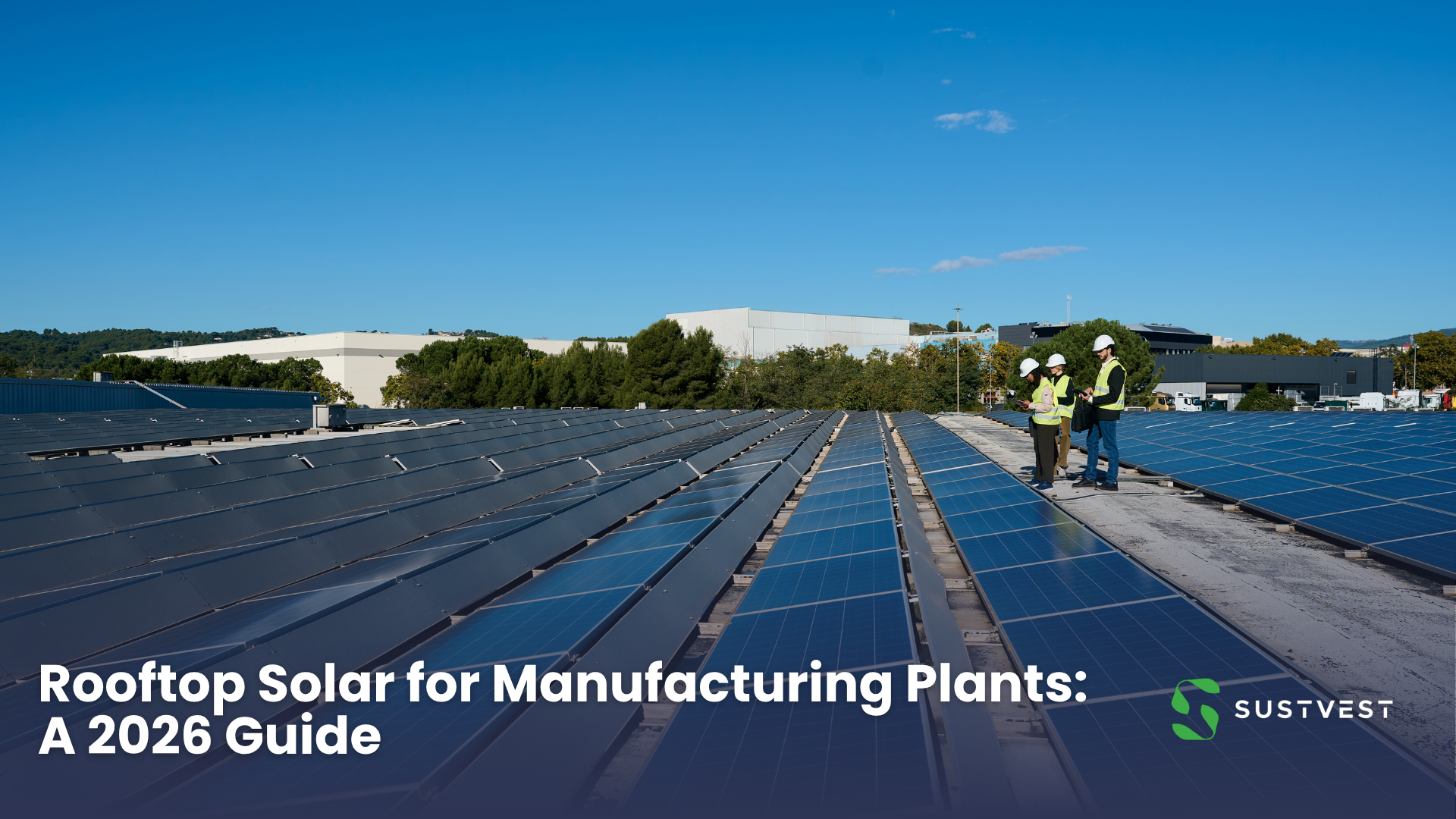
Rooftop Solar for Manufacturing Plants: A 2026 Guide
By Hardik BhatiaPublishedFor most manufacturing plants in India, electricity is one of the largest controllable costs on the P&L - and one of the few that rooftop solar can cut structurally, not just trim. But the savings a factory actually captures vary enormously from one plant to the next, and the difference usually comes down to a few technical factors that generic "save 60% on your bills" claims never explain.
Manufacturing plants are among the best-suited facilities for rooftop solar because their electricity demand peaks during daylight hours - exactly when solar generates. A well-designed system can offset a large share of a factory's daytime consumption, with savings driven primarily by how much of the solar generation is consumed on site rather than exported. The key variables are the plant's load profile, grid tariff, available shade-free roof area, and how the system is sized and funded.
Here's what plant heads, CFOs, and sourcing teams need to understand before installing.
Why are manufacturing plants well-suited to rooftop solar?
Because their consumption pattern aligns naturally with solar generation. Most factories draw their heaviest load during daytime shifts — when machinery, compressors, and HVAC are running — which is precisely when a rooftop solar system produces the most power. This alignment means a high share of generation can be consumed directly on site, which, as we'll see, is what makes the economics work.
Three structural advantages reinforce this:
High, steady daytime load. Continuous-process and single-shift daytime manufacturers can consume most of what their system generates, minimising low-value exports.
Large shade-free roofs. Factory sheds typically offer expansive, unobstructed roof area — the single biggest physical constraint on system size.
High grid tariffs. Industrial electricity tariffs commonly range from approximately ₹7–14 per kWh depending on state, consumer category, and voltage level, so every unit of self-generated solar displaces expensive grid power. [VERIFY: confirm the range reflects your target states]
India had over 25 GW of installed rooftop solar capacity by early 2026, and a growing share of new additions is coming from C&I consumers — manufacturers prominent among them. [VERIFY: update the capacity figure to the latest MNRE/CEA number at publication]
How much can a manufacturing plant save with solar?
Savings depend on your tariff, your daytime load, and how much generation you self-consume — but for a high-tariff factory with strong daytime demand, solar can offset a substantial share of daytime electricity cost. As an illustration, a factory spending ₹10 lakh per month on electricity, with a system sized to offset a meaningful share of daytime consumption, could see a material reduction in monthly bills — the exact figure depending entirely on the variables above.
The single most useful way to think about savings is this: the value of your solar system is set less by its size than by how much of its output you actually consume on site. A useful rule of thumb from the industry is that a system where the large majority of generation is self-consumed consistently outperforms a larger system that exports heavily — especially under 2026's billing rules (more below).
Rather than a headline percentage, the honest answer is a framework. Your savings rise with:
Higher grid tariff — the more you pay per unit, the more each solar unit saves
Higher daytime load — more of your generation is consumed, not exported
Better system sizing — matched to load, not just roof area
Rising future tariffs — if grid tariffs rise over time, as they have historically, solar locks in a low effective cost over the asset's 25-year life
What determines the payback period for factory solar?
For a tax-paying manufacturer with strong daytime consumption and a high tariff, payback on an owned (CAPEX) system is commonly reported in the range of 3–6 years, followed by 20-plus years of lower-cost electricity — but the range is real and depends on your specifics. The main levers are:
Grid tariff: the higher your per-unit cost, the faster the payback. Every ₹1/kWh increase in the applicable grid tariff increases the value of each self-consumed unit of solar electricity, improving annual savings for a given system size.
Self-consumption ratio: the share of generation used on site rather than exported — the higher, the better, particularly under net billing.
Funding model: CAPEX front-loads cost for maximum long-term return; OPEX removes the upfront cost entirely (see the funding section below).
Tax position: whether the business can use depreciation benefits, which we cover in our OPEX vs CAPEX guide.
How should a manufacturing plant size its solar system?
Size to your daytime load, not to your roof. The most common design mistake is treating available roof area as the target — filling the roof with the largest system it holds. Under 2026's billing rules, an oversized system that exports heavily into low net-billing rates delivers poor returns on the exported portion.
The better approach starts with your load profile:
Map your daytime consumption — how much power the plant draws during solar-generating hours, across your actual shift pattern.
Size the system so most generation is self-consumed — the sweet spot maximises on-site use rather than export.
Assess roof structure and shade-free area — factory sheds vary in load-bearing capacity and orientation; a structural check is essential before finalising capacity.
Factor in future load growth — if the plant is expanding, some headroom may be justified.
This is also where a change in the rules matters. Several Indian states have adopted or expanded net billing frameworks for larger commercial and industrial systems, and some have added grid support charges — so self-consumption has become the foundation of the economics, though the specifics vary by state. We explain this in detail in net metering vs net billing for industrial solar. For plants with significant evening or night load, pairing solar with battery storage can capture value that would otherwise be lost — though whether it pays off is a plant-specific calculation.
Should a factory choose OPEX or CAPEX for solar?
Both work for manufacturing — the choice depends on your capital position and tax situation. Under CAPEX, the plant owns the system, captures the full economic benefit, and may claim available tax benefits — best for tax-paying manufacturers with capital to deploy. Under OPEX/RESCO, a developer funds, owns, and operates the system on your roof and you buy the power at a discounted per-unit tariff with no upfront investment — best for manufacturers who want to preserve working capital for core operations or cannot use depreciation benefits.
For multi-plant manufacturers, a hybrid approach is common: CAPEX where capital and tax position allow, OPEX elsewhere. There's also a 2026-specific angle worth noting: under OPEX, the developer carries module procurement and compliance risk — relevant now that ALMM requirements govern domestically approved modules and cells for many projects.
What should manufacturers check before installing solar?
Treat solar as a plant-engineering and finance decision, not a procurement checkbox. Five questions worth answering first:
What is our true daytime load profile across shifts and seasons?
What share of generation will we self-consume versus export at low rates?
Is our roof structurally sound and shade-free enough for the target capacity?
Which funding model fits our capital and tax position — CAPEX, OPEX, or a mix?
How will we monitor and maintain performance so the system delivers its designed output for 25 years? (Underperformance from poor O&M quietly erodes returns — which is why monitoring and O&M matter as much as the install.)
A partner who answers these for your specific plant — with a proper load study and structural assessment — is doing the work that actually protects your savings.
The bottom line for manufacturers
Rooftop solar is one of the few structural cost reductions available to an Indian manufacturer, and the daytime alignment of factory load with solar generation makes plants especially well-suited to it. But the savings aren't a fixed percentage off your bill — they're the product of your tariff, your load profile, your self-consumption, and the quality of system design. The manufacturers who capture the most are those who size to load, design for self-consumption, and choose a funding model that fits their balance sheet — not those who simply fill the roof.
SustVest designs rooftop solar around your plant's actual load profile, roof, and tariff — under OPEX and CAPEX models, with in-house monitoring and O&M to protect performance over the asset's life. As a CRISIL Top-10 Rooftop Solar Developer with 83+ projects across 13+ states, we model your savings on your real numbers, not a generic percentage. Book a free site assessment for your facility.
Frequently Asked Questions
How much can a manufacturing plant save with rooftop solar? Savings depend on the plant's grid tariff, daytime load, and how much solar generation is self-consumed rather than exported. High-tariff factories with strong daytime demand can offset a substantial share of daytime electricity cost, but the exact figure varies by plant and should be modelled on the facility's actual consumption and tariff.
Why is rooftop solar well-suited to factories? Manufacturing plants typically consume the most electricity during daytime shifts, which aligns with solar's generation hours. This lets a high share of generation be consumed on site, and factories usually have large shade-free roofs and high grid tariffs — all of which improve solar economics.
What is the payback period for solar on a factory in India? For tax-paying manufacturers with strong daytime consumption and high tariffs, CAPEX payback is commonly reported in the range of 3–6 years, followed by 20-plus years of lower-cost power. Payback varies with tariff, self-consumption ratio, system cost, funding model, and tax position.
How should a factory decide what size solar system to install? Size the system to the plant's daytime load rather than simply filling the available roof. Under 2026 billing rules, a system where most generation is self-consumed outperforms a larger system that exports heavily into low net-billing rates. A proper load study and structural assessment should precede sizing.
Is OPEX or CAPEX better for a manufacturing plant? CAPEX suits tax-paying manufacturers with capital to deploy who want maximum long-term returns; OPEX suits those who want zero upfront investment and to preserve working capital, or who cannot use depreciation benefits. Multi-plant manufacturers often use a mix across sites.
Does rooftop solar work for factories with night shifts? Solar generates only during daylight, so a plant with significant night load will still draw grid power at night. Where night or evening consumption is significant, pairing solar with battery storage can help, though whether it is economical depends on the specific load pattern and tariffs.
Sources
India rooftop solar capacity (over 25 GW, early 2026): MNRE / CEA data — update to latest figure at publication
Industrial tariff ranges (₹7–14/kWh, varying by state, category, voltage): state DISCOM tariff schedules, 2026
Factory solar savings and payback observations: industry reporting, 2026
Net billing / self-consumption framing: MERC and other SERC orders, 2026 (see linked net-billing post)