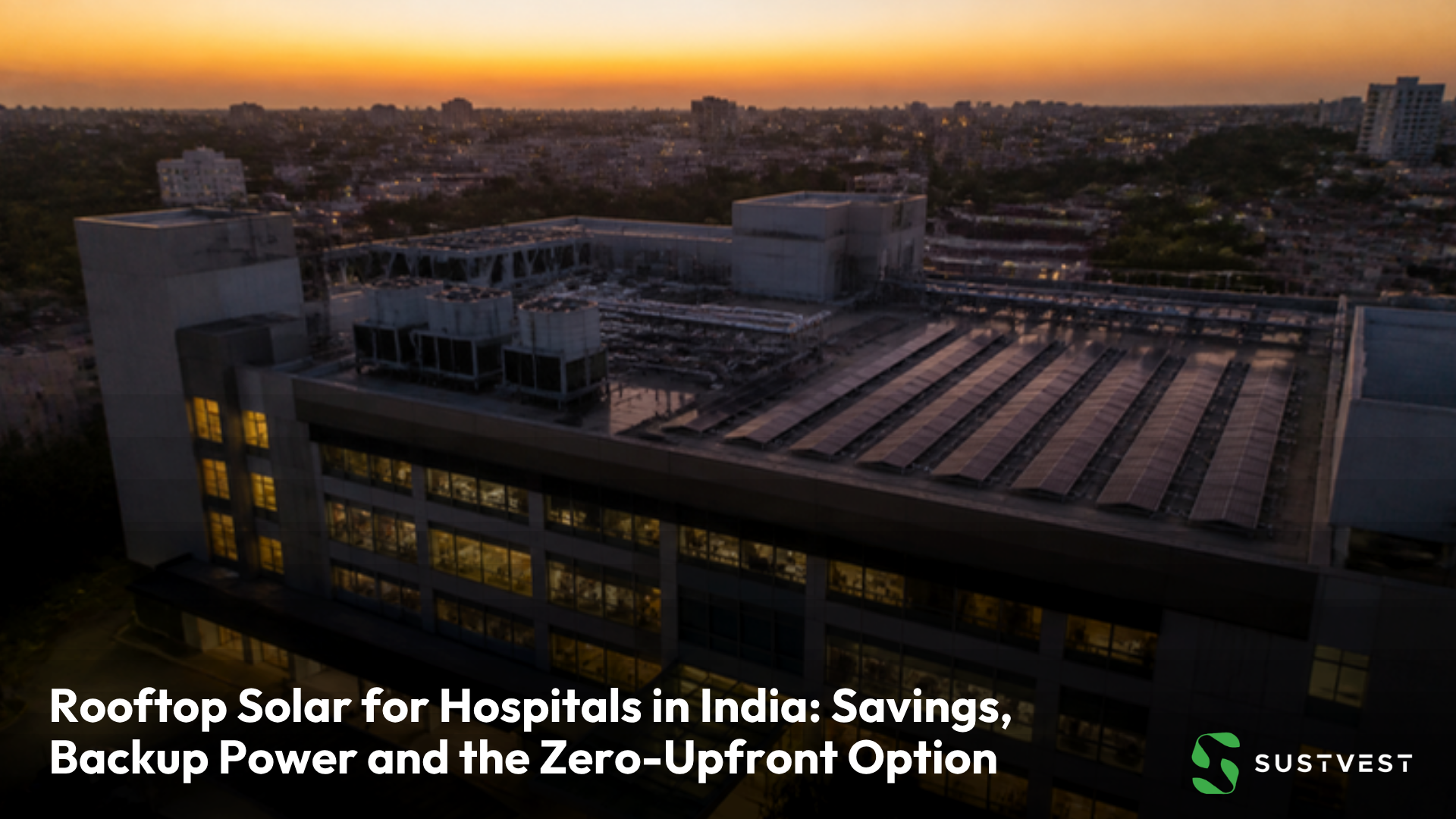
Rooftop Solar for Hospitals in India: Savings, Backup Power and the Zero-Upfront Option
A hospital never switches off. The chillers run, the lights stay on, and the power bill keeps climbing. That makes hospitals natural buyers of rooftop solar, with one serious catch: a standard solar plant will not keep your ICU running during a power cut.
This guide is for hospital owners, CFOs and facility heads. It covers what solar can do, what it cannot do, and how to pay for it.
Is rooftop solar a good fit for hospitals?
Yes. Hospitals use power all day, every day, so nearly every unit a rooftop plant generates can be used on site. A Bureau of Energy Efficiency (BEE) guide notes that hospitals usually run 24 hours a day, all year round.
Daytime is when both solar output and cooling load are high. The same BEE guide says HVAC (heating, ventilation and air conditioning) may consume 40% of total electricity in many large, centrally air-conditioned hospitals. Together, lighting and HVAC make up about 75%. The guide is from 2009, so treat these as a broad pattern and check your own meter data.
The sector's demand is also growing. Research by the Alliance for an Energy Efficient Economy (AEEE) found that hospitals are 6% of India's commercial built-up area but 14% of commercial energy use. It projected their electricity use to rise from 11 billion units in 2017 to 16 billion by 2027.
How much can a hospital save with rooftop solar?
Savings depend mainly on your tariff, roof size and financing model. Published Indian examples range from about 10% of grid use to nearly 40% of consumption.
| Hospital | Plant size | Reported result |
|---|---|---|
| Max Super Speciality Hospital, Vaishali | 392.4 kWp, OPEX, 25-year PPA | Almost 40% saving against the grid cost of power |
| Institute of Mental Health and Hospital, Agra | 321.6 kW | Potential 469,536 units a year, against 1,176,840 units consumed; payback about 5.8 years |
| Nair Hospital Dental College, Mumbai | 100 kW, partly on gazebos | About ₹12 to ₹13 lakh saved a year; grid dependence down by up to 10% |
| Gujarat Cancer and Research Institute (as cited from a NABH guidebook) | 75 kW | About 82,000 units a year; ₹7.38 lakh saved at ₹9 per unit |
The Agra project's potential output is about 40% of what the hospital consumed before. That is unusually high. Large hospitals with limited roofs will usually offset a smaller share.
What size solar plant does a hospital need?
Start from your daytime load and your usable roof, not your total bill. A common benchmark is 1,400 to 1,450 units per kW per year, with about 10,000 sq ft of roof for 100 kW. Real output varies: the Mumbai project expects about 825 units per kW a year.
Here is a rough illustration. An AEEE and CAHO webinar put the average hospital at about 11,500 units per bed per year, so a 200-bed hospital might use about 23 lakh units.
- A 100 kW plant would generate 1.40 to 1.45 lakh units, or about 6% of that use, on about 10,000 sq ft.
- A 500 kW plant would generate 7.00 to 7.25 lakh units, or about 30%, but would need about 50,000 sq ft.
Your use could be far from this average. That same webinar gives a range of 4,000 to 16,000 units per bed. Use your last 12 months of bills before you size anything.
Will rooftop solar keep the hospital running during a power cut?
Not by itself. A standard grid-connected plant shuts down when the grid fails, by design, so that it does not send power into lines being repaired. This protection is called anti-islanding, and IEC 62116 is the standard cited for it.
So do not remove your diesel generator or UPS (uninterruptible power supply) because you installed solar. Treat solar as a cost tool first. Life-safety backup stays a separate design job.
There are three levels to think about:
- Solar only. The lowest cost. It cuts your bill but gives no backup.
- Solar with diesel synchronisation. A controller lets solar run alongside the generator and keeps the generator above a minimum base load, typically about 25%, while preventing reverse power flow into it. This can reduce fuel use during outages.
- Solar with battery storage. Batteries can carry selected loads. They can raise project cost by almost 50%, so size them for specific circuits rather than the whole building.
Diesel is costly, and that strengthens the case for options 2 and 3. At a Mercom event in Lucknow, one industry speaker put diesel power at about ₹25 to ₹27 per unit, against ₹13.5 for renewables with storage. These are one speaker's estimates, so test them with your own fuel logs.
Keep ICU, operation theatre and other critical loads on their own protected circuits. Your clinical engineering team should sign off on any change that touches them.
Should a hospital choose CAPEX or OPEX solar?
Choose OPEX if you want to protect capital for clinical priorities. Consider CAPEX if you have spare cash and can use the tax benefits. We covered the general comparison in an earlier post, but three things are specific to hospitals.
| Factor | CAPEX (you own the plant) | OPEX or RESCO (developer owns it) |
|---|---|---|
| Upfront cost | About ₹30,000 to ₹50,000 per kW | Zero |
| What you pay | Loan or cash, plus maintenance | Per-unit tariff, |
| Maintenance | Yours to arrange | Developer's job |
| Tax depreciation | Yours, if you have taxable profit | Not yours |
| Performance risk | Mostly yours | You pay for units generated |
RESCO means Renewable Energy Service Company: a developer who funds, builds and owns the plant, and sells you the power.
- GST may not come back to you. Healthcare services are largely exempt, so input tax credit on a solar purchase may be limited or pro-rated by taxable turnover. Ask your CA before you count on it in a payback calculation.
- Depreciation needs profit. Solar paybacks often assume 40% accelerated depreciation. A tax saving only helps if you pay enough tax. Trust hospitals should check their position carefully.
- Capital has competing uses. A new scanner or ward may earn more than a solar plant. OPEX removes that trade-off.
Private commercial hospitals also do not get the PM Surya Ghar subsidy, so do not build one into your numbers. That source says government hospitals may be able to use state, National Health Mission or CSR funding.
What if the hospital roof is too small or crowded?
Use every available surface first, including elevated structures. Then look at off-site supply for the remaining load. Hospital roofs often carry chillers, cooling towers, water tanks and service equipment, which take up space and cast shade.
Some projects have found ways around this:
- Gazebo structures: the Mumbai project split 100 kW across two buildings, using gazebos at 3.5 to 4.2 metres of clearance.
- Better layouts: the Agra project dealt with limited space by optimising its structural drawings.
- Off-site solar: Max Healthcare's Noida hospital takes power under a long-term PPA from a solar plant in Chitrakoot. The developer's press release cites indicative savings of nearly 50%. Off-site power has its own grid charges, so compare landed costs.
Also check state metering limits. For example, Gujarat set a 1 MW cap for net metering and net billing, and Telangana allows net metering up to 500 kWp. Rules differ by state and change often.
What should a hospital check before signing?
Check your load, your roof, your approvals and your contract, in that order. This short list covers most of what goes wrong:
- Tariff category: find out what you pay per unit in solar hours. Your category varies by state, and in Telangana, for instance, HT commercial at 11 kV is ₹8.80 against ₹7.65 for industry.
- Roof life: ask a structural engineer to check load capacity, waterproofing and remaining roof life.
- Shading: map chillers, tanks, stair towers and any planned new floors or a helipad.
- Clean work: agree how the crew will access the roof, control dust and noise, and stay clear of patient areas and air intakes.
- Cleaning schedule: every two weeks in polluted areas, and every three weeks to a month elsewhere, is one common guideline.
- Contract: check generation guarantees, tariff escalation, exit terms and what happens if you expand the building.
- Developer: ask for references and operating plants, and ask who handles faults at 2 am on a Sunday.
FAQ
Can rooftop solar replace a hospital's diesel generator?
No. A standard grid-connected plant shuts down in an outage. Hospitals still need certified backup. Solar with batteries or generator synchronisation can reduce diesel use, not replace the safety system outright.
How much roof does a hospital need for solar?
About 10,000 sq ft for 100 kW is a common benchmark. Elevated structures can help when roof space is crowded with equipment.
Can a hospital get solar with no upfront cost?
Yes, under OPEX or RESCO. The developer funds, builds and maintains the plant, and the hospital pays a per-unit tariff.
Do private hospitals get a solar subsidy?
Private commercial hospitals do not get the PM Surya Ghar subsidy, according to the guide cited above. Check current state schemes separately.
About SustVest
SustVest (SolarGridX Ventures Pvt Ltd) is a CRISIL Top-10 rooftop solar developer in India (#5, 2026), running 80+ distributed solar plants (about 30 MW) across 13 states for factories, hospitals, hotels and institutions. Under its OPEX model, SustVest funds, builds, owns and maintains the plant, so you pay a lower per-unit tariff with zero upfront cost. Learn more at sustvest.com.
Sources
- BEE: Energy Efficiency in Hospitals, Best Practice Guide (2009)
- AEEE: Towards Climate-smart Hospitals (2022)
- AEEE and CAHO: Energy Efficiency in Healthcare Sector webinar (2016)
- Energetica India: 392.4 kWp plant at Max Hospital (2023)
- Mercom India: Agra hospital's 321.6 kW system (June 2026)
- Mercom India: Mumbai hospital saves with rooftop solar (October 2025)
- Mercom India: Rooftop solar savings for Uttar Pradesh industries (October 2026)
- Mercom India: Gujarat sets 1 MW cap (November 2026)
- PTI/PRNewswire via The Week: Sunsure and Max Healthcare (January 2026)
- SolarSquare: Solar panels for hospitals (October 2026)
- Heaven Green Energy: OPEX vs CAPEX solar for hospitals (2026)
- SolarCalculators.in: Hospital solar and critical load backup (October 2026)
- Sun Wave Technologies: Solar PPA rates and tariffs in India
- Power Peak Digest: TGERC rooftop solar regulation (November 2025)
- Telangana retail supply tariff schedule, FY 2026-27