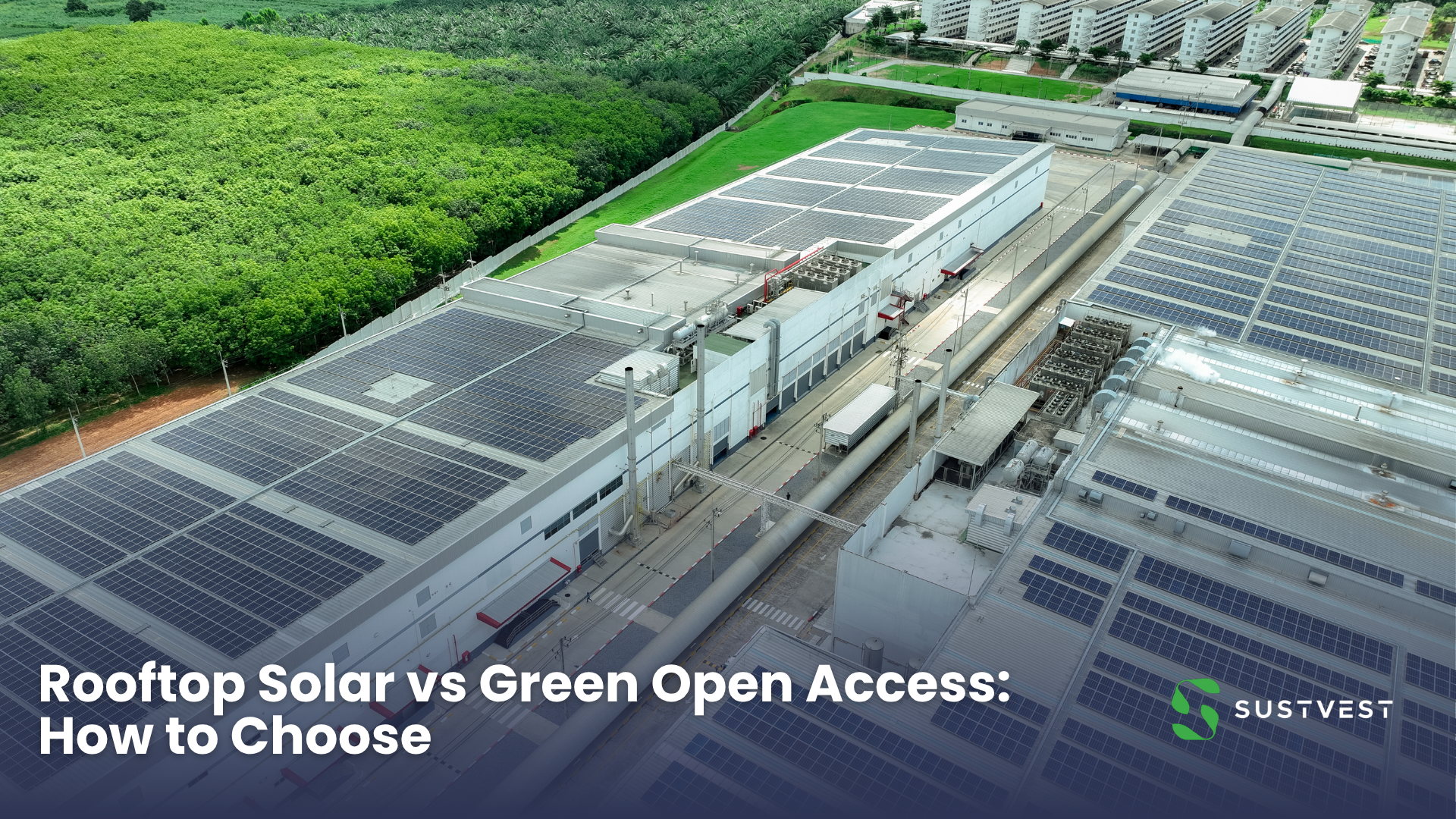
Rooftop Solar vs Green Open Access: How to Choose
If your business is serious about cutting energy costs and meeting renewable targets, you'll quickly run into two very different ways to buy solar power: putting panels on your own roof, or contracting for renewable power from a large off-site plant delivered through the grid — "green open access." They solve different problems, and a practical view among C&I energy buyers isn't that one beats the other — it's that most large consumers should understand both.
Rooftop solar generates power on your own premises and is consumed on site, avoiding the transmission and wheeling charges associated with procuring power through open access — but it's limited by your roof area. Green open access lets you buy renewable power from a large off-site plant through the grid, unlocking far greater scale, but it carries state-specific charges (wheeling, cross-subsidy surcharge, banking, and others) that can materially affect the landed cost. For many industrial consumers, a practical approach is not either/or: optimise rooftop solar for on-site daytime load first, then evaluate open access to cover the demand your roof can't meet.
Here's how the two compare, and how to decide.
What is the difference between rooftop solar and green open access?
The core difference is where the power is generated and how it reaches you. Rooftop solar is generated on your own building and consumed on site — for a behind-the-meter system, the solar generation is consumed at the facility rather than being wheeled to it through the public grid, so it avoids the transmission and wheeling charges associated with open access. Its ceiling is physical: your available shade-free roof area.
Green open access allows a consumer to procure renewable power from an off-site generating plant (often tens or hundreds of MW, typically in a high-irradiance area) and receive it through the state or central grid. The generating plant may be structured as a third-party, captive, or group-captive project. Because it uses the grid's wires, it attracts a stack of regulated charges, but it removes the physical roof-area constraint — although the amount a consumer can procure is still subject to applicable regulatory and network conditions.
Under the Ministry of Power's Green Energy Open Access Rules, 2022, the central eligibility threshold for green open access was lowered from 1 MW to 100 kW of contract demand or sanctioned load, opening the route to many mid-sized businesses that previously couldn't use it. State-level implementation and technical conditions can affect actual eligibility and access in practice, so state rules should be checked.
How do the costs of rooftop solar and open access compare?
Rooftop solar has a simpler cost structure; open access has a more complex one that varies heavily by state. With rooftop solar, because power is consumed where it's generated, you avoid the transmission and wheeling charges associated with open access — the economics come down to system cost (under CAPEX) or the PPA tariff (under OPEX) against your grid tariff, as we cover in our cost guide and OPEX vs CAPEX guide. (Rooftop consumers can still face demand charges, fixed charges, and other state-specific charges depending on their tariff category.)
Open access is different. The generation tariff may look attractive on its own, but the relevant number for a C&I consumer is the landed cost after applicable open-access charges and losses. A series of charges is added on top of the generation tariff before the power reaches your meter, which can include:
Transmission and wheeling charges — for using the grid's network to carry the power
Cross-subsidy surcharge (CSS) — compensating the DISCOM for the cross-subsidy revenue it loses when a C&I consumer leaves
Additional surcharge, where applicable — recovering the DISCOM's stranded fixed costs
Banking charges, where applicable — for carrying forward eligible surplus generation for later adjustment against consumption
Transmission and wheeling losses — deducted as a percentage of energy
Scheduling, SLDC, and system-operation charges
DSM / deviation charges — for imbalance against schedule
Standby or other state-specific charges, where applicable
Not every charge applies in every state or procurement structure. The applicable charge stack can materially increase the landed cost of open-access power, but the amount varies by state, procurement structure, project location, voltage level, and applicable regulatory orders.
This is why open access is fundamentally a state-by-state decision. The same contract that saves handsomely in one state can be uneconomic in another purely because of the charge structure. Any credible open-access proposal must model your specific state's current charges — not a national average.
What is group captive, and why does it matter for open access?
Group captive is a structure that can exempt a qualifying consumer from the cross-subsidy and additional surcharges — often two of the most consequential and variable charges. Under the Electricity Act and Rules, qualifying captive and group-captive arrangements can receive exemption from cross-subsidy surcharge and additional surcharge, subject to meeting the applicable captive-generation conditions and verification requirements.
In a group-captive arrangement, the consumer holds a qualifying equity stake in the generating plant and consumes a required share of its output, satisfying captive-use conditions. The current framework requires at least 26% ownership by captive users and at least 51% of aggregate electricity generated during the financial year to be consumed for captive use. For Association of Persons structures, the 2026 Rules provide for collective satisfaction of these thresholds, alongside specific limits on how much individual-user consumption can count toward the captive requirement. In states or consumer categories where CSS and additional surcharge are significant, the exemption available to qualifying captive structures can materially improve project economics — which is why group captive has become a prominent procurement structure for open access. The trade-off is greater structural and contractual complexity than a straightforward third-party PPA, so it needs careful evaluation. This is not legal or tax advice; the qualifying conditions should be confirmed with appropriate advisors.
2026 regulatory update: The Electricity (Amendment) Rules, 2026 clarified ownership and group structures, verification, and captive-consumption requirements — along with a mechanism under which, pending captive-status verification, cross-subsidy surcharge and additional surcharge are not levied where the prescribed declaration is submitted, becoming payable (with carrying cost) if captive status subsequently fails. Businesses evaluating group-captive open access should assess compliance under the current 2026 rules rather than relying on older captive structures or assumptions.
Which is better for an industrial consumer — rooftop or open access?
Neither is universally better; they suit different needs, and the strongest strategy often combines them. For many industrial consumers, a practical sequence is to optimise rooftop solar first, then evaluate green open access to cover the demand the roof can't meet.
The logic:
Rooftop first, because on-site solar avoids the transmission and wheeling charges of open access and directly offsets daytime grid consumption. For a facility with suitable roof area and strong daytime consumption, rooftop can often offer very attractive economics because the power is generated and consumed on site.
Open access for the residual, because for many industrial facilities, roof area limits how much of total electricity demand rooftop solar can cover. Open access unlocks the scale to cover the rest.
Storage where it fits, because as states tighten banking rules, pairing either route with battery storage can help manage surplus and peak demand — though whether it pays off is project-specific.
Rooftop tends to be the better starting point when you have adequate shade-free roof, steady daytime load, and want simplicity and on-site energy security. Open access can become particularly valuable when your demand far exceeds your roof's capacity, or when you're pursuing aggressive renewable or net-zero targets that rooftop alone can't reach — though other routes (green tariffs, renewable certificates, wind-solar hybrids) may also play a part.
What should a business check before choosing open access?
Because open access economics are state-specific and charge-driven, the modelling matters more than the headline tariff. Before committing, get clear answers on:
What is the all-in landed cost in my state — PPA tariff plus every applicable charge — versus my current grid tariff and my rooftop option?
Do group-captive or captive structures apply, and would they materially improve the economics by exempting CSS and additional surcharge?
What are the current wheeling, CSS, additional surcharge, and banking charges in my state, and how stable are they? These are revised by state regulators and can change the economics year to year.
How does the ISTS (inter-state transmission) charge position affect an inter-state contract versus an intra-state one? For qualifying renewable projects covered by the applicable ISTS framework, the ISTS waiver has been phased down in stages; projects commissioned between July 2026 and June 2027 are subject to 50% of applicable ISTS charges, with the share rising over subsequent windows — which affects inter-state economics.
What are the banking and scheduling rules, and do I need storage to manage them?
A credible developer or advisor will model all of this for your specific facility and state — because in open access, as the saying among buyers goes, the charges aren't a footnote to the decision, they are the decision.
The bottom line for industrial buyers
Rooftop solar and green open access aren't competitors so much as complementary tools for different parts of the same problem. Rooftop gives you renewable power generated and consumed on site, without the transmission and wheeling charges associated with open access; open access gives you the scale to go far beyond that, at the cost of navigating a state-specific charge structure. For most industrial consumers with meaningful renewable ambitions, the answer isn't choosing one — it's sequencing them: rooftop first for on-site load, open access for the residual, and storage where the economics support it. What matters most is modelling the real numbers for your state and your load, rather than reacting to a headline tariff.
SustVest builds rooftop solar under OPEX and CAPEX models — the on-site foundation of a sound renewable strategy — with in-house monitoring, O&M, and battery storage where it fits. Recognised by CRISIL Bridge to India among India's Top 10 Rooftop Solar Project Developers in its Solar Rooftop Map (December 2025), with 83+ projects delivered across 13+ states, we help you get the rooftop layer right first. Book a free site assessment to see how much of your load your roof can cover — and where to go from there.
Frequently Asked Questions
What is the difference between rooftop solar and green open access? Rooftop solar is generated on your own premises and consumed on site; for a behind-the-meter system, it avoids the transmission and wheeling charges associated with procuring power through open access, but it's limited by roof area. Green open access is renewable power bought from a large off-site plant and delivered through the grid, which unlocks far greater scale but attracts state-specific charges like wheeling, cross-subsidy surcharge, and banking.
Is rooftop solar or open access cheaper? It depends on your state and situation. Rooftop solar avoids the transmission and wheeling charges of open access, so rooftop power can be very cost-effective where you have suitable roof area and high self-consumption — but roof area limits how much you can generate. Open access can be economic at scale in low-charge states, but a heavy charge stack in some states can erode or eliminate the saving. Both should be modelled for your specific state and load.
Can a business use both rooftop solar and open access? Yes. Large C&I consumers can combine rooftop solar with open-access procurement where the regulatory and economic conditions support it. A common approach is to optimise rooftop solar first for on-site daytime load, then evaluate green open access to cover the remaining demand the roof can't meet.
What is the eligibility threshold for green open access? Under the Ministry of Power's Green Energy Open Access Rules, 2022, the central eligibility threshold was lowered from 1 MW to 100 kW of contract demand or sanctioned load, making the route accessible to many mid-sized businesses. State-level implementation and technical conditions can affect eligibility in practice, so state rules should be checked.
What is group captive in open access solar? Group captive is a structure where consumers hold a qualifying equity stake in the generating plant and consume a required share of its output, satisfying captive-use conditions. Qualifying captive and group-captive arrangements can be exempt from cross-subsidy and additional surcharges, which can improve open-access economics — particularly in high-charge states — subject to the applicable captive conditions and verification requirements, which were revised under the Electricity (Amendment) Rules, 2026.
Why do open access charges vary so much by state? Open-access charges are governed by a combination of central and state-level electricity regulations. State-level components such as wheeling, cross-subsidy surcharge, additional surcharge, and banking are determined under the applicable state regulatory framework and reflect that state's tariff structure and DISCOM finances. As a result, the same open-access contract can be highly economic in one state and marginal in another, which is why open access must be evaluated state by state.
Sources
Primary regulatory sources
Ministry of Power — Green Energy Open Access Rules, 2022 (100 kW threshold, approval timelines, banking provisions) and subsequent amendments
Electricity Act, 2003 and Electricity Rules (including the Electricity (Amendment) Rules, 2026) — captive and group-captive framework; CSS/additional-surcharge treatment
Ministry of Power / CERC — applicable ISTS regulations and orders, including the inter-state transmission-charge waiver phase-down
State Electricity Regulatory Commissions (SERCs) — state-specific wheeling, CSS, additional surcharge, and banking charges (must be checked per state)
Industry sources
Mercom India Research — market context and state-level open-access developments
CRISIL Bridge to India — rooftop-market data and SustVest recognition, where applicable
Company-specific claims
SustVest — rooftop solar delivery; 83+ projects, 13+ states, CRISIL Bridge to India Top-10 recognition (Dec 2025)
Also worth reading: Both net-metering and open-access C&I projects are affected by the December 31, 2026 ALMM deadline — the guide walks through what to check on your BoM, PPA, and interconnection timeline before the cut-off.