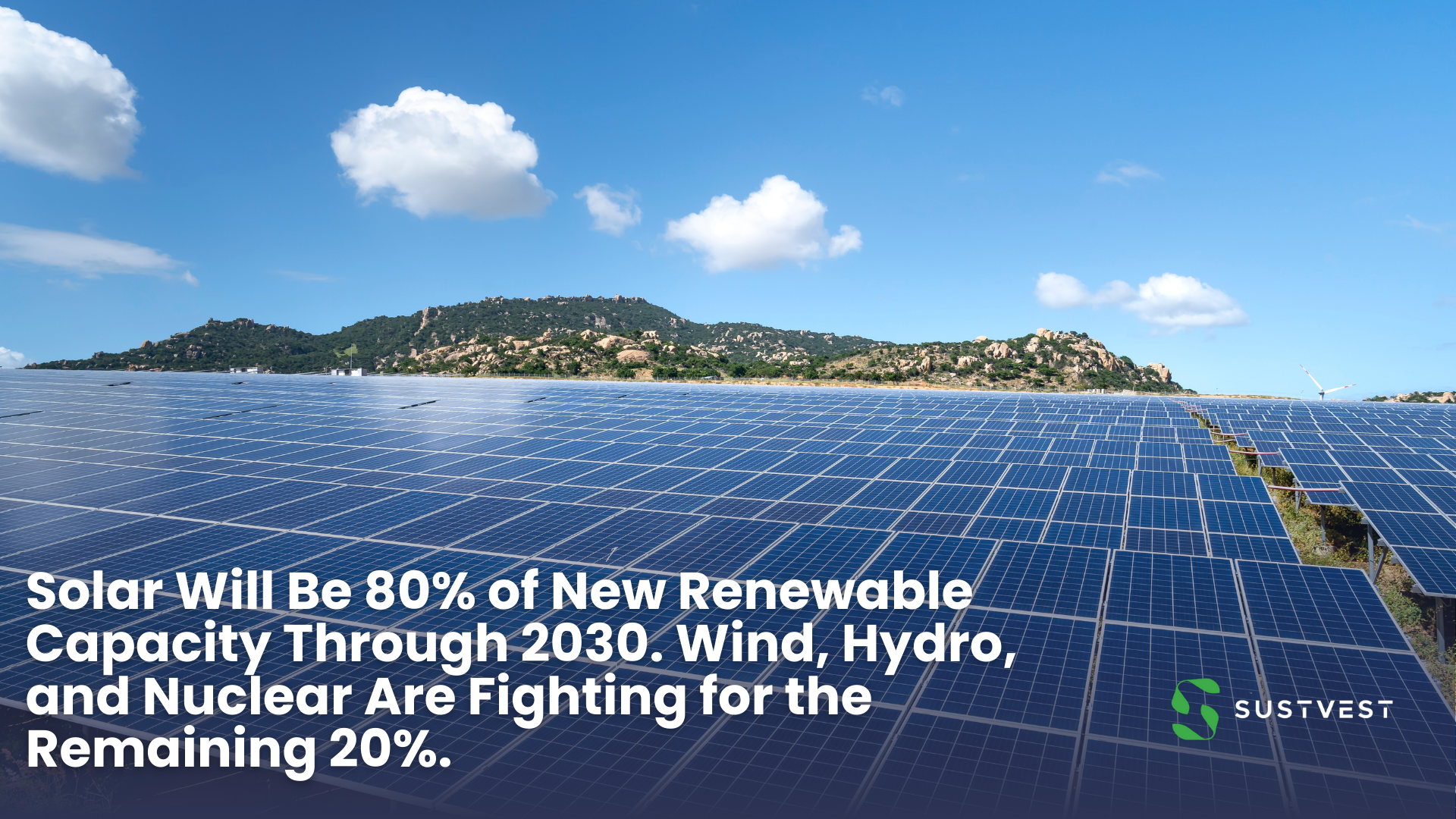
Solar Will Be 80% of New Renewable Capacity Through 2030. Wind, Hydro, and Nuclear Are Fighting for the Remaining 20%.
The International Energy Agency just settled the debate about which clean energy technology will dominate the next five years. According to their latest forecast, solar will account for 80% of all new renewable electricity capacity additions through 2030.
Not 40%. Not 50%. Eighty percent.
Wind power, hydroelectric, nuclear, and every other clean energy technology combined will compete for the remaining 20%. The renewable energy race isn't close anymore—solar has already won.
For investors still debating which clean technology to back, the IEA just gave you the answer. The question now isn't which technology. It's where to invest in the clear winner.
Why Solar Won
Solar's dominance through 2030 comes down to three factors the IEA identifies: lower costs, simpler permitting, and wide public acceptance.
Lower costs: Solar electricity generation has become remarkably cheap. More than 90% of new renewable projects now cost less than fossil fuel alternatives, according to industry analysis. This isn't about subsidies or mandates anymore—it's pure economics. When solar beats coal and natural gas on price, deployment accelerates regardless of political support.
Simpler permitting: Wind turbines face height restrictions, noise complaints, and visual impact objections. Nuclear requires decade-long regulatory processes and public safety debates. Hydroelectric alters river ecosystems and displaces communities. Solar faces fewer regulatory barriers. Panels on rooftops or in open land encounter less organized opposition than 500-foot wind turbines or nuclear cooling towers.
Wide acceptance: Public polling consistently shows strong support for solar energy across political spectrums. Even in regions skeptical of climate policy, solar installations proceed with minimal controversy. The technology is familiar, visually unobtrusive, and doesn't trigger the same concerns as other energy infrastructure.
These advantages compound. Lower costs attract more investment. More investment drives further cost reductions through manufacturing scale and learning curves. Simpler permitting means projects complete faster, generating returns sooner and encouraging additional development. Wide acceptance means projects face less political risk over their 25-year operational lives.
The result: solar becomes the default choice for new electricity generation globally.
The Numbers Tell the Story
Battery storage costs have fallen dramatically—down 2-3X in just 2-3 years according to recent industry data. This makes solar-plus-storage combinations economically competitive with fossil fuel plants that can dispatch power on demand.
That combination changes everything. The primary criticism of solar—that it only generates during daylight—evaporates when paired with affordable storage. A solar farm with 4-6 hours of battery storage can deliver electricity during peak evening demand when prices are highest. That's not intermittent renewable energy anymore. That's dispatchable power from a clean source.
Renewable energy additions are now eclipsing total electricity demand growth in many markets. This creates the "oversupply" headlines that worry some investors. But market dynamics reveal opportunity rather than crisis. When renewable generation exceeds immediate demand, electricity prices drop—creating economic incentive for energy storage, industrial load shifting, and hydrogen production. Each of these responses creates new revenue opportunities for renewable projects.
Solar's 80% share of renewable growth through 2030 represents roughly 4,500-5,000 gigawatts of cumulative additions over the five-year period, though exact projections vary by scenario. To put that in perspective, global solar capacity was roughly 1,200 GW at the end of 2023. The industry will add 3-4 times current total capacity in just five years.
What About the Other 20%?
Wind, hydroelectric, nuclear, and other technologies aren't disappearing. They're just not growing as fast as solar.
Wind power continues expanding, particularly offshore wind in Europe and Asia. The technology complements solar—wind often generates more strongly during evening hours and winter months when solar output declines. But wind faces challenges solar avoids: longer development timelines, height restrictions in populated areas, and blade transportation logistics limiting inland deployment.
Hydroelectric provides reliable baseload power and energy storage through pumped hydro systems. But most economically viable dam sites in developed countries are already built. New large hydro projects face environmental concerns about ecosystem disruption and population displacement that make permitting difficult.
Nuclear generates carbon-free electricity consistently regardless of weather. Recent small modular reactor designs promise faster deployment than traditional gigawatt-scale plants. Yet nuclear still requires extensive regulatory oversight, faces public safety concerns despite strong safety records, and involves long construction timelines. The technology works, but it doesn't scale as rapidly as solar.
These technologies serve important roles in comprehensive energy systems. Geographic diversity, seasonal balancing, and grid stability benefit from technology diversity. But investment dollars follow growth, and growth follows solar.
The Geographic Story
Solar's 80% dominance isn't evenly distributed globally. Some markets will exceed that figure; others will fall below.
Regions with excellent solar resources, affordable land, and supportive policies will capture disproportionate share of deployment. India exemplifies this dynamic—exceptional sunlight, domestic manufacturing capacity, clear policy frameworks, and enormous electricity demand growth. The country is adding tens of gigawatts of solar capacity annually while wind additions grow more slowly.
The United States faces mixed conditions. Southwestern states with high irradiance see aggressive solar deployment. Political headwinds at federal level matter less when economics strongly favor solar. California, Texas, and Nevada continue adding massive capacity regardless of federal policy changes.
Europe's northern latitudes offer less favorable solar resources but still see substantial deployment. Germany, despite moderate sunlight, has built enormous solar capacity through strong policy support and public acceptance. Southern European nations like Spain and Italy possess excellent resources and increasingly attractive investment returns.
China dominates absolute capacity additions, though exact figures vary by source. The country's manufacturing dominance in solar panels, inverters, and related equipment creates strong domestic deployment incentives. Chinese solar additions alone likely represent 40-50% of global growth.
Emerging markets in Southeast Asia, Middle East, and Latin America offer compelling investment opportunities. These regions combine high solar irradiance with rapidly growing electricity demand and improving policy frameworks. Investment returns in these markets often exceed developed market returns by 3-5 percentage points for similar-quality projects.
What This Means for Investors
The IEA forecasting solar at 80% of renewable additions through 2030 provides rare clarity in energy markets typically characterized by uncertainty.
First, concentrate capital on solar rather than diversifying equally across all clean technologies. Diversification makes sense when outcomes are uncertain. When authoritative forecasts indicate one technology will capture 80% of growth, concentration on that technology aligns capital with market reality.
Second, focus on geographies offering best combination of solar resources and market dynamics. Not all solar investments generate equal returns. Projects in regions with high irradiance, supportive policies, and growing electricity demand outperform projects in marginal locations regardless of technology quality.
Third, recognize that solar-plus-storage represents the evolved opportunity. Vanilla solar projects face increasing revenue compression in markets with high penetration. Projects combining solar generation with battery storage command premium economics by delivering dispatchable power rather than intermittent generation.
Fourth, understand that execution matters more than ever. When technology choice is clear and markets are growing rapidly, differentiation comes from execution quality. Developers who can navigate permitting, secure favorable PPAs, and deliver projects on time and budget capture superior returns. Investors should evaluate execution capability, not just project economics.
Fifth, view market "oversupply" as feature, not bug. Headlines about falling electricity prices due to renewable oversupply worry some investors. But oversupply creates demand for storage, grid flexibility, and industrial load that can shift timing. Each response creates investment opportunities for infrastructure that solves the oversupply challenge.
The Risk Everyone's Watching
Solar's dominance creates concentration risk that prudent investors should acknowledge. When 80% of renewable investment flows to one technology, sector-specific challenges affect the entire market.
Supply chain disruptions matter more when one technology dominates. Solar manufacturing concentrates in specific regions, creating geopolitical risk if trade relationships deteriorate. The industry has faced polysilicon shortages, glass supply constraints, and logistics bottlenecks that delayed projects and inflated costs.
Technology evolution could disrupt existing infrastructure. Perovskite solar cells, bifacial modules, and other innovations promise higher efficiency at lower cost. Projects financed today using current technology might face economic obsolescence if next-generation technology achieves dramatic cost improvements. Though this risk applies to any technology investment, concentration amplifies its impact.
Policy changes in key markets could slow deployment dramatically. While solar economics increasingly work without subsidies, government policy still influences deployment pace through permitting rules, grid access, and indirect incentives. Adverse policy shifts in major markets like United States, China, or European Union would ripple globally.
Grid integration challenges grow as solar penetration increases. When solar represents small fraction of electricity generation, grid operators easily accommodate variability. At 30-40% penetration, managing midday oversupply and evening shortfalls requires substantial infrastructure investment. Some markets may hit integration limits constraining further solar additions until storage and transmission catch up.
These risks are manageable but real. Investors should construct portfolios with geographic diversification, technology diversity where economic, and awareness of grid integration constraints in target markets.
Why This Matters Beyond Returns
Solar capturing 80% of renewable growth has implications beyond investment portfolios. It shapes geopolitics, industrial policy, and economic development.
Manufacturing dominance in solar equipment translates to industrial employment and export revenue. Countries leading solar manufacturing gain economic leverage comparable to oil producers in previous eras. The difference: solar manufacturing scales through technology and capacity rather than geological accident.
Energy independence becomes achievable for nations with limited fossil fuel resources. Japan, South Korea, and European nations historically dependent on energy imports can generate electricity domestically using solar. This shifts geopolitical power dynamics and reduces energy trade deficits.
Electricity costs decline in regions with strong solar deployment, improving industrial competitiveness. Lower energy costs attract manufacturing, data centers, and energy-intensive industries. Economic development follows affordable, reliable electricity.
Climate goals become economically aligned with development goals. When solar provides cheapest electricity while reducing emissions, countries don't face tension between climate commitments and economic growth. They advance both simultaneously.
The Bottom Line: Follow the 80%
The International Energy Agency doesn't forecast lightly. When they project solar will capture 80% of renewable capacity growth through 2030, it reflects comprehensive analysis of costs, policies, resources, and deployment trends across dozens of countries.
For investors, this clarity is rare and valuable. Energy technology debates that consumed years of analysis and divided expert opinions are resolved. Solar won not through mandates or subsidies, but through economic superiority, deployment simplicity, and public acceptance.
Wind, hydro, nuclear, and other technologies serve important roles. They provide geographic diversity, seasonal balancing, and grid stability. But 80% of capital deployment, 80% of capacity additions, and 80% of market growth flows to solar through 2030.
Investment strategy should reflect that reality. Concentrate capital where growth is concentrated. Focus on geographies offering best solar resources and market conditions. Prioritize solar-plus-storage projects providing dispatchable power. Evaluate execution capability of developers and operators.
The renewable energy race is over. Solar won. The remaining question is whether you'll invest in the winner before everyone else reaches the same conclusion, or wait until consensus forms and returns compress.
When credible forecasts identify one technology capturing 80% of market growth, investors have two choices: follow the data or fight it. History suggests following the data generates better outcomes.
About Sustvest: Sustvest provides US accredited investors with access to solar infrastructure through SEC Regulation D offerings. When the International Energy Agency forecasts solar will capture 80% of renewable growth through 2030, it validates what we've known: solar is the technology winner based on economics, not hopes. Our focus on India solar projects delivering 10-12% leveraged IRRs positions investors in markets with exceptional solar resources (5.5-7.0 kWh/m²/day), supportive policy frameworks, and massive electricity demand growth. We handle cross-border complexity—FEMA compliance, currency management, project oversight—so you invest where 80% of growth is happening with resources better than most developed markets.
Ready to invest in the technology capturing 80% of renewable growth? Schedule a consultation to discuss why IEA's forecast matters for portfolio construction, which geographies offer best solar returns, and how solar-plus-storage projects capture premium economics as markets mature.
Investment Disclosure: Renewable energy infrastructure investments involve risks including execution risk, offtaker credit risk, technology risk, regulatory changes, illiquidity, and potential loss of principal. International investments involve additional risks including currency fluctuation and political instability. IEA forecasts represent projections based on current trends and may not materialize as predicted. Solar technology dominance does not guarantee individual project success or investment returns. Market concentration in solar creates sector-specific risks. This content is for informational purposes only and does not constitute investment advice. IEA data cited for informational purposes; Sustvest has no affiliation with IEA. Consult qualified legal, tax, and financial advisors before making investment decisions.
SEO Keywords: solar 80% renewable growth, IEA solar forecast 2030, solar vs wind investment 2026, why solar dominates renewable energy, solar infrastructure investment opportunity, renewable energy capacity additions, solar power market share, clean energy technology winner, solar investment strategy 2026, solar plus storage investment, renewable energy portfolio construction, solar economic superiority, IEA renewable energy forecast