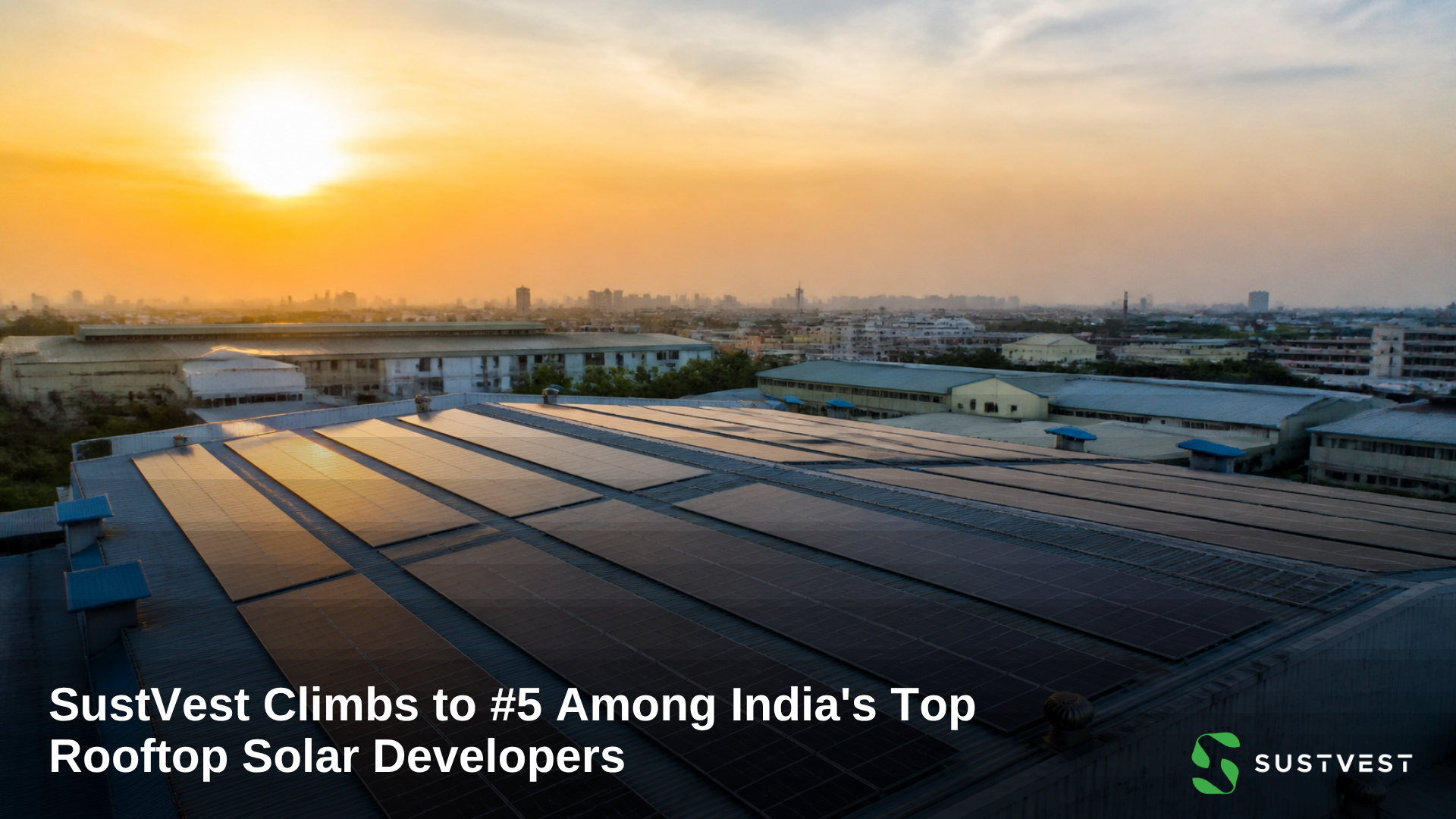
India's Top Rooftop Solar Developers 2026: SustVest Climbs to #5
SustVest is now ranked #5 among India's Top 10 rooftop solar project developers in the Crisil Bridge to India Solar Rooftop Map (June 2026). In the previous edition, released for December 2025, SustVest was ranked #8.
That is a climb of three places in six months, in one of the fastest growing segments of India's energy market.
In this post, we explain what the ranking measures, what is happening in India's rooftop solar market right now, and what it all means if you run a factory, a hospital, a campus or a housing society and are thinking about solar.
What did the Crisil Bridge to India June 2026 report say about SustVest?
Short answer: SustVest is ranked #5 in the Top 10 rooftop solar project developers in India, up from #8 in the December 2025 report.
Crisil Bridge to India is the clean energy research arm of Crisil, a company of S&P Global. Its India Solar Rooftop Map is published twice a year and is one of the most closely followed references on who is building rooftop solar in India.
Here is where SustVest stands today:
| Metric | SustVest |
|---|---|
| Rank in Top 10 rooftop project developers (June 2026) | #5 |
| Rank in previous edition (December 2025) | #8 |
| Total installed capacity | 30 MW+ |
| Solar plants | 80+ |
| States | 13 |
| Solar assets under management | ~₹100 crore |
SustVest builds rooftop solar for businesses and institutions under two models: OPEX (also called RESCO, where SustVest owns the plant and the customer pays for the power) and CAPEX/EPC (where the customer owns the plant and SustVest designs and builds it).
How are rooftop solar developers ranked in India?
Short answer: The Crisil Bridge to India ranking of project developers is based on capacity installed during the year.
This matters because it is a ranking of work that is already done. It does not count:
- Projects that are only announced
- Signed agreements that are not yet built
- Pipeline or tenders won but not executed
A plant only counts once it is installed. Behind every megawatt (MW) in the ranking is a site survey, a structural check of the roof, a design, a DISCOM (power distribution company) approval, procurement, installation and commissioning.
That is also why rankings can move quickly. A developer that keeps executing through the year can climb, and one that slows down can drop, even if both have large pipelines.
For SustVest, the move from #8 to #5 reflects plants that were built and switched on during the reporting period.
What is happening in India's rooftop solar market in 2026?
Short answer: Rooftop solar in India is growing at record speed, but most of the new capacity is on homes, not on businesses.
According to Mercom India Research's Q2 and 1H 2026 rooftop solar report:
- India added 6.6 GW of rooftop solar in the first half (1H) of 2026, up 131% from 2.8 GW in 1H 2025
- Q2 2026 alone added 3.8 GW, up 136% year on year and 39% over Q1 2026
- Rooftop made up 33% of all solar installed in India in Q2 2026
- About 4.5 million households had rooftop solar by June 2026, roughly 45% of the PM Surya Ghar target of 10 million homes
The split by customer type tells the real story. In Q2 2026:
| Segment | Share of new rooftop capacity |
|---|---|
| Residential (homes) | 84% |
| Industrial | 10% |
| Commercial | 5% |
| Government | 1% |
So while the overall market is booming, C&I (commercial and industrial) rooftop solar is a much smaller slice of new capacity today. Mercom links this partly to the fast growth of home installations under PM Surya Ghar, the government's rooftop subsidy scheme, and partly to uncertainty over module rules and rising prices of DCR (domestic content requirement) modules, which led some businesses to delay decisions.
The outlook for businesses is mixed but positive. Mercom expects commercial installations to grow significantly as higher grid tariffs improve savings. Industrial customers face some short-term hurdles, including stricter connectivity and net metering rules in some states.
For context, the Crisil Bridge to India June 2025 map reported that India added 7,117 MW of rooftop solar in the year ending June 2025. The market has kept accelerating since.
Why is rooftop solar for businesses different from home rooftop solar?
Short answer: Business rooftops are bigger, the savings are bigger, and the cost of a poorly built plant is much higher.
A home system is usually a few kilowatts (kW). A business plant is often hundreds of kW. That changes almost everything:
- Roofs are complex. Metal sheds, RCC (concrete) roofs, old structures, skylights and equipment all affect design. Some roofs need structural strengthening before panels go up.
- Approvals are tougher. Larger plants need DISCOM approvals, net metering or zero-export setups, and in some cases safety inspections. Rules differ from state to state.
- Power use is different. A factory running three shifts and a college that is busy only in the day need very different plant sizes and setups.
- Downtime costs money. If a business plant underperforms, the customer loses savings every single month. A fault that goes unnoticed for weeks adds up fast.
This is why choosing the right developer matters more for a business than for a home. The plant has to work, every day, for many years.
How does the OPEX (RESCO) model work for businesses?
Short answer: The developer builds, owns and maintains the plant. The business pays nothing upfront and pays only for the solar units it uses.
Many SustVest plants run on the OPEX model, also called RESCO (renewable energy service company). Here is how it works:
- Zero upfront cost. SustVest invests in the plant. The customer does not spend capital.
- Pay per unit. The customer signs a long-term PPA (power purchase agreement) and pays a fixed rate for every unit (kWh) the plant generates. This rate is usually lower than the grid tariff.
- Developer owns and maintains. SustVest handles design, approvals, installation, monitoring, cleaning and repairs for the length of the agreement.
- Savings from month one. Because there is no upfront spend, the customer starts saving from the first bill after commissioning.
The key point: under OPEX, the developer only earns when the plant generates. If the plant underperforms, the developer loses revenue. That puts the performance risk on the developer, not the customer.
For businesses that would rather spend capital on their core operations, OPEX is often the simplest way to cut power costs without taking on a new asset.
Businesses that prefer to own the plant can choose the CAPEX model instead, where SustVest acts as the EPC (engineering, procurement and construction) partner and hands over the plant.
What should a business look for in a rooftop solar developer?
Short answer: Look at track record, financial strength, execution capability and how the plant will be maintained over its life.
An OPEX agreement is a long relationship, often 15 to 25 years. Even a CAPEX plant needs years of reliable service. Before signing, ask:
1. Has this developer actually built at scale?
Independent rankings like the Crisil Bridge to India Top 10 are useful because they are based on installed capacity, not marketing claims. Ask for a list of live plants and references you can call.
2. Is the developer financially strong?
Under OPEX, the developer funds the plant. Check who backs them. SustVest is backed by investors including Antler, WEH Ventures, Inflection Point Ventures, Anthill Ventures, DLF Family Office and Nikhil Kamath, and manages around ₹100 crore of solar assets.
3. Who does the actual work?
Many developers outsource design and construction. Over the last year, SustVest built its own in-house EPC and procurement team, so design, sourcing, installation and maintenance stay under one roof.
4. How will the plant be monitored?
Ask how the developer will know if your plant is underperforming, and how fast they will fix it. SustVest tracks its plants on its own monitoring platform, with project managers responsible for each site.
5. What happens in year 10, or year 20?
Ask about maintenance schedules, inverter replacement, insurance and what the agreement says about generation. A good developer will have clear answers.
Is now a good time for businesses to go solar?
Short answer: For many businesses, the next few months look like a good window, though every site is different.
A few factors are worth weighing:
- Grid tariffs are rising. Mercom expects higher grid tariffs to improve savings for commercial customers, which strengthens the case for solar.
- The ALMM deadline is close. India is moving through an ALMM (Approved List of Models and Manufacturers) transition for solar modules. 31 December 2026 is a key commissioning deadline. Mercom notes that projects that have to switch to DCR modules could face much higher costs. Since this is a commissioning deadline, not a signing deadline, a plant has to be installed and running, not just agreed.
- Rooftop plants are quick to build. A typical rooftop plant takes around 3 to 4 months to install, compared with roughly 8 to 14 months for open access projects (solar farms located away from the customer's site). That makes rooftop one of the few options that can still realistically be commissioned on a short timeline.
- No capital needed under OPEX. Businesses can lock in lower power costs without waiting for budget approvals for a capital project.
Rules, tariffs and timelines vary by state and by site, so the right answer depends on your roof, your power use and your DISCOM. A site assessment is the best way to find out.
Frequently Asked Questions
What rank is SustVest in the Crisil Bridge to India rooftop solar report?
SustVest is ranked #5 among the Top 10 rooftop solar project developers in India in the Crisil Bridge to India Solar Rooftop Map, June 2026. It was ranked #8 in the December 2025 edition.
How does Crisil Bridge to India rank rooftop solar developers?
The Top 10 project developer ranking is based on rooftop solar capacity installed during the year. It counts plants that are built and installed, not announced projects or pipeline.
What is the OPEX or RESCO model in rooftop solar?
Under the OPEX (RESCO) model, the developer invests in, owns and maintains the solar plant on the customer's roof. The customer pays nothing upfront and pays a fixed rate for each unit of solar power the plant generates, usually lower than the grid tariff.
How much rooftop solar did India add in 2026?
According to Mercom India Research, India added 6.6 GW of rooftop solar in the first half of 2026, up 131% from 2.8 GW in the first half of 2025.
How big is SustVest?
SustVest has 30 MW+ of installed solar capacity across 80+ plants in 13 Indian states, with around ₹100 crore of solar assets under management.
About SustVest
SustVest (SolarGridX Ventures Private Limited) is a rooftop solar developer ranked #5 among India's Top 10 rooftop solar project developers by Crisil Bridge to India (June 2026). SustVest designs, builds, owns and maintains solar plants for factories, commercial buildings, hospitals, educational campuses and housing societies under OPEX (RESCO) and CAPEX/EPC models.
With 30 MW+ installed across 80+ plants in 13 states, an in-house EPC and procurement team, and its own plant monitoring platform, SustVest helps businesses cut power costs with little or no upfront investment. The company is backed by Antler, WEH Ventures, Inflection Point Ventures, Anthill Ventures, DLF Family Office and Nikhil Kamath.
Want to know what rooftop solar could save your business? Get a free site assessment at sustvest.com
Sources
- Crisil Bridge to India, India Solar Rooftop Map, June 2026 (Top 10 rooftop project developers, ranked on capacity installed in the year). About Crisil Bridge to India
- Crisil Bridge to India, India Solar Rooftop Map, December 2025 (SustVest ranked #8)
- Mercom India, India Added 6.6 GW of Rooftop Solar Capacity in 1H 2026
- Mercom India, Q2 and 1H 2026 India Rooftop Solar Market Report
- SolarQuarter, Solis Ranks No.1 in India's Rooftop Solar Inverter Market (citing the Crisil Bridge to India Rooftop Map, June 2025: 7,117 MW added in the year ending June 2025)