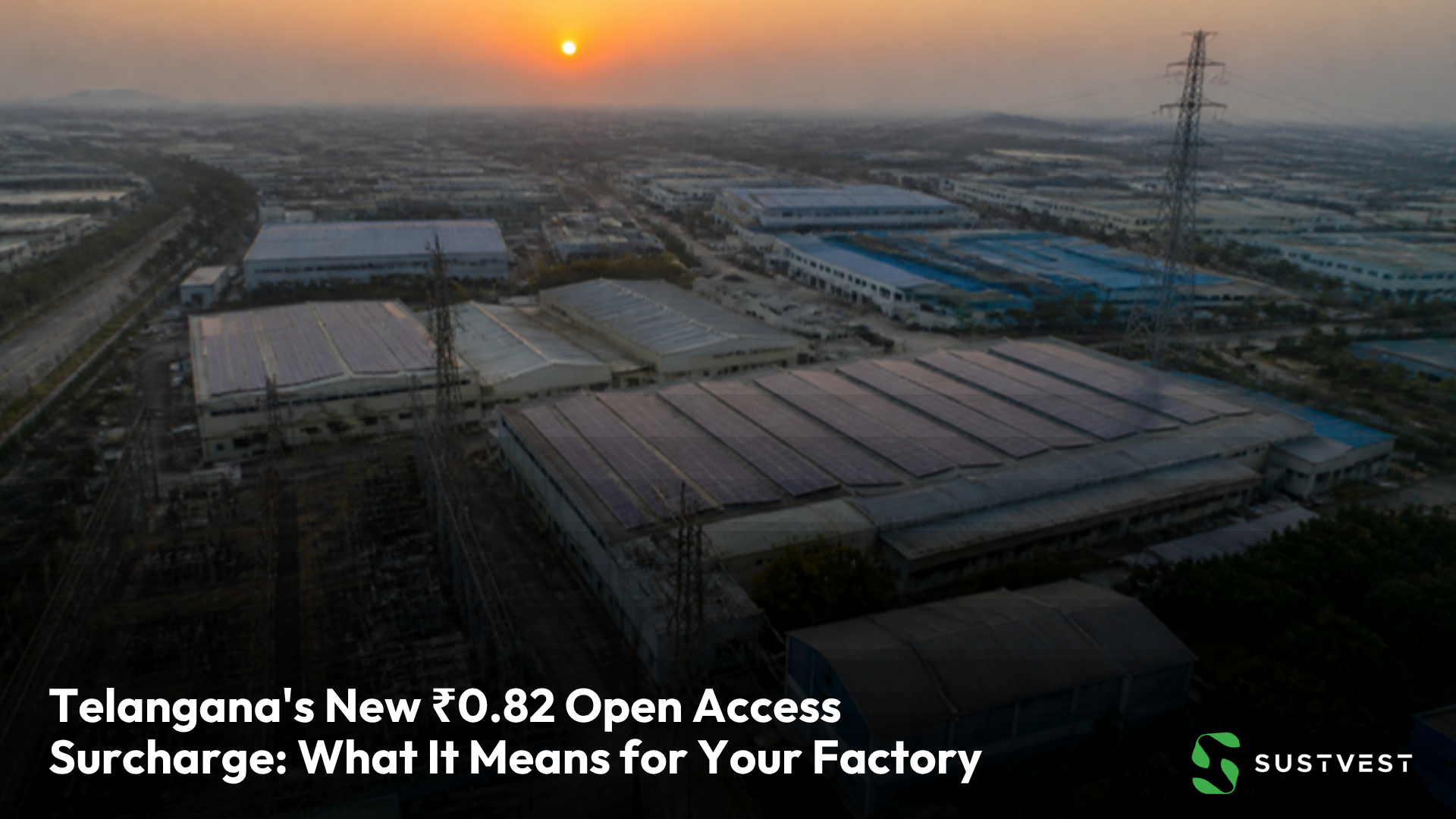
Telangana's New ₹0.82 Open Access Surcharge: What It Means for Your Factory
Buying solar through open access in Telangana just got more expensive. From 1 November 2026 to 31 March 2027, open access consumers pay an additional surcharge of ₹0.82 on every unit. Rooftop solar under net or gross metering does not pay it.
That one difference is worth a fresh look at your power plan. Here is what changed, what it adds to your bill, and how to decide what to do next.
What did Telangana's regulator decide on open access?
The Telangana Electricity Regulatory Commission (TGERC) approved an additional surcharge of ₹0.82 per kWh (one unit of electricity) on open access consumers for November 2026 to March 2027. The order came on petitions from Telangana's two state distribution companies, and SolarQuarter reported it on 3 November 2026.
Open access means buying power from a generator of your choice and using the discom's (distribution company's) wires to bring it to your plant. An additional surcharge is a fee that repays the discom for power it contracted but no longer sells to you.
Three details from the order matter:
- It covers five months. The regulator refused to allow recovery for October 2026 because the discoms filed their petitions late.
- Industry objected. Five stakeholder groups filed views, arguing that the rise is significant and that the surcharge should fall over time.
- It is temporary on paper. The period ends on 31 March 2027. A fresh order for the next period is likely, so plan for a moving number rather than a fixed one.
How did the regulator arrive at ₹0.82?
The number is roughly the discoms' stranded fixed costs divided by open access sales. The regulator allowed ₹77.07 crore of net stranded fixed charges and spread it across 936.26 million units of chargeable open access sales, which works out to about ₹0.82 per unit.
The regulator attributed 282.56 MW of stranded capacity to open access consumers, out of 11,431.77 MW of long-term power purchase capacity. That is about 2.5% of the total. It assessed this over 17,472 fifteen-minute time blocks.
Why should a plant head care about the formula? Because it shows the direction of risk. The surcharge depends on how much capacity discoms hold and how much load leaves them. As more consumers move to open access, this kind of charge is unlikely to disappear on its own.
How much will this add to my power cost?
If you buy 10 lakh units a month through open access, the surcharge adds ₹8.2 lakh a month, or ₹41 lakh over the five months. Scale that to your own volume: every lakh units costs ₹82,000 more.
The surcharge also sits on top of the cross-subsidy surcharge (CSS), a separate fee that compensates discoms for losing high-paying customers. Telangana's FY 2026-27 tariff schedule sets CSS for HT (high tension) industry at ₹1.98 to ₹1.99 per unit at 11 kV and ₹1.73 to ₹1.79 at 33 kV, depending on the discom.
Here is a simple illustration for an 11 kV HT industrial consumer in the southern discom's area, on third-party open access. It uses the national open access PPA (power purchase agreement) benchmark of ₹3.0 to ₹3.5. Your quotes will differ.
| Cost per unit | Open access (third party) | Rooftop on RESCO tariff |
|---|---|---|
| Solar tariff | ₹3.00 to ₹3.50 | ₹3.50 to ₹5.50 |
| Cross-subsidy surcharge | ₹1.98 | Nil |
| Additional surcharge | ₹0.82 | Nil |
| Wheeling and losses | Extra, varies | Nil |
| Total before other costs | ₹5.80 to ₹6.30, plus wheeling and losses | ₹3.50 to ₹5.50 |
RESCO means Renewable Energy Service Company: a developer funds and owns the plant on your roof, and you pay only for the units you use. The rooftop range above is a national benchmark. Its figures for neighbouring Karnataka (₹3.5 to ₹4.5) and Tamil Nadu (₹3.3 to ₹4.3) sit in the lower half.
What is my grid power really worth during solar hours?
At 11 kV, HT industry in Telangana pays about ₹7.15 per unit during solar hours, not the headline ₹7.65. The tariff schedule gives a ₹0.50 rebate from 10 am to 6 pm and adds ₹1.50 from 6 am to 10 am and from 6 pm to 10 pm.
This is the number to compare against, since solar mostly displaces daytime units. At 33 kV, the same maths gives ₹6.65.
Now the picture gets sharper at 11 kV:
- Third-party open access: the gap to ₹7.15 is about ₹0.85 to ₹1.35 per unit, before wheeling and losses.
- Rooftop at the national RESCO benchmark: the gap is about ₹1.65 to ₹3.65 per unit.
This does not mean open access is a bad deal. It means the margin for third-party open access at 11 kV is now thin enough that you should recheck it with real quotes and your actual charges.
Does rooftop solar in Telangana pay this surcharge?
No. Under TGERC's 2025 rooftop regulation, net and gross metering consumers do not pay banking, wheeling, cross-subsidy or additional surcharges. That is how Power Peak Digest reported the regulation, which took effect on 15 November 2025. Group and virtual net metering work differently, and wheeling charges apply there.
Know the limits before you size a plant:
- Net metering: up to 500 kWp (kilowatt peak, the plant's rated capacity).
- Gross metering: up to 1 MWp.
- Sanctioned load: industrial and commercial users are limited to 80% of sanctioned load.
- Local grid: a 50% cap applies at the feeder or transformer level, so nearby solar can affect your approval.
- Surplus units: if monthly export exceeds import, the difference is settled at the lowest solar tariff the state's discoms discovered in the previous financial year. Oversizing for export is rarely the point. Size for your own daytime use.
- Approvals: the HT application fee is ₹15,000, and systems above 56 kWp need certification by the Chief Electrical Inspector.
Are captive and group captive projects exempt?
Generally they are exempt from CSS and, in most states, from the additional surcharge, but check this for Telangana before you rely on it. Sun Wave's state comparison states the general rule under Section 42 of the Electricity Act, 2003. The report on the Telangana order does not list any exemptions, so ask your lawyer or consultant to read the order itself.
Group captive means you hold at least 26% equity in the generating project and consume at least 51% of its output, under Rule 3 of the Electricity Rules, 2005. Failing those tests can bring the charges back, so treat them as a yearly compliance job and not a one-time box.
Is this only a Telangana story?
No. Additional surcharges differ widely by state, and they can move every few months. Gujarat raised its surcharge by about 30.3% to ₹0.99 per unit for October 2026 to March 2027.
| State | Additional surcharge (₹ per unit, HT third-party open access) |
|---|---|
| Haryana | ₹1.37, plus ₹0.45 network charge |
| Madhya Pradesh | ₹1.18 (outside contract demand) |
| Gujarat | ₹0.99 (October 2026 to March 2027) |
| Telangana | ₹0.82 (November 2026 to March 2027) |
| Rajasthan | ₹0.50 |
| Karnataka | ₹0.40 |
| Maharashtra | Not levied |
Source: Sun Wave comparison, last verified 27 October 2026, plus the Telangana report above. Confirm against the current order in your state.
Charges are also only part of the cost. Mercom found that nine of 13 states saw higher landed solar costs in Q2 2026, as rising PPA tariffs outweighed lower open access charges.
Operating risk matters too. On 30 October 2026, Haryana's regulator dismissed a petition by ASK Automotive and CMES Power 2, holding that the consumer's overdrawal and the generator's under-injection can each attract separate charges. Rooftop plants sit behind your meter, so they avoid this kind of scheduling dispute on the units you consume directly.
Should I still consider open access?
Yes, if your load is much larger than your roof. Open access still has a real role, and it is growing. India added nearly 6 GW of solar open access in the first half of 2026, up 42% from a year earlier, taking the total to 36 GW.
The International Energy Agency also expects distributed solar to grow faster, with utility-scale's share of additions falling from about 75% to about 70% by 2030.
The sensible order for most plants looks like this:
- Fill the roof first. It carries the fewest grid charges and needs no scheduling.
- Size to daytime demand, within the 80% sanctioned load limit and the metering caps.
- Use open access for the remaining load, after a full landed-cost check that includes every charge.
- Stress test the deal. Ask what happens to your savings if the additional surcharge doubles or the structure loses captive status.
- Read the change-in-law clause. Find out who bears new charges during a long contract.
FAQ
When does Telangana's ₹0.82 surcharge apply?
From 1 November 2026 to 31 March 2027. The regulator did not allow recovery for October 2026.
Who collects it, and why?
Telangana's two state discoms petitioned for it to recover fixed costs of power purchase commitments that became stranded when consumers shifted to open access.
Does a rooftop plant under net metering pay it?
No. Telangana's 2025 rooftop regulation, as reported, exempts net and gross metering consumers from banking, wheeling, cross-subsidy and additional surcharges.
What is the maximum rooftop size under net metering in Telangana?
Up to 500 kWp under net metering and up to 1 MWp under gross metering. Industrial and commercial users are limited to 80% of sanctioned load.
Can I go solar with no upfront cost?
Yes, through the OPEX or RESCO model. A developer funds, builds and maintains the plant on your roof, and you pay a per-unit tariff.
About SustVest
SustVest (SolarGridX Ventures Pvt Ltd) is a CRISIL Top-10 rooftop solar developer in India (#5, 2026), running 80+ distributed solar plants (about 30 MW) across 13 states for commercial and industrial clients. Under its OPEX model, SustVest funds, builds, owns and maintains the rooftop plant, so you pay a lower per-unit tariff with zero upfront cost. To check what your roof could save, visit sustvest.com.
Sources
- SolarQuarter: Telangana approves ₹0.82/kWh additional surcharge (3 November 2026)
- Telangana retail supply tariff schedule and cross-subsidy surcharge, FY 2026-27
- Power Peak Digest: TGERC's new rooftop solar regulation (18 November 2025)
- SolarQuarter: HERC upholds overdrawal and deviation charges (3 November 2026)
- Mercom India: Gujarat hikes additional surcharge to ₹0.99/kWh (15 September 2026)
- Mercom India: Rising PPA tariffs erase gains from lower open access charges (9 September 2026)
- Mercom India: Solar open access capacity up 6 GW in 1H 2026 (20 August 2026)
- Saur Energy: IEA on open access and rooftop solar (3 November 2026)
- Sun Wave Technologies: Solar open access charges by state, FY 2026-27
- Sun Wave Technologies: Solar PPA rates and tariffs in India
- SurgePV: India open access solar guide