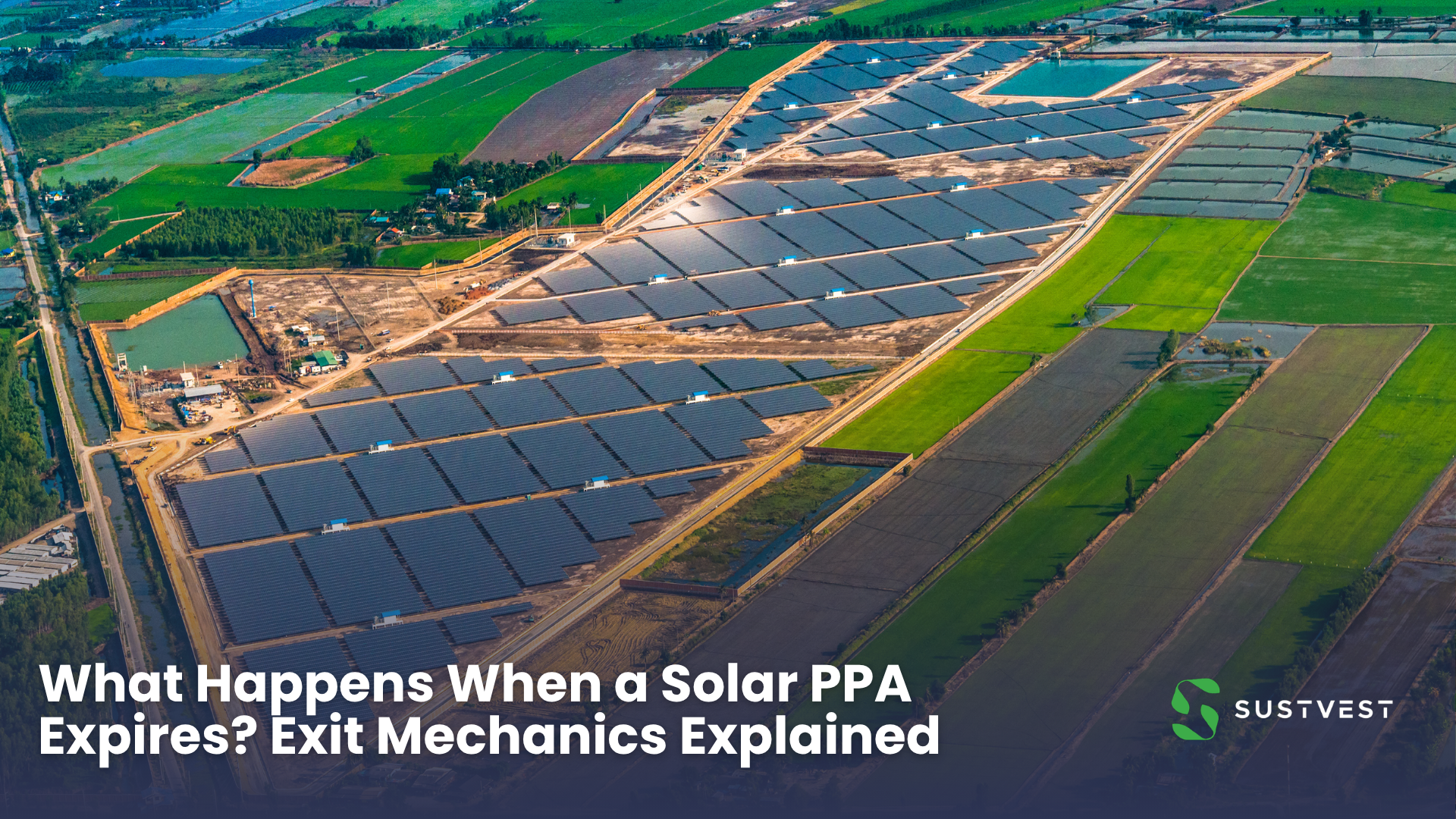
What Happens When a Solar PPA Expires? Exit Mechanics Explained
If you are evaluating a fractional solar investment, you have probably spent time understanding how the returns work - the PPA tariff, the monthly distributions, the projected XIRR. But there is a question that most platforms leave conspicuously unanswered: what happens when the PPA expires?
Every Power Purchase Agreement has a defined duration - typically 10 to 25 years. During that period, the solar project generates electricity, the off-taker pays for it under the contracted terms, and investors receive monthly distributions. But the PPA is not the asset. The solar plant is the asset. And the plant does not stop producing electricity the day the contract ends.
So what happens to your investment at that point? How do proceeds flow back to you? Who makes the decisions? And what should you look for in the offering documents before you invest?
This guide answers all of it - from the investor's seat, not the electricity buyer's.
Why Does the PPA Expiry Question Matter for Fractional Solar Investors?
It matters because the PPA defines the revenue stream that funds your returns, and when it ends, the certainty it provided ends with it.
During the PPA term, your investment has a clear economic model: the solar plant generates X kilowatt-hours, the off-taker pays Y rupees per unit, and after operating costs, the remainder flows to investors. The tariff is contractually locked. The buyer is contractually bound. The cash flow is predictable.
When the PPA expires, that contractual certainty disappears. The project still exists, the panels still produce electricity, but the guaranteed buyer and the guaranteed price are gone. What replaces them determines whether your investment winds down gracefully with a final return of capital, continues generating income under new terms, or loses value.
For fractional solar investors, the PPA expiry is not an abstract future event. It is the single most important inflection point in the investment's lifecycle - and your rights and options at that point should be clearly defined in the offering documents before you invest a dollar.
An important contextual note: India's large-scale solar buildout began in earnest around 2013-2015. As of 2026, the oldest utility-scale and C&I solar projects are roughly 11-13 years old. No large-scale PPA in India has actually reached its contractual expiry yet. This means the exit scenarios described below are based on contractual provisions, industry practice, and regulatory frameworks - not on a large body of real-world precedent. This is worth factoring into your assessment.
What Are the Possible Outcomes When a Solar PPA Expires?
There are five primary scenarios, each with different implications for investors. In practice, the outcome is determined by a combination of market conditions at the time of expiry, the terms of the original PPA and site lease, the condition of the solar equipment, and the governance provisions in the LLC Operating Agreement and PPM.
Scenario 1: PPA Renewal at Market Rates
The most straightforward outcome is renegotiating a new PPA with the same off-taker or finding a new electricity buyer. If the solar plant is still operational (and after 20-25 years, it typically is - panels retain 80-90% of their original output), there is a functioning asset that can continue selling power.
The key difference from the original PPA is pricing. The new tariff will reflect current market rates, not the rate negotiated a decade or two earlier. In India, where industrial electricity costs have historically risen over time, the renegotiated tariff could potentially be higher than the original - particularly for C&I open access arrangements where grid tariffs have increased. However, solar tariffs in new competitive auctions have also fallen dramatically over the years, so the renegotiated rate depends heavily on the specific market conditions at the time.
For investors, a PPA renewal means the investment continues generating income. The question is whether unit holders have a say in whether to renew or whether the platform's management team has sole discretion. This should be specified in the Operating Agreement.
Scenario 2: Asset Sale to a Third Party
The SPV - the entity that owns the solar plant - can be sold to another developer, infrastructure fund, or strategic buyer. Solar assets with remaining useful life, an operational track record, and grid connectivity have tangible market value even after the PPA expires.
The sale proceeds, minus any outstanding liabilities, wind-down costs, and management fees, are distributed to investors pro-rata based on their unit holdings. This is typically a lump-sum payout rather than ongoing distributions.
The residual value of the asset depends on several factors: the condition of the equipment, remaining useful life of the panels and inverters, the status of the land lease (critical - if the lease expires before or at the same time as the PPA, the asset's value drops significantly), grid connection status, and whether a new PPA or open access arrangement is in place or negotiable.
For investors, asset sale is often the cleanest exit - a defined event, a defined payout, and closure of the investment. The question is what price the asset commands in the secondary market, which is inherently uncertain years in advance.
Scenario 3: Ownership Transfer to the Off-Taker
In some Indian C&I solar PPA structures - particularly RESCO (Renewable Energy Service Company) and OPEX models - the PPA includes a provision for transferring ownership of the solar plant to the electricity buyer at the end of the contract term. The transfer price is typically nominal - often as low as ₹1 or the depreciated book value of the equipment.
In this scenario, the solar asset effectively has zero residual value for the investor after the transfer. All returns were generated during the PPA period through the tariff spread. The investment thesis rests entirely on the distributions received during the contract term, not on any terminal value.
For investors, this is the least favorable exit scenario in terms of terminal value - but it is not inherently bad if the projected XIRR already accounts for zero residual value. The critical question is whether the PPM discloses this transfer provision clearly. If the financial projections assume zero terminal value, the returns you see are the returns you get. If they assume some residual value but the PPA includes a nominal transfer clause, the projections are overstated.
Scenario 4: Repowering with New Equipment
Repowering involves replacing the original solar panels and inverters with newer, more efficient equipment on the same site. The existing land lease, grid connection, and transmission infrastructure remain in place - which are significant cost advantages compared to building a new project from scratch.
After 20-25 years, the original panels will have degraded to 80-88% of their initial output. Replacing them with current-generation panels, which are significantly more efficient, can substantially increase the site's energy output from the same footprint. The grid connection and land rights are often the most difficult and expensive components of a solar project - retaining them while upgrading the generation equipment is economically compelling.
For investors, repowering represents a potential upside scenario - the investment could be restructured with a new PPA, new equipment, and a fresh investment thesis. However, repowering requires additional capital expenditure, a new or extended land lease, and a new PPA negotiation. It also raises governance questions: who funds the repowering? Are existing investors diluted? Is there an option to exit instead of reinvesting?
India does not yet have a formal solar repowering policy comparable to its wind repowering guidelines. Given that no large-scale solar PPAs have expired yet, this framework is still developing.
Scenario 5: Decommissioning and Salvage
In the least favorable scenario, the solar plant is decommissioned - the panels, inverters, and mounting structures are removed, and the site is returned to its original condition (or as close to it as the lease requires).
The salvage value of decommissioned solar equipment is modest. Panels contain recoverable materials - silicon, aluminum, glass, copper - but the recycling infrastructure for solar panels is still in early stages globally, and in India, the secondary market for used panels is informal and fragmented. Inverters and electrical equipment have some scrap value, but not enough to constitute a meaningful return to investors.
Decommissioning is typically the outcome when the site lease has expired, the equipment has degraded beyond economic usefulness, no buyer can be found for the asset, and repowering is not viable due to site constraints or regulatory issues. For investors, decommissioning returns minimal terminal value and should be treated as the downside case in any scenario analysis.
Does a Solar Project Still Have Value After the PPA Ends?
Yes - in most cases, the physical asset retains meaningful productive capacity well beyond the PPA term.
Solar panels are designed to operate for 25 to 30 years or more. According to the National Renewable Energy Laboratory (NREL), modern crystalline silicon panels degrade at a median rate of approximately 0.5% per year. At that rate, a panel retains roughly 87-88% of its original output at year 25. A comprehensive NREL study of nearly 2,000 solar systems worldwide found that monocrystalline panels manufactured after 2000 degrade at just 0.4% annually - meaning they could retain over 90% of original output at the 25-year mark.
Real-world data supports this. Panels installed in the late 1980s and early 1990s have been documented producing more than 80% of their original power after 30 or more years of operation, with degradation rates as low as 0.24% per year in some cases.
The practical implication for investors: when a 25-year PPA expires, the solar plant is not a dead asset. It is a functioning power generation facility with 5-15 years of remaining useful life. The question is not whether the asset has value, but how that value is realized - through PPA renewal, asset sale, repowering, or some combination.
The main caveat is that while panels last 30-40 years, inverters have shorter lifespans - typically 10-15 years for string inverters and up to 25 years for microinverters. Most solar plants will require at least one inverter replacement during the PPA term. If the inverters are due for replacement at PPA expiry, that additional capital expenditure reduces the net residual value of the asset.
Who Decides What Happens — the Platform, the SPV, or the Investors?
This is the governance question that separates well-structured offerings from opaque ones.
In a fractional solar investment structured as a Delaware LLC, the decision-making authority at PPA expiry is defined by the LLC Operating Agreement. This document - which should be included in or referenced by the PPM - specifies who has the authority to negotiate PPA renewals, approve asset sales, authorize repowering expenditures, decide on decommissioning, and distribute terminal proceeds to investors.
In most fractional solar structures, the platform's management entity serves as the Managing Member of the LLC and holds broad discretionary authority over operational decisions. This typically includes PPA renegotiation and day-to-day management of the SPV. However, the scope of that discretion and whether it extends to major decisions like asset sales or decommissioning, varies by offering.
If the Operating Agreement gives the manager unlimited discretion with no investor consent requirements and no defined wind-down timeline, that is a governance risk worth weighing before investing — regardless of how attractive the projected returns are.
How Do Proceeds Flow Back to Investors at Exit?
The mechanics of the final distribution depend on which exit scenario plays out.
In a PPA renewal scenario, there is no lump-sum exit event. The investment continues, and monthly distributions resume under the new PPA terms. The returns during the renewal period may be higher or lower than the original PPA, depending on the renegotiated tariff, equipment condition, and operating costs.
In an asset sale scenario, the distribution waterfall typically follows this sequence: the buyer pays the agreed purchase price to the SPV. The SPV settles any outstanding liabilities - debt service, O&M obligations, taxes, administrative costs. The remaining proceeds flow up to the LLC. The LLC deducts any management fees, wind-down costs, and reserves. The net amount is distributed pro-rata to unit holders based on their membership interest percentage.
The timeline from the sale agreement to the final investor payout can vary. Asset sales involve due diligence, regulatory approvals (including any FEMA-related clearances for cross-border transactions), and administrative processing. Investors should expect a period of several weeks to a few months between the sale closing and receipt of final distributions.
In a decommissioning scenario, the salvage value of the equipment (minus removal costs, site restoration costs, and administrative expenses) is distributed to investors following the same waterfall structure as an asset sale — but the amounts are significantly smaller.
What Should Investors Look for in the PPM Regarding Exit Terms?
Before investing, review the PPM and Operating Agreement for the following exit-related provisions:
PPA term vs. site lease term. This is the single most critical structural check. If the land lease expires at the same time as or before the PPA, the asset cannot continue operating, and scenarios like PPA renewal and repowering become impossible. The site lease should extend meaningfully beyond the PPA term - ideally by at least 5-10 years - to preserve optionality.
Transfer or buyback clauses in the PPA. Does the PPA include a provision for transferring ownership to the off-taker at expiry? If so, at what price? If the transfer is at nominal value (₹1 or depreciated book value), the financial projections should reflect zero terminal value. If the projections assume some residual value but the PPA includes a nominal transfer clause, the projections are inconsistent.
Wind-down provisions. Is there a contractual commitment to complete the wind-down within a specified period? What happens to undistributed funds during the wind-down?
Inverter replacement provisions. Who bears the cost of inverter replacement during the PPA term? Is there a reserve fund, or does the cost come out of distributions? How does this affect the asset's condition at PPA expiry?
Insurance and decommissioning reserves. Is there a provision for decommissioning costs? Some structures require the SPV to set aside decommissioning reserves during the operating period, ensuring that wind-down costs do not consume the final distribution.
Extension or renewal rights. Does the SPV have a right of first offer or right of first refusal on PPA renewal? Or can the off-taker simply walk away at expiry without obligation?
If a PPM does not address these items, ask the platform directly before investing. The absence of clear exit terms is itself a risk factor.
Frequently Asked Questions
Can I exit before the PPA expires? In most fractional solar structures, early exit options are limited. Membership units in a private LLC are not traded on any public exchange, and there is generally no guaranteed secondary market. Some Operating Agreements may include provisions for unit transfers to other accredited investors with manager approval, or for buyback at the manager's discretion - but these are not standard across all offerings. If early exit flexibility is important to you, confirm the specific provisions before investing.
What is the typical residual value of a solar plant after 25 years? There is no single answer because residual value depends on equipment condition, remaining useful life, site lease status, grid connection, and local market conditions. As a rough framework: panels retain 80-90% of original output at year 25, but inverters may need replacement. If the site lease extends beyond the PPA and the grid connection is active, the asset has meaningful operating value. If the lease expires with the PPA and ownership transfers to the off-taker at nominal value, residual value for investors is effectively zero.
Does PPA renewal mean my investment tenure extends automatically? This depends on the Operating Agreement. In some structures, the manager may have authority to renew the PPA and continue the investment without individual investor consent. In others, PPA renewal may require a vote of unit holders, or investors may have the option to receive a payout in lieu of continuing. Clarify this provision before investing - an automatic extension without investor consent is a governance concern that sophisticated investors should evaluate carefully.
What happens if the off-taker goes bankrupt before the PPA expires? If the electricity buyer defaults or becomes insolvent during the PPA term, the SPV loses its contracted revenue stream. The PPA is a binding contract, so the SPV may have legal claims against the off-taker's estate in bankruptcy proceedings. Practically, the SPV would need to find a new off-taker and negotiate a new PPA - which may take time and result in different terms. During the interim period, the solar plant may continue generating electricity and selling it on the open market or through short-term arrangements, but at potentially lower rates. The financial impact depends on the duration of the disruption and the terms of any replacement arrangement. Well-structured investments mitigate this risk by selecting creditworthy off-takers and including termination payment provisions in the PPA.
About Sustvest
SustVest LLC is a Delaware-registered fractional solar investment platform offering SEC Regulation D 506(c) compliant investment opportunities in Indian solar energy projects. Through its US entity structure, Sustvest enables accredited investors and NRIs to own membership interests (units) in operating solar projects backed by long-term Power Purchase Agreements. Each project is held in a separate Indian SPV, with SustVest LLC owning 100% of each SPV. Investors receive proportional monthly cash distributions in USD, with a minimum investment of $500 and target returns of 10–14% XIRR. Project details, SEC filings, and real-time generation data are available at sustvest.com.
This content is for informational purposes only and does not constitute an offer to sell or a solicitation of an offer to buy any securities. Investments in private offerings under SEC Regulation D are speculative, illiquid, and involve a high degree of risk, including the potential loss of the entire investment. Fractional solar investments are available only to verified accredited investors as defined under SEC Rule 501(a). Past performance is not indicative of future results. The exit scenarios described in this blog are based on contractual provisions and industry frameworks, not on established precedent for Indian C&I solar PPAs, as no large-scale PPAs have yet reached contractual expiry. Prospective investors should carefully review the Private Placement Memorandum (PPM) and LLC Operating Agreement, and consult with their own legal, tax, and financial advisors before making any investment decision. SustVest LLC does not provide investment, legal, or tax advice.
Sources:
NREL — Median solar panel degradation rate: 0.5% per year for crystalline silicon modules
Okon Recycling / NREL study — Monocrystalline panels manufactured after 2000 degrade at 0.4% annually; panels from the late 1980s-1990s documented producing 80%+ output after 30 years
NuWatt Energy — "Panels retain 85-90% capacity at year 25; real-world lifespan is 30-40 years" (May 2026)
Good Energy Solutions — "Panels installed in the late 1980s and early 1990s found still generating more than 80% of their original power after 30+ years, degrading only about 0.24% per year"
SEIA — "At the end of the PPA contract term, a customer may be able to extend the PPA, have the developer remove the system, or choose to buy the solar energy system"
Sun Wave Technologies — Indian C&I PPA end-of-term: "ownership typically transfers for ₹1 or pre-agreed residual value"; early termination via NPV of remaining payments or depreciated book value (April 2026)
Montel Energy — End-of-PPA options: renew, buy the system, or system removal (March 2025)
EnergyLink — PPA contract end options: renew, purchase the project, or walk away (January 2023)
A1 Solar Store / NREL — "Solar panels degrade at 0.3-0.5% per year, retaining 85-90% capacity at year 25" (December 2025)
Paradise Solar Energy — "Most panels don't require replacement until after 25-30 years; degradation of 0.5-0.8% per year" (November 2025)
Internal links (add when publishing):