300 kWp Rooftop Solar in Chengalpattu: ₹14 Lakh Saved a Year
Published Nov 3, 2026 · Updated Nov 4, 2026
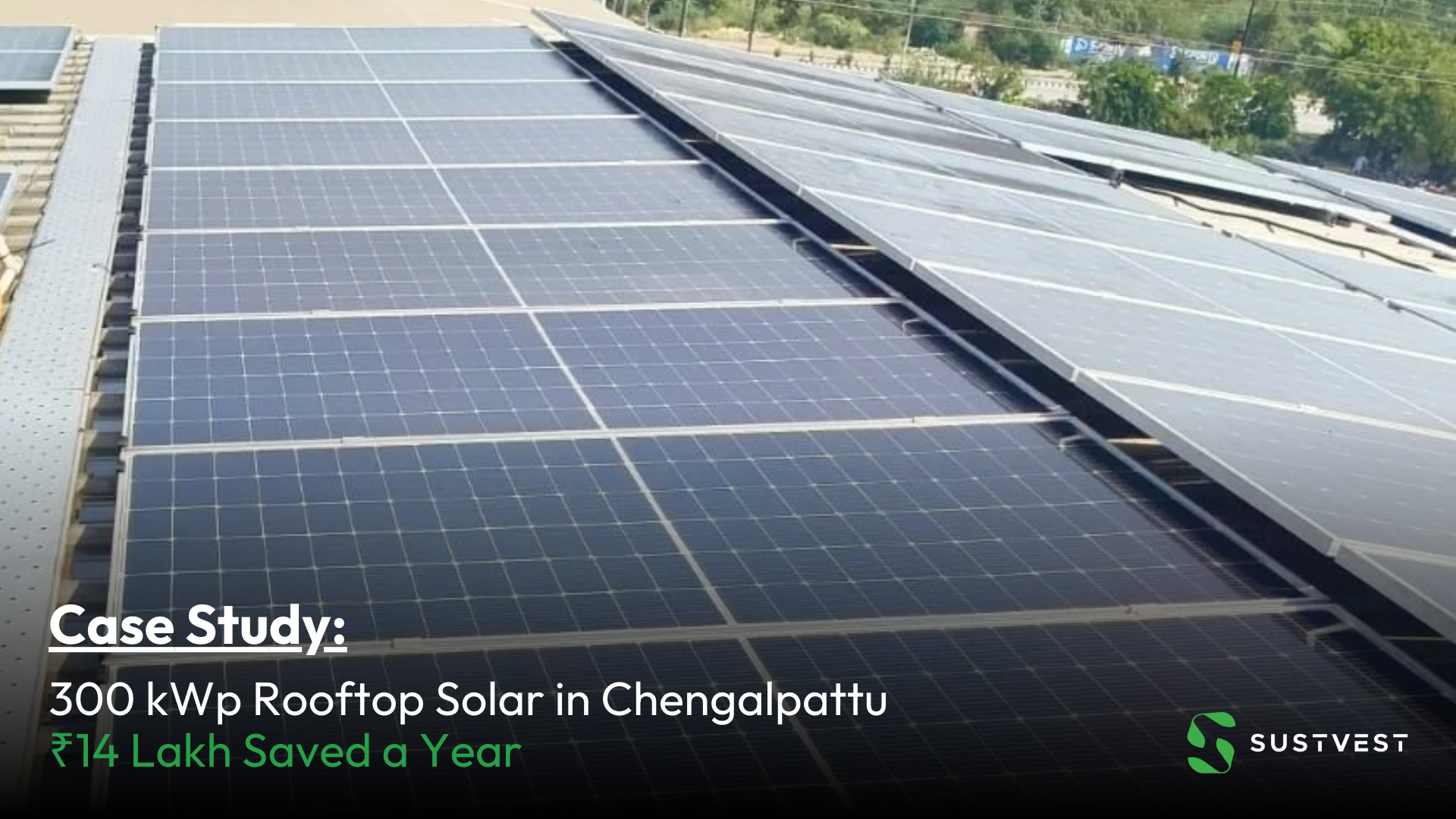
A Chengalpattu auto components factory got 25% of its power from a 300 kWp zero-investment rooftop solar plant in month one, saving ₹14 lakh a year.
SustVest built, owns and runs a 300 kWp rooftop solar plant for an auto components manufacturer in Mahindra World City, Chengalpattu, Tamil Nadu. The factory paid nothing upfront. In its first full month, September 2026, the plant supplied 25% of the site's power and saved ₹1.37 lakh after solar payments.
At a glance
Industry | Auto components manufacturing |
Location | Mahindra World City, Chengalpattu, Tamil Nadu |
Capacity | 300 kWp rooftop solar |
Model | OPEX (RESCO), zero capex |
First generation | 31 August 2026 |
Commissioned | 28 September 2026 |
Projected generation | 4.05 lakh units a year (P90, 1,350 kWh per kWp) |
Projected savings | ₹14.3 lakh a year, net of solar payments |
CO₂ avoided | 2,88,239 kg a year projected, equal to about 13,240 trees |
The problem: high HT power costs in Tamil Nadu
In August 2026 the factory bought 1,86,176 kWh from the grid on a TANGEDCO high tension (HT) tariff, paying about ₹8.13 per unit once time-of-day peak rates were counted.
On top of energy charges, demand was billed at a fixed floor of 585 kVA against 650 kVA sanctioned, whether the plant used it or not.
Why the factory had not gone solar earlier
The company had looked at rooftop solar before but had not found a developer who understood its plant safety rules and could also meet its cost target. SustVest solved both: a safety plan built around the factory's own EHS (environment, health and safety) requirements, and a fixed per-unit OPEX tariff below the grid rate, with no capital outlay from the factory.
What SustVest built
Capacity: 300 kWp rooftop solar plant
Timeline: first generation on 31 August 2026, commissioned on 28 September 2026
Hardware: Rayzon 625 Wp solar modules and Sungrow inverters with iSolarCloud remote monitoring
Grid setup: runs in zero-export mode while net metering is pending, so every solar unit is used inside the factory
New to the model? Read how zero investment OPEX solar works.
Results in the first month (September 2026)
Savings: ₹1.37 lakh net, after solar payments
Generation: 38,740 kWh, about 129 kWh per kWp
Share of load: solar covered 25% of total site consumption (38,740 of 1,54,132 kWh); grid purchase fell to 1,15,392 kWh
CO₂ avoided: 27,571 kg (at the CEA grid factor of 0.7117 kg per kWh)
What we learned: zero export caps output on holidays
Until net metering is approved, the plant can only power the factory's live load. September had 11 non-production days (4 Sundays and 7 shutdown days), and 63% of the month's generation (24,366 kWh) came on the 19 production days. Once net metering is approved, surplus on low-load days can be banked instead of capped.
Frequently asked questions
How much can a 300 kWp rooftop solar plant save a factory in Tamil Nadu?
About ₹14.3 lakh a year, projected, for this auto components factory in Chengalpattu. That assumes a P90 yield of 1,350 kWh per kWp, or 4.05 lakh units a year, supplied under SustVest's OPEX model at a fixed tariff below the factory's grid cost.What is zero investment (OPEX) rooftop solar?
Under SustVest's OPEX (RESCO) model, SustVest funds, builds, owns and maintains the rooftop solar plant. The factory pays only for the solar units it uses, at a fixed per-unit tariff below its grid rate. Savings start from the first month, with no capital spent by the factory.Can a Tamil Nadu factory use rooftop solar before net metering is approved?
Yes, in zero-export mode. The inverters limit output to the factory's live load, so no power flows into the grid and every solar unit is used on site. This Chengalpattu plant has run this way since 31 August 2026 while its net metering approval is pending.Who maintains a rooftop solar plant under the OPEX model?
The developer does. SustVest owns the plant, monitors it remotely and handles cleaning, repairs and breakdowns for the full contract. The factory has no maintenance cost and pays only for the units the plant delivers.
See what your factory roof could save
SustVest builds, owns and runs rooftop solar plants for factories across 13 Indian states, with zero upfront investment. Get a free rooftop solar assessment.