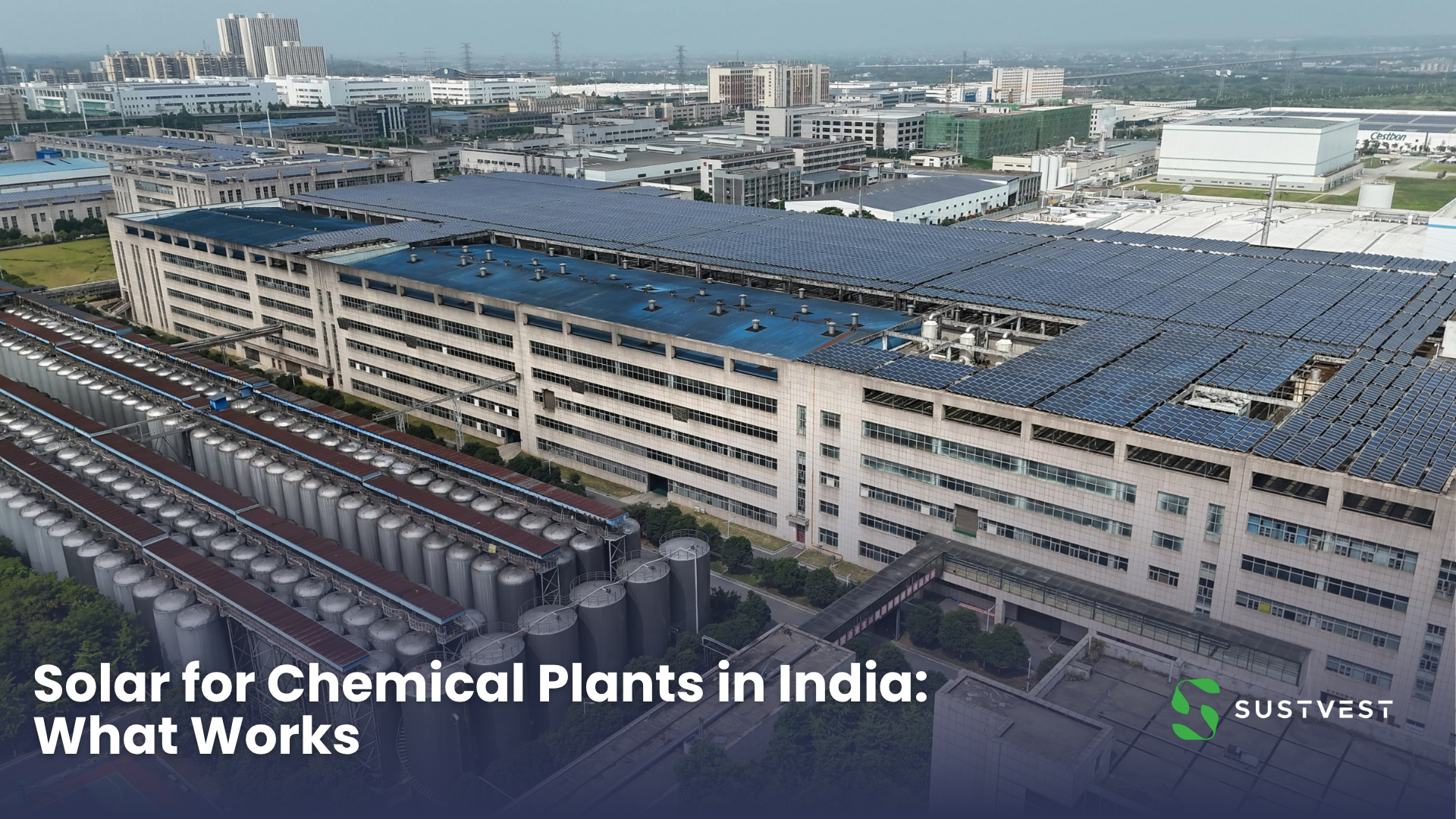
Solar for chemical and specialty chemical plants in India: what actually works on a process-heavy, safety-critical site
Many chemical and specialty chemical plants have energy-intensive operations and stringent safety requirements; some run continuously, while others operate in batches. That combination makes solar genuinely attractive — electricity can be a significant operating cost — but it also means a solar project here cannot be designed like one on a warehouse roof. This post is an honest look at where solar fits on a chemical site, where it doesn't, and what a buyer should check before committing.
In short: Solar can meaningfully cut the electricity bill of a chemical plant — pumping, compression, utilities, lighting, effluent treatment — but it does not replace process heat (steam, thermal fluid, furnaces), which is usually a separate fuel load. On a hazardous-classified site, the rooftop and electrical design must respect the plant's area classification. For many chemical manufacturers the bigger lever is open-access or captive solar, not rooftop alone.
Is rooftop solar worth it for a chemical plant?
Yes, for the electrical load — with caveats. Chemical and specialty chemical manufacturing is electricity-intensive: motors, pumps, compressors, agitators, cooling, lighting, and effluent treatment run on power, much of it during daylight. That daytime electrical load is exactly what a solar plant can offset, potentially at a lower effective cost than grid electricity, depending on the project economics.
But two things make a chemical site different from a generic factory:
A large part of your energy isn't electricity. Steam, hot thermal fluid and direct-fired heat for reactors, distillation and drying are commonly supplied by fuel-fired boilers or furnaces, although some processes use electric heating. Solar PV offsets electrical consumption directly; replacing fuel-based process heat requires a separate assessment of thermal technologies or heat electrification. Any honest proposal will size the saving against your electricity consumption, not your whole energy spend.
Safety classification governs the design. Parts of a chemical plant are hazardous-classified areas where flammable gases, vapours or dusts may be present. Where a roof or yard sits over or near a classified zone, the solar layout, cabling and electrical equipment have to be designed around that classification — not dropped in as a standard rooftop kit.
So the right question isn't "is solar worth it" in the abstract — it's "how much of my load is daytime electrical load, and where on my site can a plant be built safely." Model your own facility; the answer varies a lot between, say, a fine-chemicals batch plant and a continuous bulk-chemical unit.
How much can a chemical plant save with solar?
Savings depend on the gap between your effective grid electricity cost and the solar tariff, applied to the units solar actually supplies and the value of those units under your billing arrangement. Future grid tariffs may rise or fall, while the solar PPA tariff follows the escalation terms agreed in the contract (which may be fixed or carry a defined annual escalation). Any projected long-term saving should therefore be modelled against your actual tariff and contract terms.
We deliberately don't publish a single "₹X/kWh" or "Y% saving" number here, because it depends on your state tariff, load profile, roof or land availability, and the procurement route. The credible way to size it is a site-specific assessment against your actual bills. What we can say is structural: energy can be a significant operating cost for chemical manufacturers, but the share attributable to electricity varies by process and sub-sector. Even a partial offset of daytime electrical consumption may deliver meaningful savings over the expected operating life of the solar asset, which may extend beyond the PPA term depending on equipment condition, degradation and maintenance.
Rooftop, open access, or captive — which route fits a chemical plant?
For many chemical manufacturers, rooftop alone won't cover the load, because process plants have dense equipment, piping racks, vents and classified zones that limit usable roof area relative to demand. There are three routes, often used in combination:
Rooftop solar (CAPEX or OPEX/RESCO): offsets part of the daytime load using your own available roof. Under OPEX/RESCO you put in no capital and buy generated units at the tariff and escalation terms specified in the PPA; under CAPEX you own the asset. Often a useful first tranche; whether it is enough on its own depends on your roof area, demand and electrical design.
Open access (ground-mount, off-site): lets you source a much larger block of solar from a third-party plant and wheel it to your site through the grid. This can help large chemical consumers procure renewable electricity at a scale beyond their available rooftop area, subject to state-specific regulations and economics (open-access charges, losses and applicable exemptions all affect the delivered cost).
Group captive / captive: you take an equity stake in the generating company and consume the power as a captive user. Under India's Electricity Rules, a qualifying captive generating plant generally must satisfy minimum ownership and consumption tests: the captive users must collectively satisfy the applicable minimum ownership requirement, generally 26%, and the required captive-consumption test, generally 51% of generation annually, subject to the rules applicable to the project's structure. The Electricity (Amendment) Rules, 2026 clarify how these requirements apply to different ownership and group structures. The precise compliance test — and whether an arrangement qualifies for captive status and its associated surcharge treatment — should be checked against the project's structure and the current rules.
A relevant example is Privi Speciality Chemicals, which announced a captive power procurement arrangement for a 16.6 MW solar project in Maharashtra in March 2026. According to Mercom India, the arrangement involves a project SPV developed by Radiance Renewables. The example illustrates how a specialty chemicals manufacturer can procure solar power through an off-site captive structure rather than relying on rooftop solar alone.
What about process heat — can solar do that?
Solar PV does not directly replace fuel burned in boilers or furnaces. The thermal loads in a chemical plant — steam for reactors and distillation, hot oil/thermic-fluid systems, drying, direct-fired heating — are usually met by boilers or furnaces on fuel, and PV doesn't touch them directly. However, process-heat costs may be addressed through separate solutions, including solar thermal, electric boilers or heat pumps, where technically and economically suitable. These options require process-specific engineering and should not be assumed to form part of a standard solar PV project.
To expand on those adjacent options, each a separate decision with its own economics:
Solar thermal technologies, including concentrated solar where suitable, can supply process heat for selected applications, depending on the required temperature, operating profile and site conditions — a different technology and site requirement from PV.
Electrification of heat (electric boilers, heat pumps for low-grade heat) can, in principle, shift some thermal load onto electricity that solar then supplies — but that's a process-engineering project, not a solar one, and it depends heavily on temperature needs and power cost.
For most chemical plants today, the honest scope of a solar project is the electrical load. Anyone promising solar will slash your total energy bill including process heat is overselling.
What safety and design issues are specific to chemical sites?
This is where a chemical-plant solar project diverges most from a standard C&I install. Chemical plants may contain hazardous areas classified according to the likelihood and duration of an explosive atmosphere. Gas and vapour zones (0, 1 and 2) and combustible-dust zones (20, 21 and 22) are addressed under applicable hazardous-area classification standards (for example, IS 5572:2009 for classification of areas with flammable gases and vapours, and the applicable standards in the IS/IEC 60079 series, including IS/IEC 60079-10-2 for classification of areas where combustible dusts may be present). Equipment selection, cable routing and installation design must follow the site's approved classification drawings and applicable standards and editions, as confirmed by the plant's electrical engineering and EHS teams. In those classified zones, electrical equipment must be of the appropriate protection type (flameproof, intrinsically safe, etc.), and a solar array's DC cabling, inverters, combiner boxes and isolators cannot be treated as ordinary rooftop hardware.
Practically, that means a credible developer will:
Start from your hazardous-area classification drawings, not a generic roof plan — siting the array and routing cable to respect classified zones, vents and relief points.
Locate electrical equipment outside classified areas wherever practicable. Where equipment or wiring must be installed within a classified area, specify suitable equipment and installation methods for the applicable zone and protection requirements, in coordination with the plant's electrical engineering and EHS teams.
Coordinate with your EHS team and statutory requirements — applicable factory-safety legislation, state rules, electrical-safety requirements and fire-safety provisions must be assessed for the installation, not just the chemistry.
Design for reliability, since an unplanned trip in a continuous chemical process is expensive and potentially unsafe. Standard grid-connected rooftop solar systems with anti-islanding protection shut down when the grid supply fails and do not independently provide backup power. Backup requires a separately designed and appropriately configured system, potentially incorporating storage, controls and other backup sources such as DG sets or UPS. So solar complements, rather than replaces, your existing power-reliability setup.
A developer that owns, operates and maintains the plants it builds has a direct incentive to get this right, because under an OPEX/RESCO structure it typically carries the asset and its maintenance for the PPA term, not just the installation — though the exact allocation of maintenance and performance responsibility depends on the contract.
What should a chemical-plant buyer check before signing?
What's the daytime electrical load the solar is actually sizing against — and is the saving quoted against electricity, not total energy?
Which route (rooftop / open access / captive) and does the mix match your load and available area?
Hazardous-area design: has the developer worked from your classification drawings and involved EHS early?
Who owns O&M and performance risk for the asset's life? (See solar monitoring and O&M — why they decide ROI.)
PPA terms: tariff escalation (fixed or defined), term length, transfer and exit conditions. Our solar PPA checklist covers the clauses that matter.
The right next step is always a site-specific assessment, not a number copied from a brochure.
FAQ
Can solar power a chemical plant completely? Rarely on its own. Solar offsets the daytime electrical load — pumps, compressors, utilities, lighting, effluent treatment — but not process heat (steam, thermal fluid, furnaces), which usually runs on fuel. Large chemical consumers typically combine rooftop with open-access or captive solar to cover a bigger share of electricity, while thermal load stays separate.
Does solar reduce a chemical plant's process-heat cost? Not directly. Solar PV produces electricity, so it reduces the electricity bill, not fuel-based process heat. Solar thermal or electrification of heat can address some thermal load, but those are separate projects with their own economics and site requirements.
Is rooftop solar safe on a hazardous-classified chemical site? It can be, when designed for the site's hazardous-area classification. Areas where flammable gases, vapours or dusts may be present are classified into zones under applicable standards (for example, IS 5572:2009 for areas with flammable gases and vapours, and the IS/IEC 60079 series, including IS/IEC 60079-10-2 for combustible-dust areas), and electrical equipment and cabling in or near those zones must use the right protection type. The array should be sited and wired from the plant's approved classification drawings, with the electrical engineering and EHS teams involved early.
What's the difference between rooftop, open access and captive solar for a chemical plant? Rooftop uses your own roof to offset part of the load. Open access sources a larger block of solar from an off-site plant wheeled through the grid, subject to state-specific charges and economics. Captive (including group captive) means you take an equity stake in the generating project and consume the power as a captive user — under India's Electricity Rules the captive users must collectively satisfy the applicable minimum ownership requirement, generally 26%, and the captive-consumption test, generally 51% of generation annually, with the Electricity (Amendment) Rules, 2026 clarifying how the tests apply to different structures. Whether an arrangement qualifies should be checked against its structure and the current rules.
Will solar give backup power during a grid outage? Standard grid-connected rooftop solar with anti-islanding protection shuts down when the grid supply fails and does not independently provide backup power. Backup requires a separately designed and appropriately configured system, potentially incorporating storage, controls and other backup sources such as DG sets or UPS. So solar complements existing reliability measures rather than replacing them, which matters for continuous chemical processes.
How do I size the real saving for my plant? Model it against your actual electricity bills, load profile, available roof or land, and state tariff — not a generic per-unit figure. A site-specific assessment is the only credible way to size the saving, because it varies widely across chemical sub-sectors and states.