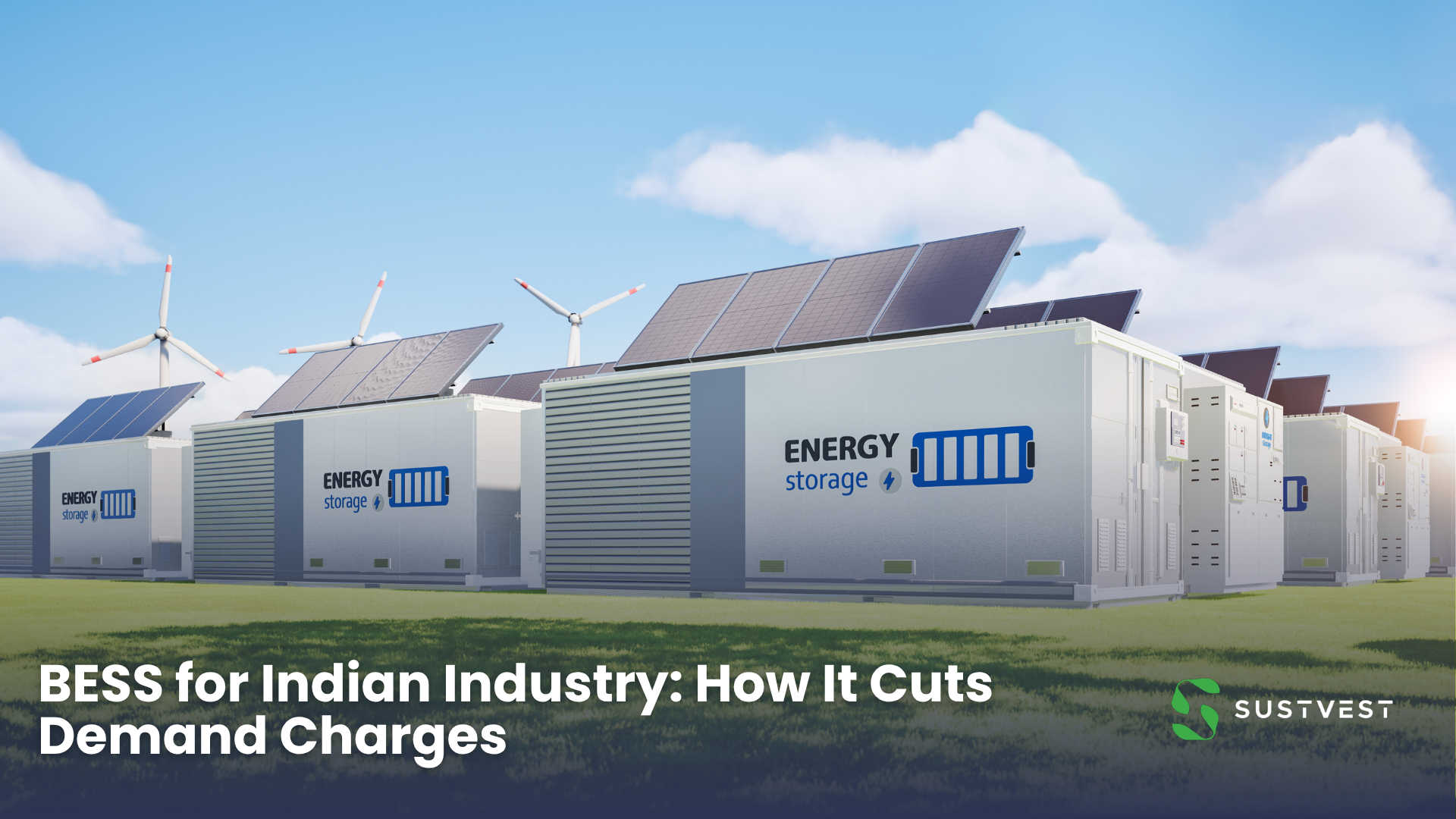
BESS for Indian Industry: How It Cuts Demand Charges
Most industrial electricity bills hide a costly line item that has nothing to do with how much energy a plant uses: the demand charge. It's billed on your highest power draw in a period — sometimes a single spike lasting minutes - and for many industrial consumers it's one of the largest components of the bill. Battery energy storage (BESS) is increasingly being used to attack exactly this cost, and in 2026 the economics have shifted enough that it's moving from aspirational to genuinely worth modelling for many facilities.
A behind-the-meter battery energy storage system (BESS) stores electricity — from the grid during cheap off-peak hours or from on-site solar — and discharges it during expensive peak periods. This lets an industrial facility shave its peak demand (reducing demand charges), shift load away from high time-of-day tariff windows, and increase solar self-consumption. Demand charges can represent a significant share of an industrial bill in many tariff categories, so trimming peaks is often one of the largest savings a BESS delivers. The economics depend heavily on your tariff structure, load profile, and system sizing — so, as with solar, the modelling and site-specific ROI analysis matter more than any headline number.
Here's how it works and what determines whether it pays off.
What is a demand charge, and why does it cost so much?
A demand charge is a fee generally based on your highest measured demand (kW or kVA) during the applicable measurement interval or billing period — not the total energy (kWh) you consume. The exact structure — whether it's billed on kVA or kW, the measurement window, the rate, and any penalties for exceeding contracted demand — varies by state and tariff category. Utilities levy it because they must build and maintain enough network capacity to meet your peak, even if you only hit that peak briefly. So a plant that draws a sharp spike — a large motor starting, a furnace cycling, multiple machines coinciding — is billed on that peak for the period, regardless of how little energy the spike actually used.
For many industrial tariff categories, the demand (or "maximum demand") charge is a substantial part of the monthly bill — industry analysis commonly cites a wide range depending on the consumer and state. The important insight for a plant manager is that this charge is triggered by a short window of peak draw, which means it can be reduced by managing that window — which is precisely what a battery does.
How does a BESS reduce demand charges?
Through "peak shaving": the battery discharges during your peak-demand windows to help keep the power drawn from the grid below a target threshold, then recharges when demand is low. In practice, an energy management system monitors the facility's load in real time; when demand approaches your target ceiling, the battery supplies the difference from stored energy, so the grid draw stays closer to the threshold rather than spiking to the full peak. It then recharges during lower-demand periods — timed to avoid creating a new peak of its own. The result is a lower recorded maximum demand — and therefore a lower demand charge. How effectively this works in billing terms depends on how your utility measures maximum demand (the averaging window and metering methodology), which varies by state.
The same battery typically earns its keep in more than one way:
Peak shaving — cutting the maximum-demand charge, which can be a major source of savings where demand charges are high and peaks are sharp.
Time-of-day (ToD) arbitrage — charging when tariffs are low and discharging during high-tariff windows. With ToD tariffs available under applicable tariffs in several Indian states, this can be a real source of savings, though the net benefit is reduced by the battery's round-trip efficiency losses and depends on the tariff spread.
Solar self-consumption — storing excess daytime solar (rather than exporting it at low rates under the applicable settlement mechanism) for use later, which ties directly to the shift we cover in net metering vs net billing.
Backup power — bridging outages for critical loads, though sizing purely for backup is a different calculation.
In some cases, sustained peak reduction can also support a lower contracted or sanctioned demand with the utility over time, which may reduce associated fixed charges — though this depends on the tariff structure and requires confidence that peaks will stay reduced.
A well-designed system stacks these benefits; the value comes from the combination, not any one alone.
How much does a commercial BESS cost in India in 2026?
There is no single reliable 2026 C&I BESS price in India. Project pricing varies with battery chemistry, system duration, PCS (power conversion) capacity, thermal management, fire-safety systems, integration, site works, warranty terms, and grid requirements. Current market quotes should be treated as project-specific rather than as a national benchmark, and compared as complete project quotations rather than headline ₹/kWh figures.
Two things can be said with confidence about the direction of costs:
Battery costs have fallen substantially over the longer term. In competitive Indian storage procurement, the Ministry of Power has reported storage costs falling dramatically over recent years — a storage tariff/procurement metric rather than installed C&I BESS CAPEX, but a clear indicator of the long-run trend.
2026 has also brought renewed cost pressure. Higher commodity prices (lithium, copper, aluminium), supply-chain conditions, and changes in Chinese export economics have put upward pressure on storage project costs during 2026 — so the long-term decline is not a straight line, and current pricing should be checked rather than assumed to keep falling.
As with rooftop solar, the battery pack is only part of the cost — the inverter/PCS, balance-of-system, installation, safety systems, and grid-connection work make up a significant share, so any per-kWh quote should mean the complete installed system.
What determines whether a BESS pays off?
There is no reliable national payback benchmark for C&I BESS. Payback varies with demand charges, peak duration, ToD tariff spreads, system cost, cycling, round-trip efficiency, degradation, and financing. A project-specific model using actual interval load data is the only reliable way to estimate it. The main levers:
Demand-charge magnitude — the higher your maximum-demand charge, the more each kW of peak reduction saves.
Peak "shape" — short, sharp, predictable peaks are ideal for a battery; long, sustained high demand needs a much larger (costlier) system.
ToD tariff spread — a bigger gap between off-peak and peak tariffs makes arbitrage more valuable.
Sizing discipline — an oversized battery wastes capital; an undersized one misses peaks. Sizing to the actual load profile is the whole game.
Battery life and degradation — LFP batteries degrade with cycling and time, and warranty periods and capacity-retention guarantees vary by manufacturer and system. Realistic economics should account for gradual capacity loss and eventual replacement, not just year-one performance.
Solar pairing — combining BESS with rooftop solar can improve the economics where surplus daytime generation would otherwise be exported cheaply.
For a facility with sharp, predictable peaks and a high demand charge, peak shaving alone can justify the investment; for a flat load profile with a low demand charge, the case is weaker. The only honest way to know is a proper analysis of your specific load and tariff.
How should an industrial facility size a battery system?
Size to your peak-demand profile and target reduction, not to a round number. The right capacity depends on how much peak you want to shave (in kW), how long your peaks last, and how much usable energy the system needs, along with how often the peaks occur. This requires actual interval data from your facility — ideally several months of interval load readings — to see the real shape of your peaks.
This is why a credible BESS proposal starts with a load study, not a product catalogue. A monitoring system that captures your real load profile is the foundation: without it, sizing is guesswork, and guesswork in storage is expensive. Beyond sizing, a sound installation also depends on the quality of the battery management and thermal-management systems, safety design, and siting — factors that affect long-term reliability and should form part of any evaluation. For facilities already running or considering rooftop solar, the load and generation data you already have is a valuable starting point.
Does a BESS make sense alongside solar and open access?
Often, yes — storage is the piece that ties a renewable strategy together. Rooftop solar cuts your daytime energy cost; open access can cover demand beyond your roof; and storage manages the peaks and the timing that neither addresses on its own. As we discuss in rooftop solar vs green open access, the strongest industrial energy strategies increasingly combine these tools rather than relying on any single one.
Storage is particularly complementary where the applicable settlement mechanism values exported solar at less than the grid tariff: when surplus solar earns little on export, storing it for your own later use — instead of exporting it cheaply — can capture value that would otherwise be lost. Whether it pays off in your specific case is a project-level calculation, but the strategic logic is increasingly clear.
The bottom line for industrial buyers
Battery storage in 2026 is increasingly a practical tool rather than a speculative add-on — a long-term decline in battery costs, wider time-of-day tariffs, and emerging policy support have made it a serious option for cutting the demand charges that quietly inflate industrial electricity bills, even as 2026 has brought some renewed cost pressure. But it isn't a universal yes: the economics turn entirely on your demand-charge structure, load profile, and disciplined sizing. The facilities that benefit most are those with sharp, predictable peaks and high demand charges — and the only way to know if yours is one of them is to model your actual load. As with solar, the headline cost is a starting point; the real answer is in your numbers.
SustVest is expanding into battery energy storage alongside its rooftop solar offering — designing storage around your real load profile, with in-house monitoring and O&M. As a rooftop solar developer recognised by CRISIL Bridge to India among India's Top 10 Rooftop Solar Project Developers (Solar Rooftop Map, December 2025), with 83+ projects delivered across 13+ states, we model storage on your actual numbers, not a generic payback. Book a free site assessment to see whether a battery makes sense for your facility.
Frequently Asked Questions
How does a battery storage system reduce demand charges? A BESS reduces demand charges through peak shaving: it discharges stored energy during your peak-demand windows to help keep the power drawn from the grid below a target threshold, lowering your recorded maximum demand. Because demand charges are based on your highest power draw, cutting those peaks reduces the charge — with the exact billing benefit depending on how your utility measures maximum demand.
What is a demand charge on an industrial electricity bill? A demand charge is a fee generally based on your highest measured demand (kW or kVA) during the applicable measurement interval or billing period, rather than total energy consumed. Utilities levy it to cover the network capacity needed to meet peak demand, so even a brief spike can raise the charge for the whole period. The exact structure and rate vary by state and tariff category.
How much does a commercial battery storage system cost in India in 2026? There is no single reliable national benchmark for installed C&I BESS costs in India. Pricing varies with battery chemistry, duration, PCS capacity, balance-of-system equipment, safety systems, site conditions, warranty terms, and project scale. The appropriate approach is to compare complete project quotations rather than relying on a headline ₹/kWh figure.
What is the payback period for a commercial BESS? There is no single payback period for commercial BESS. It depends heavily on demand charges, the facility's load profile, ToD tariff spreads, system cost, cycling, and degradation. A project should be modelled using its actual load and tariff rather than a generic payback assumption.
Can a battery be used with rooftop solar? Yes, and the combination is often powerful. A battery can store surplus daytime solar for use later — valuable where the applicable settlement mechanism values exported solar below the grid tariff — while also shaving peaks and enabling time-of-day arbitrage. Whether it's economical depends on your specific load and tariff.
How do I know what size battery my facility needs? Sizing should be based on your actual peak-demand profile: how much peak you want to shave, how long your peaks last, and how often they occur. This requires interval load data (ideally several months of readings), which is why a credible proposal begins with a load study rather than a fixed product.
Sources
Ministry of Power / PIB — "Per kWh Cost of Battery Energy Storage System Falls Steeply" (December 15, 2025)
Ministry of Power / PIB — "Viability Gap Funding for Battery Energy Storage Systems" (April 3, 2025)
JMK Research & IEEFA — EnergyWatts monthly update on India's energy storage market (July 2026)
Reuters — "India battery storage tariffs seen rising as higher costs squeeze low-priced projects" (July 2026)
State Electricity Regulatory Commission (SERC) tariff orders — for any specific demand-charge or ToD tariff examples (state-specific)
SustVest — BESS offering, rooftop solar delivery; 83+ projects, 13+ states, CRISIL Bridge to India Top-10 recognition (December 2025) — company-specific claims