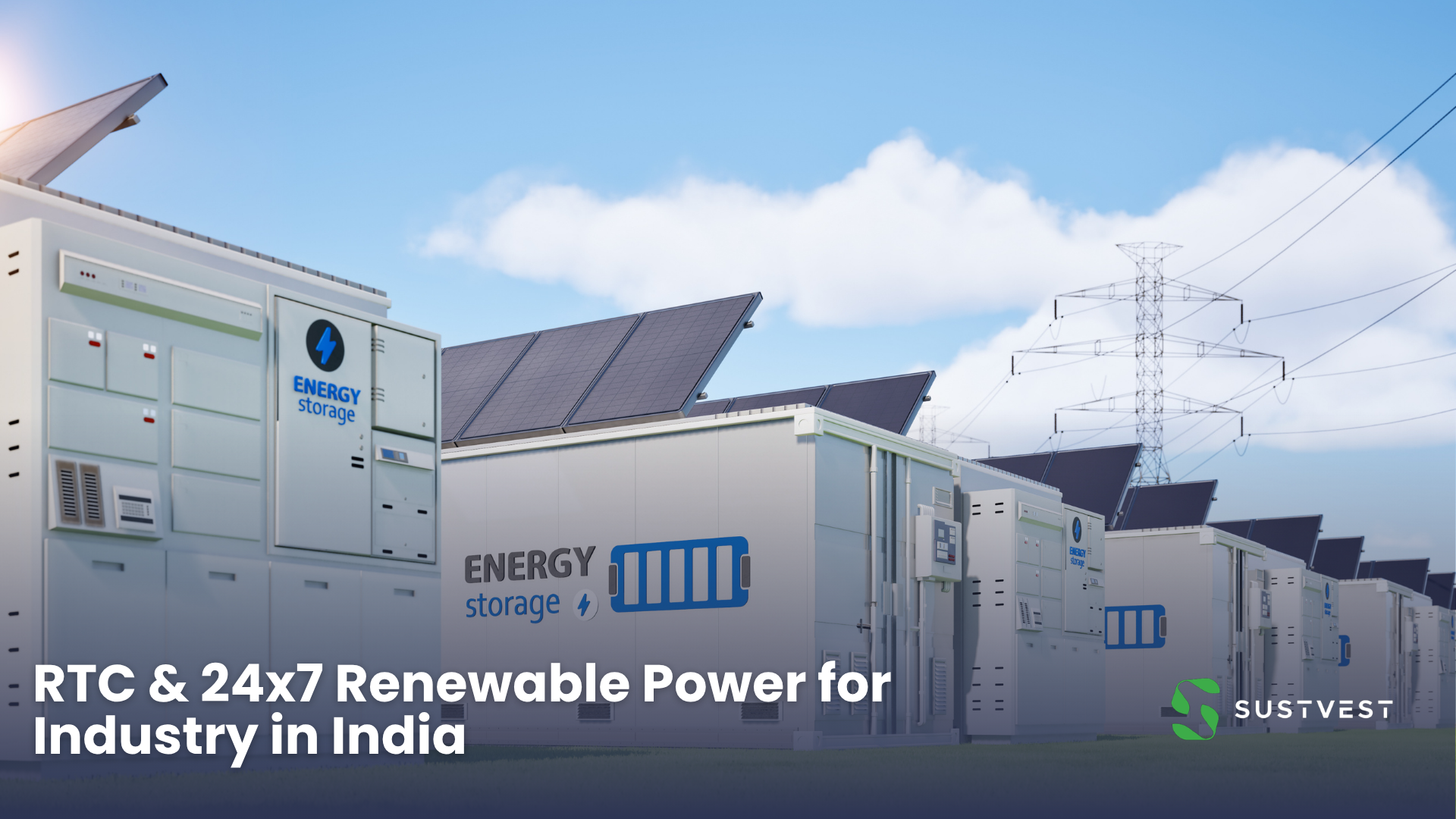
RTC & 24x7 Renewable Power for Industry in India
Round-the-clock (RTC) and 24x7 renewable power for Indian industry: what it means, and where solar + storage actually fit
"Can we run our plant on 100% renewable power, around the clock?" is a question more Indian industrial buyers are asking — driven by sustainability commitments, customer pressure and the hope of a stable, long-term power price. The honest answer is that it's increasingly possible, but it's an engineering and contracting problem, not a solar panel you bolt on. This post explains what round-the-clock (RTC) renewable power actually means, how solar and battery storage fit into it, and what's realistic for a factory today.
In short: Round-the-clock (RTC) renewable power means renewable electricity supplied against a defined delivery or availability profile across the day — related to, but not automatically the same as, true 24x7 carbon-free energy (which matches your consumption with carbon-free supply in every hour). Daytime solar alone can't cover the full day. A firmer renewable profile is built by blending solar, wind and battery storage — increasingly procured as a single "firm" package — so power is available at night and through cloudy spells. For most factories, rooftop solar covers the daytime slice, and RTC or firm supply is the bigger, off-site contract that wraps around it.
What does round-the-clock (24x7) renewable power actually mean?
Round-the-clock (RTC) renewable power generally refers to renewable electricity supplied against a defined delivery or availability profile across the day. The exact contractual requirements depend on the procurement arrangement. This is related to, but not automatically the same as, 24x7 carbon-free energy (CFE), which aims to match electricity consumption with carbon-free electricity in every hour. The distinction matters, because it's where a lot of "100% renewable" claims get loose:
Annual matching (the common approach today): a company procures renewable electricity or qualifying contractual instruments equivalent to its consumption over a year. This does not necessarily mean renewable generation matches its demand in every hour; the remaining hours may still rely on grid electricity, which can be coal-heavy.
Hourly matching / 24x7 carbon-free energy: electricity consumption is matched with eligible carbon-free electricity in each hour, subject to the applicable accounting rules and sourcing requirements. That requires generation that runs, or is stored, outside daylight hours.
The move toward hourly matching is also being discussed in how corporate emissions are reported. The GHG Protocol's Scope 2 revision process has considered how companies account for renewable electricity purchases, including the alignment between electricity consumption and supply. The move toward more granular electricity emissions accounting could increase the importance of matching electricity procurement more closely with consumption in time. The final requirements remain subject to the standards-development process. Following the July 2026 announcement of a harmonised corporate standard with ISO, a consolidated public consultation is planned for Q2 2027, with publication targeted for Q4 2028. These are planned dates and should be rechecked before publication. An RTC contract does not automatically satisfy hourly carbon-free accounting criteria.
Why can't solar alone deliver 24x7 power?
Because solar only generates when the sun is up. A rooftop or ground-mount solar plant produces through the day, peaks around midday, and generates nothing at night. A factory that runs three shifts needs power at 2 a.m. too, and that's simply not solar's hours.
So a higher share of hourly renewable supply has to solve the "other hours" problem with some combination of:
Wind, which often generates more in the evening and monsoon months, partly complementing solar's daytime profile.
Battery energy storage (BESS), which stores daytime solar and discharges it into the evening and night.
The grid as backstop, drawn on when the renewable blend falls short.
The grid can provide operational backup when renewable generation and storage fall short. However, drawing from the grid does not automatically satisfy a 24x7 carbon-free energy target; that depends on the electricity actually supplied and the applicable hourly accounting and sourcing criteria.
This is why firm renewable supply is a portfolio, not a product. It also explains the cost picture: firm, storage-backed renewable supply typically involves additional costs for storage, balancing and delivery commitments compared with unfirmed daytime solar. The actual delivered cost depends on the contract structure, generation mix, storage requirements and applicable network charges.
How is RTC renewable power actually procured in India now?
The big shift is that firm renewable power is increasingly bought as a single package rather than assembled piece by piece. The market term is FDRE — Firm and Dispatchable Renewable Energy. It refers to renewable electricity procured against specified delivery or dispatchability requirements. The generation mix, storage configuration and delivery obligations depend on the tender or contract; in SECI's FDRE-RTC tender cited below, renewable energy projects are combined with storage systems to meet the specified supply requirements.
This is now a live, competitive market. SECI (Solar Energy Corporation of India) issued a tender in March 2026 for 1,000 MW of FDRE-RTC power (the FDRE-RTC-V tender, published 10 March 2026); the auction was conducted in August 2026, procuring power from interstate-transmission-connected renewable projects paired with energy storage. Results give a sense of the scale and discovered pricing (these are tender-specific awarded tariffs, not a guaranteed delivered price for a factory):
Hero Solar Energy, a subsidiary of Hero Future Energies, secured 120 MW in that FDRE-RTC auction at an awarded tariff of ₹5.25 per unit, with the project to be integrated with an energy storage system; reported project terms give commissioning within 24 months of signing (SolarQuarter, August 2026).
Juniper Green Energy won 230 MW in the same 1 GW FDRE-RTC tender, at an awarded tariff of ₹5.26 per unit (pv magazine India, August 2026).
Alongside the SECI procurement route, solar-plus-battery projects are also being contracted through other arrangements. For example, Ceigall India's wholly owned subsidiary executed a PPA on 29 June 2026 with Rewa Ultra Mega Solar Limited for a 220 MW solar-plus-BESS project at Morena Solar Park, Madhya Pradesh. This illustrates the broader development of storage-backed renewable procurement, although the project's tariff and contractual structure should not be treated as directly comparable with SECI's FDRE-RTC awards. The point for a C&I buyer: firm, storage-backed renewable supply has moved from concept to a contractable product with discovered prices — even if those prices are specific to each tender and not a figure you can copy to your own site.
Where does rooftop solar fit in an RTC strategy?
For most factories, rooftop solar is usually the first layer, not the whole answer. The sensible way to think about it:
Rooftop solar can supply a portion of daytime electrical demand directly at the consumer's premises. Because behind-the-meter generation can avoid certain transmission and wheeling charges, it may offer an attractive delivered cost. Actual economics depend on the site's load profile, usable roof area, system cost, tariff and applicable regulations. (See our guides on OPEX/RESCO and the C&I solar pillar.)
Open access brings in a larger block of off-site solar or wind for load the roof can't cover. (See rooftop solar vs green open access.)
Storage (BESS) can shift electricity to higher-demand periods and may reduce demand charges where the tariff structure and battery operating strategy make peak shaving economical. (See BESS and demand charges for Indian industry.)
Firm RTC / FDRE contracts wrap around all of this to push toward a higher share of hourly renewable coverage for the hours the above can't reach.
Rooftop solar can complement firm renewable supply and may reduce the amount of off-site electricity a factory needs to procure. The benefit depends on how closely solar generation matches the facility's daytime load, along with applicable tariffs, charges and contractual requirements.
Is 24x7 renewable power worth it for a factory?
It depends on why you're doing it, and the honest answer has three parts:
If the driver is cost alone: daytime rooftop solar (and open access) often give the best ₹/kWh. Firm, storage-backed supply carries additional costs for storage and firming. It can still make sense as a hedge against long-term grid tariff rises, but it's not automatically the cheapest power.
If the driver is a sustainability or customer commitment: hourly matching can provide stronger evidence of temporal alignment than annual matching, particularly for companies pursuing 24x7 carbon-free energy goals — and firm, time-matched supply is where more defensible "carbon-free" claims are heading.
If the driver is reliability: a storage-backed renewable setup can improve resilience, but designing for genuine backup is a separate engineering exercise (standard grid-tied solar shuts down in an outage).
The right approach is to model your own load shape and goals, evaluate the most economical options for the facility, and add firmness only as far as your targets require. There's no single "24x7 solar" product that fits every plant.
FAQ
What is round-the-clock (RTC) renewable energy? RTC renewable power generally means renewable electricity supplied against a defined delivery or availability profile across the day. It is related to, but not automatically the same as, 24x7 carbon-free energy, which aims to match consumption with carbon-free electricity in every hour. Because solar only generates in daylight, a firmer renewable profile is built by blending solar, wind and battery storage so power is available at night and during low-generation periods.
Can a factory run on 100% solar power 24x7? No, not on solar alone. Solar generates only during daylight, so round-the-clock supply requires other sources, storage, or both. These are often contracted as a firm, dispatchable package (FDRE), with the grid as a backstop, and rooftop solar typically covers the daytime slice. Grid imports can provide operational backup, but they do not automatically qualify as carbon-free electricity for hourly matching purposes.
What is FDRE (Firm and Dispatchable Renewable Energy)? FDRE is renewable electricity procured against specified delivery or dispatchability requirements, rather than supplied only when the sun or wind is available. The generation mix and storage configuration depend on the tender or contract. SECI issued a 1,000 MW FDRE-RTC tender in March 2026 and conducted the auction in August 2026. Awardees included Hero Solar Energy, a subsidiary of Hero Future Energies, with 120 MW at ₹5.25/kWh, and Juniper Green Energy, with 230 MW at ₹5.26/kWh. Both projects combine renewable generation and storage. These are tender-specific awarded tariffs, not delivered prices for individual factories.
Does RTC renewable power cost more than solar? Firm, storage-backed RTC supply typically involves additional costs for storage, balancing and delivery commitments compared with unfirmed daytime solar. The actual delivered cost depends on the generation mix, contract structure, storage requirements and applicable network charges. RTC can still be worth it as a long-term price hedge or to meet a 24x7 carbon-free commitment, but it isn't automatically the lowest-cost option. Model it against your own load and goals.
How does battery storage help a factory use more renewable power? A battery stores surplus daytime solar and discharges it into the evening and night, extending renewable coverage beyond daylight hours. It may also reduce demand charges where the tariff structure and battery operating strategy make peak shaving economical. The right battery size depends on your load profile and objective, so it should be sized against your actual consumption rather than a rule of thumb.
Is annual matching the same as being 100% renewable? No. Annual matching buys enough renewable energy over a year to equal total consumption. However, renewable generation may not coincide with the facility's consumption in every hour, so the plant may still rely on grid electricity at some times. Hourly matching matches electricity consumption with eligible carbon-free electricity in each hour, subject to applicable accounting and sourcing requirements. It is not automatically equivalent to an RTC contract, and neither annual matching nor an RTC contract alone establishes that a facility is carbon-free in every hour.