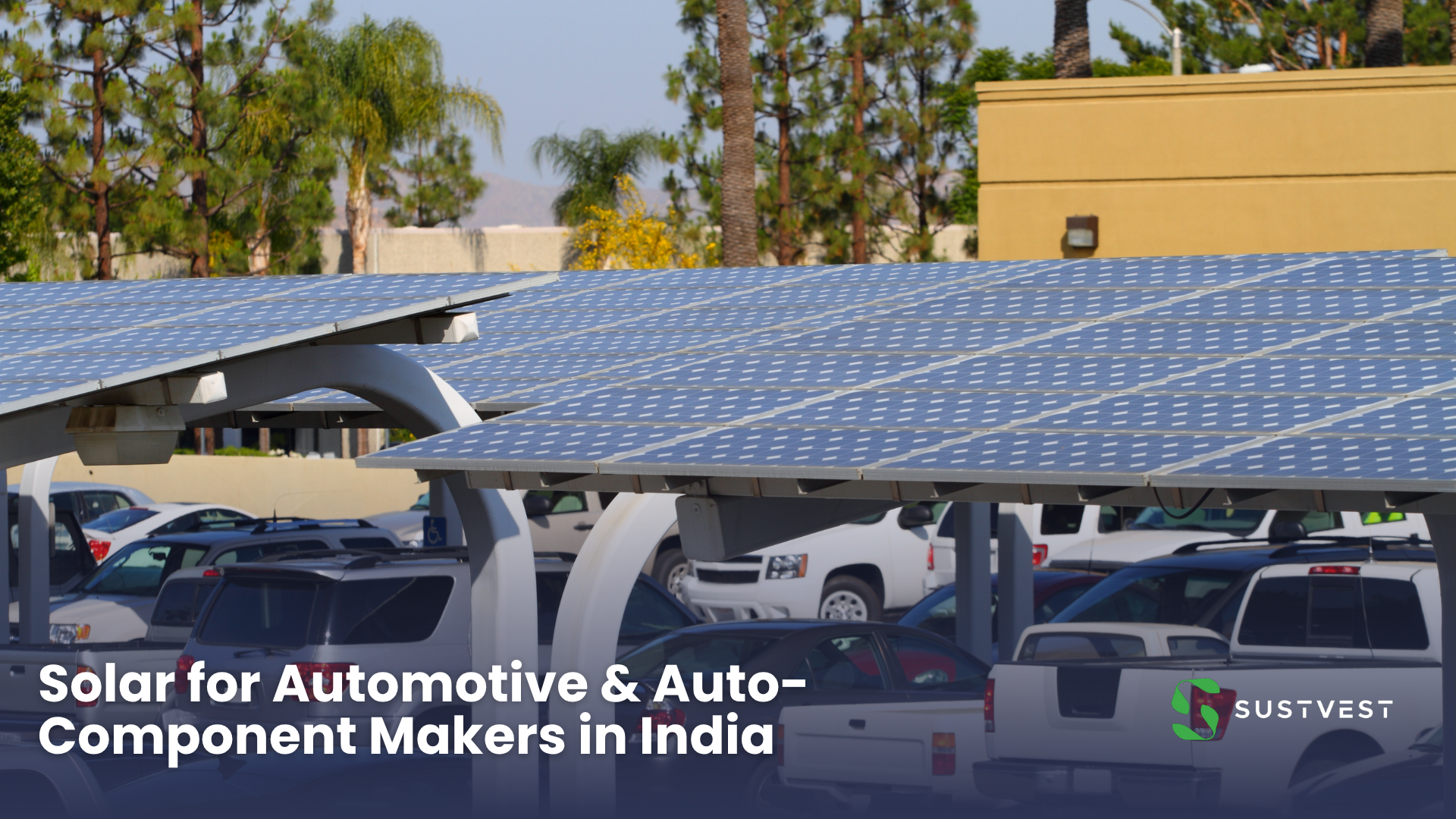
Solar for Automotive & Auto-Component Makers in India
For an auto-component manufacturer in 2026, rooftop solar is no longer just an energy-cost decision. Renewable-energy targets, customer sustainability requirements, and growing demand for reliable emissions data are making energy sourcing a more strategic supply-chain issue. Auto plants also have a natural technical fit for rooftop solar: large factory roofs and substantial daytime loads from presses, paint shops, welding, compressed air, and other production systems. The result is a business case that increasingly combines electricity savings with measurable renewable-energy and sustainability benefits.
Auto and auto-component plants are strong candidates for rooftop solar: they have large factory sheds, high daytime process loads (presses, paint shops, welding, compressed air), and pay industrial power tariffs — so a well-sized system can displace meaningful grid cost. In 2026, the decision is increasingly shaped by supply-chain sustainability as well as cost: OEMs are pursuing renewable-energy targets that can translate into supplier expectations, SEBI's BRSR framework requires large listed companies to disclose Scope 2 (purchased-electricity) emissions, and EU customers increasingly request carbon data from their suppliers. On-site solar can contribute to all of these — it cuts energy cost and produces metered renewable-generation data — though whether a specific renewable-energy claim can be made depends on the project's contractual and reporting arrangements. As always, the actual savings depend on your load, tariff, and roof — not a headline figure.
Here's why solar matters specifically for this sector and how to approach it.
Why is solar particularly relevant for auto-component makers in 2026?
Because the sector faces energy-cost pressure and renewable/sustainability pressure at the same time — and on-site solar can help with both. Automotive manufacturing is energy-intensive: high-tonnage presses, paint-shop climate control, robotic welding, and compressed-air systems often operate during production shifts, creating substantial daytime electricity demand — which is when solar generates. That daytime process load makes for good self-consumption, so a well-sized rooftop system can displace a meaningful share of grid power at industrial tariffs.
The compliance and supply-chain dimension is what has changed the conversation. Three pressures are increasingly relevant to component suppliers:
OEM renewable-energy and supplier expectations. Major automakers are pursuing renewable-electricity and decarbonisation targets, which can translate into renewable-energy and emissions-data expectations for their suppliers. The exact requirement varies by OEM, programme, and supplier relationship — this is a growing commercial expectation, not a universal mandate.
Indian ESG disclosure (SEBI BRSR). SEBI's Business Responsibility and Sustainability Reporting framework requires the top 1,000 listed entities by market capitalisation to report specified sustainability information, including Scope 2 emissions from purchased energy. This creates a growing need for reliable energy and emissions data across corporate operations and, in some cases, value chains.
EU customer and supply-chain requirements. EU climate and sustainability rules are raising the importance of product and supplier emissions data. The Carbon Border Adjustment Mechanism (CBAM), which entered its definitive regime in 2026, currently covers cement, iron and steel, aluminium, fertilisers, electricity, and hydrogen — not automotive components as a category. For an auto-component exporter, the more immediate relevance is usually indirect: EU customers may request emissions data for their own sustainability, procurement, or reporting needs, particularly where their supply chains involve CBAM-covered materials such as iron, steel, or aluminium. CSRD also has a defined and evolving scope (narrowed in 2026), so exporters should not assume it applies to them directly simply because they sell into Europe.
These pressures don't mean every component maker is legally required to install solar. Rather, they make reliable energy and emissions data increasingly valuable in customer relationships, sustainability reporting, and procurement decisions. On-site solar can contribute to all three: it reduces grid electricity consumption, generates metered renewable-energy data, and can support customer and ESG reporting — where the project's contractual and reporting arrangements allow the associated renewable attributes to be claimed. That combination of cost saving plus sustainability value is why solar has moved up the agenda for this sector.
What makes an auto-component plant a good technical fit for solar?
Large factory roofs, strong daytime process loads, and industrial tariffs combine to make many auto plants well-suited to rooftop solar. The specifics that matter:
Roof area. Automotive sheds and press shops tend to have large roof spans. As with any facility, the usable area depends on shading, existing rooftop equipment, and structural condition — so a structural assessment comes first.
Daytime load match. Presses, paint shops, welding, and compressed air run during production shifts, giving strong daytime demand that absorbs solar generation on site. High self-consumption is what makes solar most valuable where exported power is credited below the retail rate, as we cover in net metering vs net billing.
Multi-shift operations. Plants running two or three shifts have load beyond daylight hours — solar covers the daytime portion, and pairing with storage or open access can extend renewable coverage further (more on that below).
Process-critical reliability. Automotive lines are sensitive to interruption, so solar must integrate without any risk to production-critical power — system design and monitoring reliability matter.
The same principle from our manufacturing solar guide applies here: the value comes from matching generation to on-site consumption, sized to your actual load rather than to the roof.
How does solar help with OEM and ESG reporting requirements?
On-site solar produces detailed, metered generation records that can support renewable-energy tracking, OEM sustainability reporting, and ESG data collection — subject to the applicable reporting and renewable-claim rules. It's not enough to say you use renewable energy; you have to be able to evidence and report it. Modern solar systems come with monitoring that records generation in detail, which can support:
OEM vendor reporting — evidence of on-site renewable generation for customer sustainability programmes.
Scope 2 emissions accounting — on-site solar can reduce electricity purchased from the grid and therefore may reduce reported Scope 2 emissions under BRSR and similar frameworks, subject to the applicable accounting methodology and how the renewable attributes are treated.
Export carbon documentation — data to help respond to carbon-information requests from EU and other export-market customers.
An important nuance: metered generation data proves how much a system produced, but making a specific renewable-energy claim (for RE100, Scope 2, or an OEM programme) also depends on ownership of the renewable attributes, the contractual structure, and the rules of the relevant framework. Simply generating solar power does not automatically satisfy every reporting requirement. This is where monitoring matters — the detailed generation records it produces form part of the evidence base for renewable and carbon reporting, alongside the contractual and attribute arrangements. A component maker choosing solar partly for reporting value should treat robust, detailed monitoring as a core requirement.
That said, on-site rooftop solar usually can't cover a plant's entire electricity demand — roof area and daytime-only generation limit how much of total consumption it can meet. Meeting a high renewable target typically requires combining rooftop with other routes.
Can rooftop solar meet an auto plant's full renewable target?
Rarely on its own — for many energy-intensive, multi-shift auto plants, rooftop solar alone will not cover total electricity demand, so it's usually combined with green open access (often via group captive) to reach higher renewable shares. Rooftop solar is the efficient on-site foundation: behind-the-meter, it avoids the wheeling charges associated with off-site open-access power and displaces daytime grid consumption. But an energy-intensive, multi-shift auto plant usually consumes far more than its roof can generate, so covering a large share of total demand — or moving toward an OEM-linked renewable target — generally means adding off-site renewable power.
That's where green open access comes in: renewable power from a large off-site plant, delivered through the grid. Many larger manufacturers use group-captive structures for this. Depending on the structure and applicable state and regulatory rules, captive status can provide relief from certain open-access charges (such as cross-subsidy and additional surcharge), but the economics are highly state-specific — we explain the mechanics and the charge considerations in that post. The common approach for a serious renewable target is a sequence: optimise rooftop first for on-site daytime load, then layer open access to cover more of the demand. Storage plays a different role again — it can shift renewable energy into non-solar hours, while open access adds renewable generation beyond what the rooftop can produce.
The practical takeaway: rooftop solar is a natural place for most auto-component makers to start — it's the most straightforward on-site starting point — but it's usually one part of a broader renewable strategy, not the whole answer.
Should an auto-component maker use OPEX or CAPEX for solar?
Either works; the choice depends on your balance sheet, tax position, and whether you want to own the asset — the standard C&I funding decision. Under CAPEX, you fund and own the system and retain its ownership economics; under OPEX/RESCO, a developer funds and owns it and you buy the power with no upfront capital. We compare the two in OPEX vs CAPEX solar for business.
For component makers, one factor is worth noting: the reporting value of solar (metered renewable-generation data) is available under either model — the solar plant can provide generation data whether you own the system or buy the power under a PPA. The customer's ability to make specific renewable-energy claims, however, depends on the PPA structure, ownership of the environmental attributes, and the applicable reporting framework. So the OPEX-vs-CAPEX choice can be made largely on financial grounds (capital, tax, appetite for ownership). Working-capital-sensitive suppliers often favour OPEX to keep capital in the core business; those with a strong tax position and capital may prefer CAPEX. Multi-plant groups sometimes use both.
The bottom line for automotive and auto-component makers
For this sector in 2026, solar sits at the intersection of two pressures that used to be separate: energy cost and renewable/sustainability expectations. A well-sized rooftop system cuts power costs on energy-intensive processes, and — increasingly relevant now — it produces metered renewable-generation data that can support OEM supply-chain programmes, SEBI's BRSR disclosures, and EU customer carbon-data requests, subject to the applicable reporting and renewable-claim rules. None of this makes solar a universal legal requirement, but together these drivers make reliable energy and emissions data strategically valuable for a component supplier. Rooftop solar is the natural starting point: on-site daytime generation, sized to your load. For higher renewable targets it's usually paired with open access, but the roof is often the most straightforward starting point for combining on-site cost savings with renewable-energy generation. As with any facility, the real numbers come from modelling your specific plant — but for an energy-intensive supplier facing renewable expectations from its customers, that modelling is increasingly worth doing.
SustVest designs rooftop solar for automotive and auto-component plants under OPEX and CAPEX models — sized to your process load, with in-house monitoring that produces detailed, metered generation records for your OEM and ESG reporting. Ranked #8 among India's rooftop solar project developers in CRISIL Intelligence's CY2025 ranking (India Solar Rooftop Map, December 2025) — a ranking of project-development activity, not an endorsement — with 83+ projects delivered across 13+ states (company figures), we help suppliers turn a sustainability expectation into a cost saving. Book a free site assessment to see what your plant's roof and load can deliver.
Frequently Asked Questions
Why is rooftop solar important for auto-component manufacturers? For auto-component makers, solar can address two pressures at once: it cuts electricity cost on energy-intensive processes (presses, paint shops, welding), and it produces metered renewable-generation data that supports the sustainability expectations increasingly coming from OEM supply-chain programmes, SEBI's BRSR disclosure, and EU customers. In 2026, renewable energy has become a supply-chain and reporting consideration for many suppliers, not only a cost one — though the specific requirements vary by company and relationship.
Do car makers require their suppliers to use renewable energy? Some major automakers have renewable-energy and decarbonisation targets that can translate into renewable-energy or emissions-data expectations for suppliers. However, requirements vary by OEM, programme, and supplier relationship, so this is a growing commercial expectation rather than a universal mandate. Being able to demonstrate documented renewable energy use can help a tier-1 or tier-2 supplier in customer sustainability programmes.
How does solar help with BRSR or ESG reporting? On-site solar generates metered renewable electricity that offsets purchased grid power, which can reduce the Scope 2 emissions that frameworks like SEBI's BRSR require the top 1,000 listed companies to disclose — subject to the applicable accounting methodology and how the renewable attributes are treated. The monitoring data from the solar system provides part of the evidence base for that reporting, alongside the contractual and attribute arrangements, and can also support OEM vendor programmes and export carbon-data requests.
Can rooftop solar power an entire automotive plant? Usually not on its own. Roof area and daytime-only generation limit how much of a multi-shift, energy-intensive plant's total demand rooftop solar can meet. Many auto plants aiming for a high renewable share combine rooftop solar with green open access (often via a group captive structure) and sometimes storage, starting with rooftop as the on-site foundation.
Is solar worth it for an auto-component maker? The economics depend on your electricity tariff, self-consumption, roof, and system sizing rather than a single figure, and should be modelled for the specific plant. Beyond direct energy savings, solar increasingly carries sustainability value — supporting OEM expectations and ESG data needs — which is part of why many component makers treat it as strategic rather than optional.
Should an auto-component maker choose OPEX or CAPEX for solar? Both work, and the metered generation data for reporting is available under either — though the ability to make specific renewable-energy claims depends on the contract structure and ownership of the environmental attributes. The choice is largely financial: OPEX (no upfront capital, developer owns the system, you buy the power) suits working-capital-sensitive suppliers, while CAPEX (you fund and own the system) suits those with capital and a strong tax position. Some multi-plant groups use both.
Sources
SEBI — Business Responsibility and Sustainability Reporting (BRSR) / BRSR Core: applicability to the top 1,000 listed entities by market capitalisation; Scope 2 (purchased-energy) emissions disclosure
SEBI — March 2025 circular on ESG value-chain disclosure/assurance (current treatment of value-chain reporting)
European Commission — CBAM definitive regime (2026): covered sectors are cement, iron and steel, aluminium, fertilisers, electricity, hydrogen (not automotive components as a category)
European Commission — CSRD / revised ESRS developments in 2026, including proposed scope simplification and value-chain reporting limits (revised ESRS adopted July 2026, subject to scrutiny period)
RE100 / Climate Group — Technical Criteria and 2026 Reporting Guidance (renewable-electricity sourcing and claim criteria)
Tata Motors — renewable-energy strategy / 2030 RE100 target and 2026 wind-solar hybrid PPA (illustrative OEM renewable activity)
Green Energy Open Access Rules, 2022 / group captive — off-site renewable procurement (see SustVest open-access post; state-specific charges)
CRISIL Intelligence — India Solar Rooftop Map, December 2025; SustVest ranked #8 among rooftop solar project developers (CY2025)
SustVest — rooftop solar delivery for C&I including auto/manufacturing; 83+ projects, 13+ states (company figures)