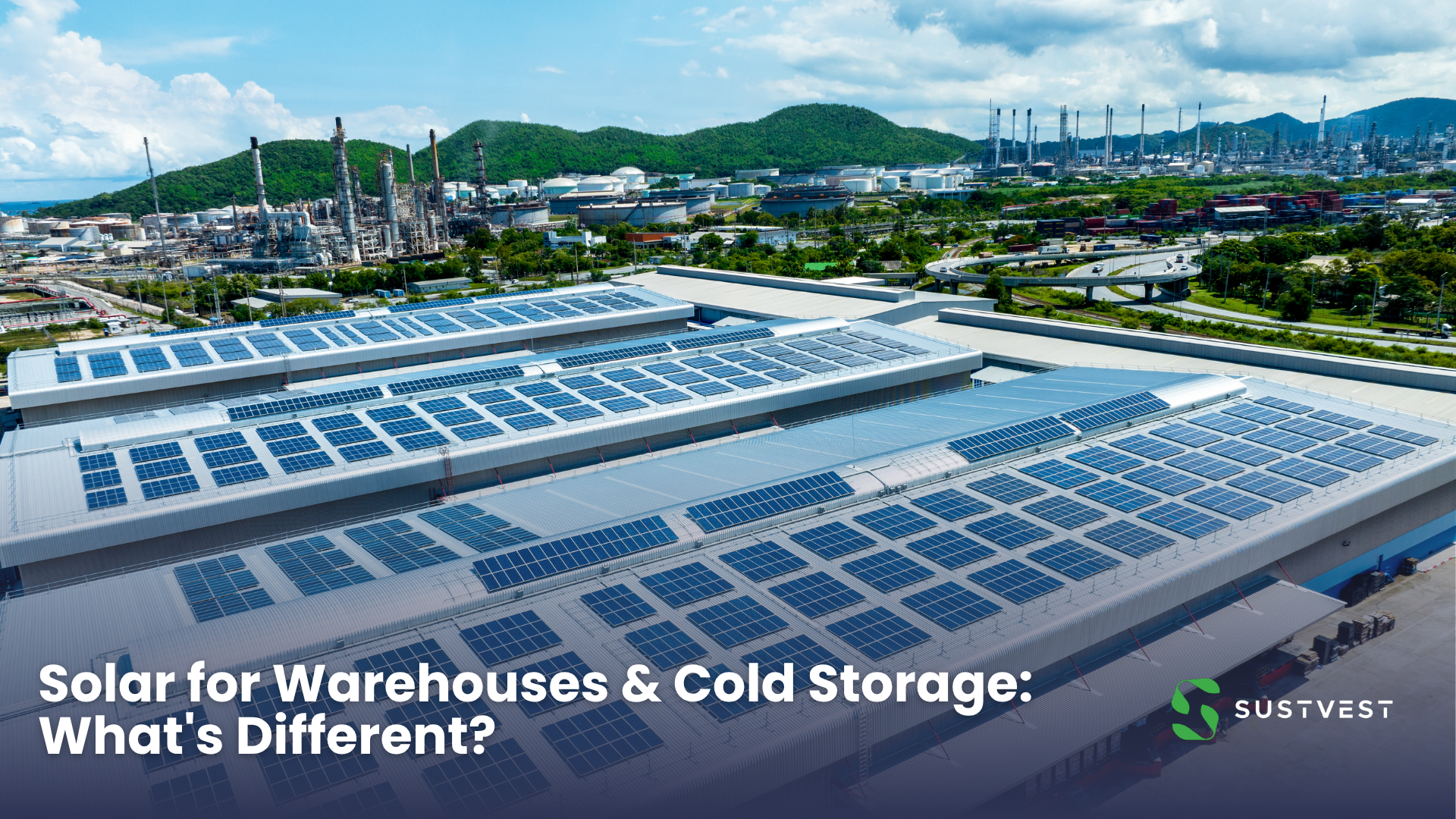
Solar for Warehouses & Cold Storage: What's Different?
Warehouses and cold storage often offer two useful ingredients for rooftop solar: large, flat, unshaded roofs and meaningful electricity demand, over facilities that pay industrial power tariffs. But the two aren't the same solar proposition. A dry warehouse and a refrigerated cold store have very different load profiles, and that difference changes the economics substantially. For cold storage in particular, the fit can be a particularly strong one — and it's worth understanding why.
Warehouses and cold storage are strong candidates for rooftop solar because they combine large roof areas with meaningful daytime electricity demand. Cold storage is the stronger fit of the two: it requires round-the-clock temperature control, creating substantial electricity demand across the day — so, when the system is sized to the facility's load, a high share of solar generation can be consumed on site rather than exported. Where a state or DISCOM credits exported power below the value of electricity consumed behind the meter, that self-consumption is exactly what makes solar most valuable. Dry warehouses have lighter, more variable loads (lighting, material handling, HVAC, increasingly EV charging), so the solar case depends more on how much daytime load the facility actually runs. For both, the economics turn on self-consumption, roof suitability, and tariff — not on a headline savings figure.
Here's what's different about solar for these facilities and how to think about it.
Why is cold storage such a good fit for rooftop solar?
Because refrigeration is a large, relatively continuous electrical load — and solar's value is highest when the power is used on site as it's generated. Refrigeration is typically one of the largest electrical loads in a cold store, with temperature-control systems operating across both daytime and nighttime hours to hold temperature. (Compressors cycle and modulate with temperature, product load, ambient conditions and defrost cycles rather than running flat-out continuously, but the facility's overall demand stays substantial through the day.) That means a cold storage facility has meaningful demand during exactly the hours solar is generating, so — when the system is sized to the load — a high share of the solar output can be self-consumed rather than exported to the grid.
This matters more than it first appears, for a specific policy reason. Where a state or DISCOM uses net billing or another export-credit mechanism that values exported electricity below the retail rate you pay for grid power, the value of solar increasingly comes from self-consumption — using your own generation rather than exporting it cheaply. We explain this shift in net metering vs net billing. A facility that consumes most of what it generates captures far more value than one that exports a large surplus. Because cold storage has substantial electricity demand across the day, it can often achieve strong solar self-consumption when the system is appropriately sized — which is why it's frequently cited as a strong industrial rooftop category in India.
A second factor: many cold stores use diesel generators for backup during outages, and diesel power is considerably more expensive than grid or solar power. Where a cold store uses diesel generation for backup, a suitably designed solar-plus-storage system may also reduce diesel runtime during eligible operating conditions — though a standard grid-connected solar plant typically shuts down during an outage unless it has appropriate islanding/backup architecture. The economics depend on the facility's outage profile, backup design, battery sizing, and diesel cost.
How is a dry warehouse different from cold storage for solar?
A dry warehouse has a lighter and more variable load, so its solar case depends more on how much daytime demand it actually has. A typical distribution warehouse draws power for lighting, material-handling equipment (conveyors, dock levellers, forklift charging), HVAC or ventilation, and increasingly EV charging for delivery fleets. These loads are real but generally smaller and more intermittent than continuous refrigeration.
The practical implications:
Self-consumption varies more. A busy, well-lit, multi-shift warehouse with material handling and EV charging can self-consume a healthy share of solar output; a lightly-used storage shed may export more, which is worth less where exported power is credited below the retail rate.
The roof is still an asset. Warehouses often have very large roofs relative to their electrical load, so the constraint can flip — the question becomes how much generation you can use, not how much the roof can hold. Sizing to on-site consumption (rather than filling the roof) is usually the more economic approach, unless favourable export terms or open access change the maths.
EV charging changes the picture. As logistics fleets electrify, warehouse daytime load is rising — which improves the solar fit, because fleet charging can absorb daytime generation directly.
For both facility types, the same principle from our manufacturing solar guide applies: the value comes from matching generation to on-site consumption, not from the roof size alone.
What determines the savings for a warehouse or cold storage solar system?
The savings depend on your tariff, your self-consumption share, your roof, and your sizing — not on a single national figure. The levers that actually move the outcome:
Your electricity tariff. The value of each unit displaced by solar depends on the applicable electricity tariff, including energy and demand charges. For energy-intensive facilities like cold stores, electricity can represent a significant share of operating cost, so displacing grid units has a larger effect on the bottom line.
Self-consumption share. The proportion of solar output you use on site (rather than export) is the single biggest driver of value where exported power is credited below the retail rate. Continuous loads (refrigeration) tend to push this high when sizing is right; intermittent loads push it lower.
Roof suitability. Large flat or low-slope roofs are well-suited to solar, but the structure must be assessed — older roofs, or those with heavy existing loads, may need evaluation. Cold-store roofs may have additional insulation, waterproofing, and thermal-envelope considerations, so the mounting approach should be selected accordingly.
Demand charges. Where the tariff includes demand charges and peak demand occurs when solar cannot fully cover the load, pairing solar with battery storage may help reduce recorded peaks — relevant for cold stores with compressor-driven peaks. The value depends on the applicable tariff and load profile.
Diesel displacement. Where a suitably designed solar-plus-storage system reduces reliance on expensive diesel backup, the value per displaced unit can be higher.
Because these vary so much between facilities, the only reliable way to know the savings for your warehouse or cold store is to model your actual load profile and tariff — which is why any credible proposal starts with your consumption data, not a generic per-square-foot estimate. For how project cost itself is built up, see our rooftop solar cost guide.
What are the special considerations for cold storage solar?
Cold storage brings a few facility-specific factors that a standard rooftop assessment must account for. Beyond the strong economic fit, watch for:
Roof structure and insulation. Cold store roofs may have additional insulation, waterproofing, and thermal-envelope considerations, and can differ structurally from standard industrial roofs; the mounting approach should be selected so that fixings and penetrations don't compromise the thermal envelope.
Load profile varies by facility type. "Cold storage" covers frozen, chilled, controlled-atmosphere, blast-freezing, and packhouse operations, and the electrical load profile can differ substantially between them. Two cold stores with similar floor area can have very different solar economics depending on storage temperature, product turnover, refrigeration system, occupancy, and operating schedule — another reason to model the specific facility rather than use generic figures.
Load-reduction first. Solar sizing should follow the reduced load, not the current one. Efficiency measures — better insulation, fast roll-up doors, efficient compressors and controls — cut refrigeration demand, and it's more economic to size solar to an optimised load than to an inefficient one. Solar complements efficiency; it doesn't replace it.
Refrigeration continuity. Solar and any storage must integrate without any risk to temperature-critical refrigeration — the cold chain cannot be interrupted, so system design and O&M reliability matter more than in a dry facility.
Compliance and cold-chain standards. Facilities operating under food-safety, pharmaceutical, or export requirements should ensure that solar installation and associated works do not compromise temperature control, hygiene, building integrity, safety systems, or applicable compliance requirements.
These aren't obstacles — they are design considerations that need to be addressed properly — but they're reasons the work should be done by a developer who understands refrigerated facilities, not treated as a generic rooftop.
Should a warehouse or cold store use OPEX or CAPEX for solar?
Either can work; the choice depends on your balance sheet, tax position, and appetite for owning the asset — the same decision every C&I buyer faces. Under CAPEX, you fund and own the system and retain the project's ownership economics over its operating life; under OPEX/RESCO, a developer funds and owns it and you buy the power with no upfront capital. We compare the two in detail in OPEX vs CAPEX solar for business.
For logistics and cold-chain operators specifically, two factors often tilt the decision. Working-capital-sensitive operators may prefer OPEX to keep capital in the core business. But operators with a strong tax position and capital to deploy may prefer CAPEX to capture ownership benefits over the system's life. Multi-site logistics portfolios sometimes use both — CAPEX where it pays, OPEX elsewhere. There's no universal answer, only the right fit for your facility and finances.
The bottom line for warehouse and cold storage operators
Warehouses and cold stores can be strong candidates for rooftop solar in Indian industry — big roofs, industrial tariffs, and, for cold storage especially, an around-the-clock temperature-control load that creates the conditions for strong self-consumption when the system is properly sized. That last point is the crux: where billing credits exported power below the retail rate, the facilities that use most of what they generate benefit most, and cold storage is well-placed on that measure. But the real numbers — savings, sizing, payback — depend entirely on your load, tariff, and roof, so the right figure comes from modelling your facility, not a headline per-square-foot claim. For an energy-intensive cold store, that modelling is well worth doing.
SustVest designs rooftop solar for warehouses, logistics parks, and cold storage under OPEX and CAPEX models — sizing to your actual load profile, with in-house monitoring and O&M, and battery storage where peak demand justifies it. Ranked #8 among India's Top 10 rooftop solar project developers in CRISIL Intelligence's India Solar Rooftop Map (December 2025), with 83+ projects delivered across 13+ states, we model the numbers on your facility, not a generic estimate. Book a free site assessment to see what your roof and load can deliver.
Frequently Asked Questions
Is rooftop solar worth it for a cold storage facility? Cold storage is often a strong industrial fit for rooftop solar in India. Because it requires round-the-clock temperature control, a cold store has substantial electricity demand through the day, so — when the system is sized to its load — it can consume a high share of its solar generation on site rather than exporting it. That is especially valuable where exported electricity is credited below the value of electricity consumed behind the meter. The actual savings depend on tariff, self-consumption, and sizing, so they should be modelled for the specific facility.
Why can cold storage be a stronger solar fit than a dry warehouse? Cold storage typically has substantial electricity demand across both daytime and nighttime hours because temperature control must be maintained around the clock, which helps absorb solar generation on site when the system is properly sized. A dry warehouse has lighter, more variable loads — lighting, material handling, HVAC — so its self-consumption, and therefore its solar value, depends more on how actively the facility is used during daylight hours.
How much can solar save a warehouse or cold storage business? There is no single figure — savings depend on your electricity tariff, how much of the solar you consume on site, your roof, and system sizing. Energy-intensive facilities generally see solar displace higher-value grid units. The reliable way to estimate savings is to model your actual load profile and tariff rather than rely on a per-square-foot estimate.
Does solar work with a cold store's refrigeration and insulation? Yes, but it needs facility-aware design. Cold store roofs are insulated and may differ structurally from standard industrial roofs, so mounting and penetrations must be handled without compromising the thermal envelope, and the system must integrate without any risk to temperature-critical refrigeration. This is why cold storage solar should be done by a developer experienced with refrigerated facilities.
Should solar sizing come before or after energy-efficiency improvements? Efficiency first, then size solar to the reduced load. Measures like better insulation, fast roll-up doors, and efficient compressors cut refrigeration demand, and it's more economic to size a solar system to an optimised load than to an inefficient one. Solar complements efficiency measures rather than replacing them.
Can warehouse solar support EV charging for delivery fleets? Yes, and it's an increasingly good match. As logistics fleets electrify, daytime charging load rises, which solar can supply directly — improving self-consumption and the overall solar economics. Warehouses planning fleet electrification should factor expected charging load into solar sizing.
Sources
Primary / institutional
Bureau of Energy Efficiency (BEE) / World Bank — cold-chain energy-efficiency work on India (refrigeration as a dominant load; insulation, fast roll-up doors, and efficient compressors/controls as demand-reduction measures) — beeindia.gov.in; worldbank.org
Applicable State Electricity Regulatory Commission / DISCOM regulations — rooftop-solar compensation mechanisms (net metering, net billing, gross/feed-in), which vary by state
CRISIL Intelligence — India Solar Rooftop Map, December 2025 (SustVest ranked #8 among Top 10 rooftop solar project developers)