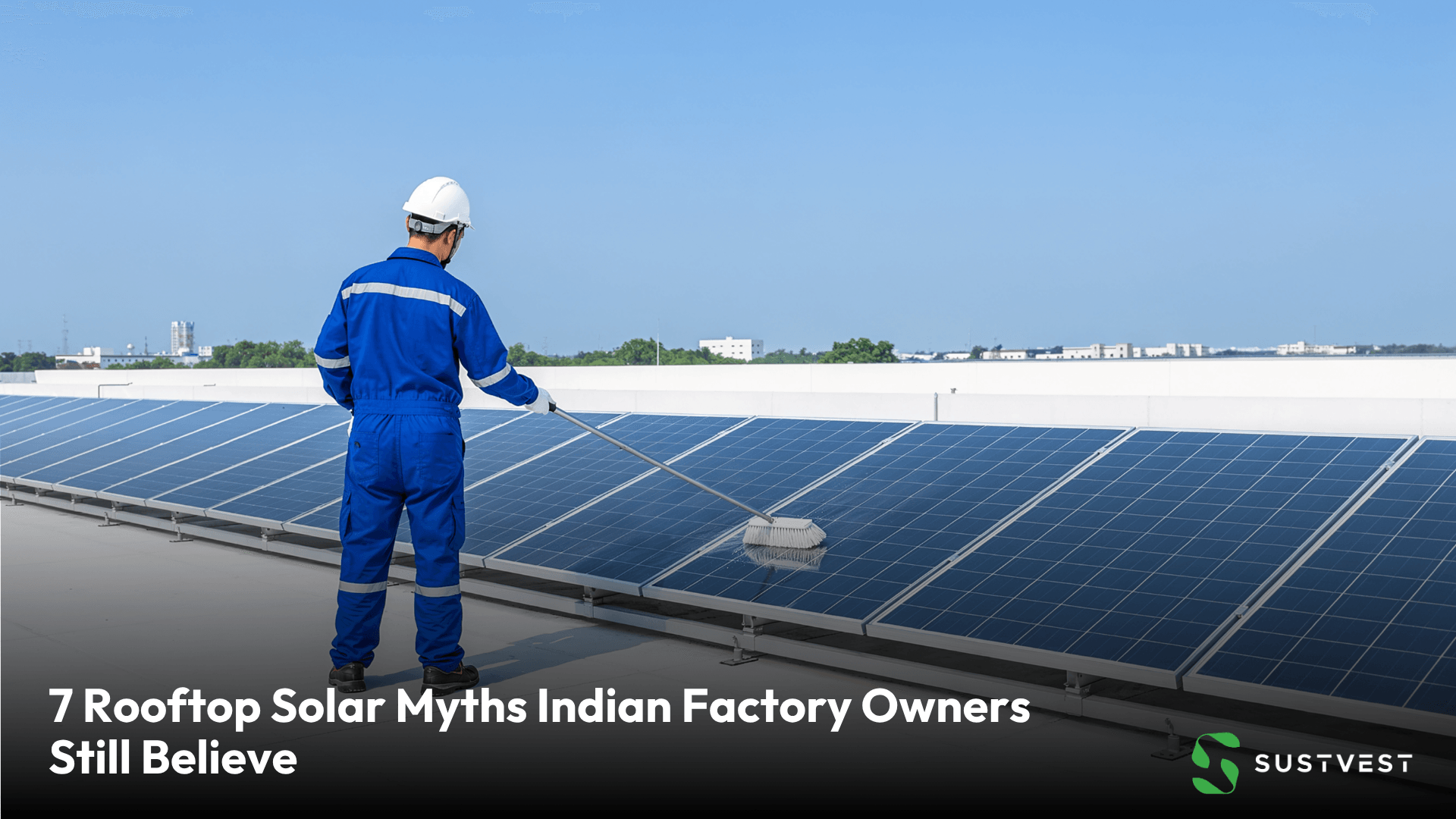
7 Rooftop Solar Myths Indian Factory Owners Still Believe
Most factory owners in India have heard a solar pitch by now. Many still say no, and often the reason is a myth rather than a real problem with their site.
Some myths make solar look harder than it is. Others make it look easier, which causes disappointment later. Both kinds cost money.
Here are seven common beliefs, what the evidence says, and what each one means for a plant head or CFO weighing up rooftop solar.
Myth 1: Does rooftop solar always need a big upfront investment?
No. Under the OPEX or RESCO (Renewable Energy Service Company) model, the developer pays for the plant and you pay only for the power it produces, at a per-unit tariff. Your capital stays in your core business.
There are two main ways to go solar:
| Point | CAPEX (you buy the plant) | OPEX / RESCO (developer owns the plant) |
|---|---|---|
| Upfront cost | You pay for the full plant | Zero upfront cost |
| Who owns the plant | Your company | The developer, for the contract period |
| What you pay | Your own running and maintenance costs | A fixed per-unit tariff for solar power used |
| Who maintains it | You, or a contractor you hire | The developer |
| Best for | Companies with spare capital that want the full savings | Companies that want lower bills without using capital |
The zero investment rooftop solar route suits factories that would rather spend capital on machines or expansion. Our explainer on how the RESCO model works for factories walks through the contract step by step.
Myth 2: Will rooftop solar keep my factory running during a power cut?
Not on its own. A standard grid-connected solar plant is designed to switch off when the grid goes down, for safety. This surprises many owners.
The rule comes from the Central Electricity Authority (CEA). Its connectivity regulations for distributed generation require a plant to stop feeding the grid within two seconds of an "unintended island" forming. An island is a small pocket of the network that stays live while the main grid is down.
Why? Line workers repairing a fault expect the lines to be dead. A solar plant pushing power back into them would be dangerous.
If backup power matters, for example for a cold room, a server room or a critical process line, you need a hybrid setup with battery energy storage. The battery and a suitable inverter let the plant supply chosen loads safely while the grid is off.
Myth 3: Do solar panels stop working after 5 to 10 years?
No. Panels lose output slowly. A large study by the US National Renewable Energy Laboratory found a median loss of about 0.5% a year. The NREL review of photovoltaic degradation rates covered nearly 2,000 measured rates from field tests over 40 years.
At that rate, a panel would still give about 95% of its first-year output after 10 years, and about 88% after 25 years. Real results vary by panel quality, climate and care, so check the performance warranty in your contract.
The parts most likely to need attention during a plant's life are inverters, cables and connectors, not the panels themselves. That is why a plan for solar plant operations and maintenance matters more than the panel brand alone.
Myth 4: Is India too hot for solar panels to work well?
Heat does reduce output a little, but India's strong sunshine more than makes up for it. Panels convert light, not heat, into electricity.
Most of India gets 4 to 7 kWh (kilowatt hours) of solar energy per square metre per day, according to Invest India, the national investment promotion agency. That is among the better solar resources in the world.
The heat penalty is real but modest. NREL's PVWatts design guide uses a temperature coefficient of minus 0.37% per degree Celsius for standard crystalline silicon panels. Panel ratings are measured at 25°C cell temperature. If cells run 25°C hotter than that on a summer afternoon, output drops by roughly 9%.
A good design keeps this in check. Leaving a gap under the panels for air flow, choosing the right mounting structure, and avoiding hot spots all help.
Myth 5: Is rooftop solar maintenance-free?
No. Solar has no moving parts, but dust is a real and steady loss in India. Panels that are not cleaned give less power every day.
A field study in Gandhinagar, Gujarat, co-authored with IIT Gandhinagar researchers, found that soiling cut solar output by about 0.37% per day when panels were left uncleaned. Over a dry fortnight that adds up quickly.
Basic maintenance for a factory plant includes:
- regular panel cleaning, more often in dry and dusty months,
- checks on inverters, cables, earthing and connectors,
- tightening of mounting structure bolts,
- and a daily look at generation data to catch faults early.
Live solar plant monitoring shows when output falls below what the weather says it should be. For a full schedule, see our rooftop solar O&M checklist for factories.
Myth 6: Will solar panels damage my factory roof?
Not when the roof is checked first and the plant is designed for it. Problems come from skipping the survey, not from solar itself.
Most issues fall into three groups:
- Leaks. On metal sheet roofs, poorly sealed fixings can let water in. Using the right clamps and sealing methods avoids drilling where it is not needed.
- Load. The roof structure must carry the added weight and wind load. A structural check confirms this.
- Old sheets. If the roof will need replacing in a few years, it is usually better to replace it before the plant goes up.
Before you sign, ask for a site survey and a structural assessment. Our factory roof solar readiness checklist lists the ten points to check.
Myth 7: Are all solar panels the same quality?
No. Quality varies, and India sets mandatory standards that panels, inverters and batteries must meet. Ask your developer to show compliance before installation.
In January 2025, the Ministry of New and Renewable Energy (MNRE) notified a revised Quality Control Order for solar photovoltaic products. It says solar modules, inverters and storage batteries must conform to the latest Indian Standards and carry the Standard Mark under a licence from the Bureau of Indian Standards (BIS).
Beyond the mark, check:
- the panel and inverter make and model named in the contract,
- the product and performance warranties, and who honours them,
- and the developer's track record with plants that have run for several years.
What should a factory owner do next?
Start with your data: your electricity bill, your roof and your load pattern. These three decide whether solar makes sense and how big the plant should be.
- Collect 12 months of electricity bills.
- Get a roof survey and structural check.
- Decide whether you want to own the plant or pay per unit.
- Ask about backup needs before design, not after.
- Compare developers on track record, maintenance and monitoring, not only on price.
Clearing up these myths early is likely to save weeks of back and forth, and avoid a plant that does not match what you expected.
FAQ
Does rooftop solar work during a power cut?
A standard grid-connected plant switches off when the grid fails, as required by CEA safety rules. To run critical loads during outages, you need a hybrid system with battery storage.
How long do solar panels last?
Panels lose output slowly. An NREL review found a median loss of about 0.5% a year, so a panel would keep roughly 88% of its first-year output after 25 years at that rate.
Can I get rooftop solar without paying upfront?
Yes. Under the OPEX or RESCO model, the developer funds, builds, owns and maintains the plant, and you pay a per-unit tariff for the solar power you use.
How often should factory solar panels be cleaned?
It depends on local dust. A Gandhinagar field study found output fell about 0.37% per day without cleaning, so dusty sites need frequent cleaning, guided by generation data.
Do solar panels in India need BIS certification?
Yes. MNRE's 2025 Quality Control Order requires solar modules, inverters and storage batteries to meet Indian Standards and carry the BIS Standard Mark.
About SustVest
SustVest (SolarGridX Ventures Pvt Ltd) is a rooftop solar developer in India, ranked in the CRISIL Top 10 (#5 in 2026), running 80+ distributed solar plants of about 30 MW across 13 states. We fund, build, own and maintain rooftop plants for factories, hospitals, hotels and institutions under the OPEX/RESCO model, so clients pay a lower per-unit tariff with zero upfront cost. Have a question about your roof? Get a free rooftop solar assessment for your factory.
Sources
- CEA: Compendium of Regulations, including the Technical Standards for Connectivity of Distributed Generation Resources Regulations, 2013 (Regulation 11(6))
- NREL: Photovoltaic Degradation Rates, An Analytical Review (Progress in Photovoltaics, 2013)
- Invest India: India's Rising Solar Sector
- NREL PVWatts: System Design help (temperature coefficients)
- Valerino et al., Solar Energy (2020): Soiling impacts, a field study in Western India
- PIB: MNRE notifies Revised Quality Control Order for Solar Photovoltaic Products (29 January 2025)