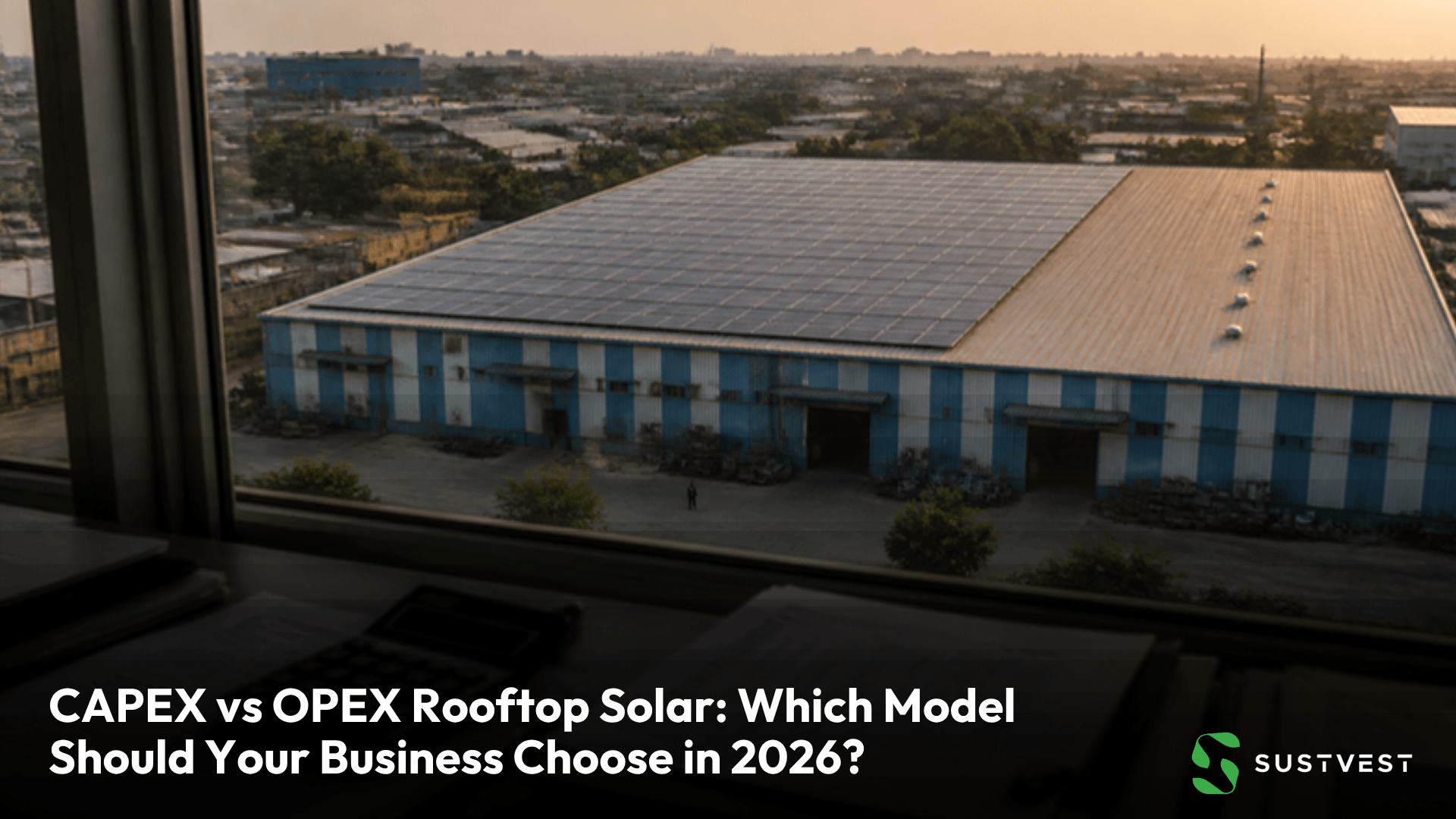
OPEX vs CAPEX Rooftop Solar: Which Should Your Factory Choose?
By SustVest Last reviewed:
Choose CAPEX (you buy and own the plant) if you have spare cash, enough taxable profit to use the depreciation, and a long future on the same roof. Choose OPEX (a developer owns the plant and you pay only for the units it makes) if your capital earns more inside your business, or you do not want to run a power plant. If your roof, your lease or your power use is uncertain, neither model fits yet: fix that first.
This guide is the decision page. It puts both models side by side, walks through the questions that actually decide the answer, and ends with four short scenarios so you can see where your own site lands.
What is the difference between CAPEX and OPEX rooftop solar?
In CAPEX (capital expenditure), you pay for the plant and own it. In OPEX (operating expenditure), a developer pays for it, owns it and maintains it, and you pay a fixed per-unit tariff for the power it generates.
OPEX is also called the RESCO (Renewable Energy Service Company) model. The contract behind it is a PPA (power purchase agreement), which sets your tariff, any yearly escalation, the term and the exit terms. If you want the full mechanics, our explainer on the zero investment rooftop solar RESCO model covers how it works step by step.
A simple way to picture it: CAPEX is buying the building, OPEX is signing a long lease on the space. Both get you the space. Only one ties up your own money and puts the asset on your books.
How do CAPEX and OPEX compare side by side?
CAPEX usually gives the larger lifetime saving. OPEX gives a smaller saving from the first bill, with no upfront cost and less work. The table shows where each model puts the money, the risk and the effort.
Question | CAPEX (you own) | OPEX / RESCO (developer owns) |
|---|---|---|
Upfront cost | Full project cost, from your cash or a loan | Zero or close to it |
What you pay over time | Loan repayments (if financed) and upkeep | A per-unit tariff, only on units generated |
Lifetime saving | Highest, once the plant has paid for itself | Lower, but positive from month one if the tariff is below your grid rate |
Who maintains the plant | You, or a paid O&M (operations and maintenance) contractor | The developer |
Who carries performance risk | Mostly you | Mostly the developer, since it earns only on generation |
Tax depreciation | You claim it | The developer claims it |
Effect of interest rates | Direct, if you borrow | Fixed into your tariff once the PPA is signed |
Contract | EPC (engineering, procurement and construction) contract, then you own it | Long-term PPA with buyout and end-of-term terms |
Best for | Cash-rich, profitable, long-stay owners | Owners who want savings without capital or plant work |
You can read more about each route on our pages for CAPEX rooftop solar and the OPEX solar model.
Which saves more money over the life of the plant?
CAPEX almost always saves more in total, because you are not paying a developer's margin. But that larger saving is a return on your own capital, so it is only "better" if that capital has nothing more profitable to do.
The fair test is not "CAPEX saving vs OPEX saving". It is "CAPEX saving vs what the same money would earn elsewhere in your business, plus the OPEX saving". A factory that earns a strong return on a new machine or more working capital may be better off keeping its cash there and taking the OPEX saving on top.
To compare honestly, ask for both options on the same roof and the same generation estimate, then put three numbers next to each other:
CAPEX: total project cost, expected yearly generation, and the yearly O&M cost you will carry.
OPEX: the year-one tariff, the escalation each year, and the term.
Your grid rate: the energy charge you actually pay per unit today, from your own bill.
Use the energy charge per unit, not the total bill divided by units, because fixed and demand charges usually do not fall when you add solar.
How long does CAPEX take to pay back, and does OPEX have a payback at all?
CAPEX payback is simply the project cost divided by the yearly saving after upkeep. OPEX has no payback period in the usual sense, because there is no large investment to recover.
As a worked illustration only (replace these with your own quotes): a plant costing ₹1 crore that saves ₹25 lakh a year after O&M pays back in 4 years. Every month after that is close to free power for the rest of the plant's life.
Three things move CAPEX payback more than anything else:
Your grid tariff. The higher your per-unit rate, the faster solar pays.
How much you use in the daytime. Solar is worth most when you consume it on site. Export rules differ by state and are often tight.
Real generation. Ask any supplier for the yearly units they expect per kWp (kilowatt-peak) on your roof, and how they got that number.
Who gets the tax benefit, and is it worth much?
The owner of the plant claims depreciation. Under CAPEX that is you. Under OPEX it is the developer, and some of that benefit is usually reflected in the tariff you are offered.
The Income Tax Department's table of depreciation rates (New Appendix I) lists "solar power generating systems" under renewable energy devices at 40%, on a written-down-value basis.
As an illustration: on a ₹1 crore plant, 40% is a ₹40 lakh deduction in the first year. At an assumed 25% effective tax rate, that defers about ₹10 lakh of tax. It only helps if you have enough taxable profit to absorb it. Timing within the financial year and the current rules also matter, so have your chartered accountant confirm the position for your company before you count on it.
Not sure which side of the line your site falls on? SustVest builds both. Ask for a CAPEX and an OPEX proposal on the same roof and compare them like for like.
Does GST change the choice between CAPEX and OPEX?
It narrowed the gap in CAPEX's favour slightly. GST (Goods and Services Tax) on renewable energy devices was cut from 12% to 5%, effective 22 September 2025. The Ministry of New and Renewable Energy announced this in a PIB release on the GST cut for renewable energy devices, noting that it lowers module and component costs.
A turnkey CAPEX contract mixes goods and services, so the tax on your total invoice depends on how the contract is split. Under OPEX, you pay GST as part of the power tariff arrangement instead. Our post on GST on rooftop solar for CAPEX vs OPEX goes through both cases. Always ask for the tax split on every quote.
Do rising interest rates tilt the decision?
Yes, a little. Higher rates make a loan-funded CAPEX plant more expensive, while an OPEX tariff is fixed by contract once you sign.
The Reserve Bank of India raised the policy repo rate by 25 basis points to 5.50% on 7 October 2026, according to the RBI Governor's statement of 7 October 2026. The minutes of the October 2026 Monetary Policy Committee meeting record a 6 to 0 vote.
Developers borrow too, so new OPEX tariffs can feel the same pressure. The difference is who carries it after signing. With OPEX, your tariff and escalation are locked in the PPA. With a floating-rate CAPEX loan, a later rise lands on you.
When does CAPEX win, when does OPEX win, and when does neither fit yet?
Most sites fall clearly into one of these four patterns. Find the one that sounds like yours.
Scenario 1: CAPEX wins
A profitable manufacturer owns its building, plans to stay for decades, runs mostly in daylight hours, and has an engineering team that can manage a contractor. It has cash or cheap credit and enough taxable profit to use the depreciation. This owner should usually buy the plant outright. From SustVest's own project records, one example is an 800 kWp CAPEX plant at a manufacturing unit in Navi Mumbai, delivered by our EPC team.
Scenario 2: OPEX wins
A growing auto components maker needs every rupee of capital for new lines and working capital. It wants lower power bills now, with someone else responsible for cleaning, repairs and generation. OPEX fits: no upfront cost, a tariff below the grid rate, and the developer carries performance risk. From SustVest's own project records, one OPEX client, an auto components maker in Chennai, started with 250 kWp and came back for a second 250 kWp phase, taking its total to 500 kWp.
Scenario 3: OPEX wins for a different reason
A hospital, hotel group or multi-site business has no one whose job should include a power plant. Even if it could fund CAPEX, it prefers one predictable tariff and a single partner who handles solar O&M and plant maintenance across sites.
Scenario 4: neither fits yet
The roof needs repair within a few years, the building is on a short lease, or the factory may relocate. A 20-year asset on a roof with a 5-year future is a bad fit under either model. Fix the roof or settle the lease first. Our roof-readiness checklist for factory solar helps you decide whether the roof is ready, needs work first, or is not suitable. If the roof is simply too small for your load, compare rooftop solar vs open access solar before you decide.
What should you check before signing an OPEX PPA?
Focus on the tariff path over the full term, the exit and buyout terms, and whether the developer will still be around in 20 years. OPEX is simple to start, but the contract may outlast your current leadership team.
Escalation: model the tariff for every year of the term, not just year one.
Buyout schedule: get the price to buy the plant in each year, in writing.
End of term: check who owns the plant when the PPA ends, and at what price.
Generation shortfall: ask what happens if the plant under-delivers.
Roof works and relocation: ask what happens if you repair the roof, expand or move.
Track record: ask how many plants the developer runs, for how long, and who maintains them. Look at real case studies from 80+ distributed solar plants rather than renders.
For the full clause-by-clause list, see our rooftop solar PPA checklist.
What should you check before signing a CAPEX contract?
Compare quotes line by line, not by the total alone, and agree who owns performance after handover.
Scope: modules, inverters, structure height, cabling, earthing, net-metering approvals and monitoring should all be named.
Generation guarantee: ask whether the EPC contractor guarantees yearly units, and for how long.
O&M after handover: price a multi-year maintenance contract upfront so it is not a surprise later.
Warranties: separate the module, inverter and workmanship warranties, and check who you claim from.
Tax split: ask for the goods and services portions shown separately.
FAQ
Is CAPEX or OPEX better for rooftop solar in India?
CAPEX usually gives the larger lifetime saving. OPEX needs no upfront money and passes performance risk to the developer. The better choice depends on what your capital would earn elsewhere, your taxable profit and how long you will stay on the site.
Can I claim accelerated depreciation under OPEX?
No. The plant's owner claims depreciation, and under OPEX that is the developer. Some of that benefit is usually reflected in the tariff you are offered.
What depreciation rate applies to a solar plant?
The Income Tax Department's depreciation table lists solar power generating systems at 40% on a written-down-value basis. Ask your chartered accountant to confirm how it applies to your company.
Do higher interest rates make OPEX more attractive?
Slightly. A loan-funded CAPEX plant costs more when rates rise, while an OPEX tariff is fixed in the PPA once you sign. New OPEX tariffs can still rise because developers borrow too.
Can I switch from OPEX to owning the plant later?
Often yes, through the buyout clause in the PPA. The price usually falls over the term, so ask for the full buyout schedule before you sign.
When should I not go solar yet under either model?
If the roof needs major repair soon, the building is on a short lease, or the factory may move, sort that out first. A solar plant is a long-term asset and needs a roof with a long future.
About SustVest
SustVest (SolarGridX Ventures Pvt Ltd) is a rooftop solar developer in India, ranked #5 in the CRISIL Top-10 for 2026, running 80+ distributed solar plants (about 30 MW) across 13 states for factories, hospitals, hotels, tea estates and institutions. It offers both routes: OPEX/RESCO, where SustVest funds, builds, owns and maintains the plant at zero upfront cost, and EPC projects for owners who prefer CAPEX. Talk to SustVest about CAPEX and OPEX options for your site.