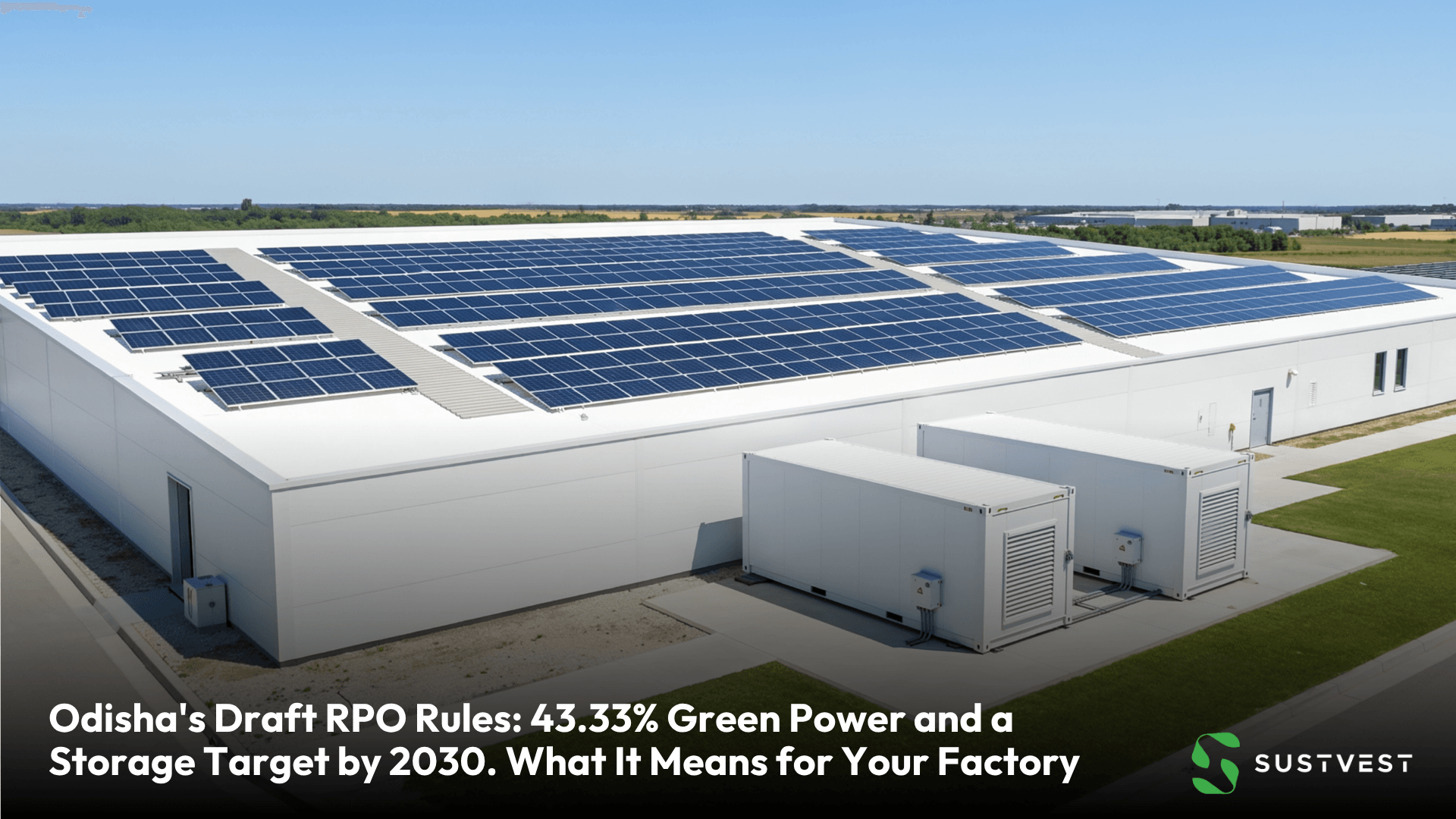
Odisha's Draft RPO Rules: 43.33% Green Power and a Storage Target by 2030. What It Means for Your Factory
Odisha wants obligated buyers of electricity to source 43.33% of their power from renewable energy by 2029-30, and to add a separate energy storage target on top. The Odisha Electricity Regulatory Commission (OERC) published the draft on 9 November 2026 and is taking comments until 5 December 2026.
If your factory in Odisha runs a coal or diesel captive plant, or buys conventional power through open access, this draft is about you. If you buy all your power from the DISCOM (distribution company), it still matters, because rooftop solar on your roof is exactly the kind of power the new rules want more of.
Here is what the draft says, who it covers, and what a plant head or CFO should do before the comment window closes.
What has OERC proposed?
OERC has proposed new renewable purchase obligation (RPO) rules that rise from 35.95% in 2026-27 to 43.33% in 2029-30, plus an energy storage obligation that rises from 2.5% to 4%. The draft is called the OERC (Procurement of Energy from Renewable Energy Sources and its Compliance) Regulations, 2026.
An RPO is a legal rule that says a share of the electricity you consume must come from renewable sources such as solar, wind or hydro. Once finalised, the new regulations will replace Odisha's 2021 RPO framework.
The draft was issued through a public notice dated 9 November 2026. Objections and suggestions are invited until 5 December 2026, as listed on the OERC draft policies page.
Who has to follow Odisha's new RPO?
Three groups are covered: the distribution licensee, consumers who own captive power plants based on fossil fuel, and open access consumers. The draft calls them "obligated entities".
In plain terms, the rules apply to anyone consuming electricity that is:
- generated by their own conventional captive plant (for example, a coal-based captive unit),
- produced through cogeneration from non-renewable sources, or
- bought from conventional generators through open access.
The 2026 draft does not mention a minimum captive plant size. The earlier 2024 OERC draft applied only to captive plants of 1 MW and above. If the final rules drop that floor, smaller captive users could also come under the obligation.
A factory that buys all its power from the DISCOM is not an obligated entity itself. The DISCOM carries the obligation for those units.
What are the year-wise RPO targets in the draft?
The total RPO climbs by about two to three percentage points each year, and it is split into four buckets: wind, hydro, distributed renewable energy (DRE) and other renewable energy. These are the figures in Table 1 of the OERC draft:
| Year | Wind | Hydro | Distributed RE (DRE) | Other RE | Total RPO |
|---|---|---|---|---|---|
| 2026-27 | 1.97% | 1.34% | 2.70% | 29.94% | 35.95% |
| 2027-28 | 2.45% | 1.42% | 3.30% | 31.64% | 38.81% |
| 2028-29 | 2.95% | 1.42% | 3.90% | 33.09% | 41.36% |
| 2029-30 | 3.48% | 1.33% | 4.50% | 34.02% | 43.33% |
The 43.33% end point is not unique to Odisha. It matches the national trajectory in the Ministry of Power's Renewable Consumption Obligation (RCO) framework, and Karnataka has proposed the same figure. We covered that in our post on Karnataka's 43.33% draft RPO for factories.
What is the new energy storage obligation?
The draft adds an energy storage obligation (ESO) of 2.5% in 2026-27, rising by half a point every year to 4% in 2029-30. It is measured on an energy basis, which means the share of your consumption that flows through a storage system.
| Year | Energy storage obligation |
|---|---|
| 2026-27 | 2.5% |
| 2027-28 | 3.0% |
| 2028-29 | 3.5% |
| 2029-30 | 4.0% |
There is a condition. Storage only counts if at least 85% of the energy stored in a year comes from renewable sources. Charging a battery from grid coal power at night will not tick this box.
Storage that meets the 85% rule also counts towards the "other RE" part of the RPO. For a factory, that makes solar plus battery energy storage for commercial and industrial sites a way to meet two targets with one asset.
Does rooftop solar count towards the RPO?
Yes. Rooftop solar counts towards the DRE bucket, whether it is net metered, gross metered, virtual net metered, group net metered or behind the meter. Clause 4.4 of the draft defines DRE as renewable projects of up to 10 MW and lists all of these configurations.
Three details in the draft are worth knowing:
- DRE is ring-fenced. A shortfall in DRE cannot be covered by buying more wind or other renewable power. A DRE surplus, however, can count towards other buckets.
- Missing data has a default. If actual generation data is not available, the draft assumes 4 kWh (kilowatt hours) per kW of capacity per day.
- Behind-the-meter plants are in. A plant that only feeds your own load, with no export to the grid, still counts. This is a common setup for factories that use all their solar power on site.
Because DRE cannot be swapped for other sources, the only way to fill that bucket is with small, distributed plants. Rooftop solar is the simplest of these for most factories.
How much rooftop solar would an open access factory need for its DRE share?
As a rough example, a factory consuming 1 crore units (10 million kWh) a year would need about 185 kW of rooftop solar for its 2026-27 DRE share, and about 310 kW by 2029-30. This uses the draft's own default of 4 kWh per kW per day.
The working is simple:
- 2026-27: 2.70% of 1 crore units is 2.7 lakh units. At 4 kWh per kW per day, that is about 1,460 units per kW per year, so roughly 185 kW.
- 2029-30: 4.50% of 1 crore units is 4.5 lakh units, or roughly 308 kW.
Real generation depends on your roof, tilt, shading and cleaning, so treat this as a starting estimate. Our guide on how to size rooftop solar for a factory explains how to work from your own load data.
What are the ways to comply, and what if a factory falls short?
The draft allows three routes: consume renewable power (directly or through storage), buy Renewable Energy Certificates (RECs), or pay the buyout price set by the Central Electricity Regulatory Commission (CERC). RECs bought through virtual power purchase agreements are also allowed.
Captive and open access consumers can also ask the DISCOM to supply them green energy, under clause 5.2 of the draft.
The Odisha State Load Despatch Centre (SLDC) is named as the agency that will monitor compliance. Shortfalls can lead to action under Section 142 of the Electricity Act, 2003, which allows the regulator to impose penalties for not following its rules.
RECs and buyout payments are pure cost. They meet the rule but do nothing for your power bill. A rooftop plant does both: it meets the DRE share and cuts the units you buy. If you also weigh up open access, see our comparison of rooftop solar vs open access solar for factories.
What should Odisha factory owners do now?
Check whether you are an obligated entity, estimate your likely DRE and storage gap, and decide before 5 December whether to send comments to OERC. The rules are still a draft, and the final numbers could change.
- Map your power sources. List how many units come from a captive plant, open access and the DISCOM each year.
- Estimate the gap. Apply the draft percentages to your obligated units for each year to 2029-30.
- Check your roof. Rooftop solar is the most direct route to the DRE share. A site survey tells you how many kW your roof can hold.
- Plan storage early. Batteries charged from your own solar can help with the storage target. Sizing them takes time.
- Choose how to pay. You can buy the solar plant outright, or choose zero investment rooftop solar where a developer funds and owns the plant and you pay only for the units you use.
- Track generation. SLDC reporting will need real numbers. Solar plant monitoring gives you the data trail, so you do not fall back on default assumptions.
Factories that start now are likely to meet the DRE share with their own plant, rather than paying for certificates every year.
FAQ
Is Odisha's 2026 RPO regulation final?
No. It is a draft published by OERC on 9 November 2026. Comments are open until 5 December 2026, and the final rules may differ.
Does the Odisha RPO apply to a factory that only buys power from the DISCOM?
Not directly. The obligated entities are the distribution licensee, fossil fuel captive plant owners and open access consumers buying conventional power. The DISCOM carries the obligation for its own consumers.
Does rooftop solar count towards Odisha's RPO?
Yes. It counts towards the distributed renewable energy (DRE) share, which covers projects up to 10 MW under net metering, gross metering, virtual or group net metering and behind-the-meter setups.
What is the energy storage obligation in Odisha's draft?
It starts at 2.5% in 2026-27 and rises to 4% in 2029-30. Storage counts only if at least 85% of the energy stored each year comes from renewable sources.
What happens if an obligated entity misses its RPO?
It can buy Renewable Energy Certificates or pay the CERC buyout price. Unmet shortfalls can lead to action under Section 142 of the Electricity Act, 2003.
About SustVest
SustVest (SolarGridX Ventures Pvt Ltd) is a rooftop solar developer in India, ranked in the CRISIL Top 10 (#5 in 2026), running 80+ distributed solar plants of about 30 MW across 13 states. We fund, build, own and maintain rooftop plants for factories, hospitals, hotels and institutions under the OPEX/RESCO model, so clients pay a lower per-unit tariff with zero upfront cost. Planning for Odisha's new RPO? Talk to our team about a rooftop solar plan for your factory.
Sources
- OERC: Draft OERC (Procurement of Energy from Renewable Energy Sources and its Compliance) Regulations, 2026, public notice dated 9 November 2026
- OERC: Draft policies and objections page
- OERC: Draft (Procurement of Energy from Renewable Sources and its Compliance) Regulations, 2024
- SolarQuarter: OERC proposes new renewable purchase and energy storage obligations for Odisha (12 November 2026)
- Energetica India: MoP issues revised RCO framework