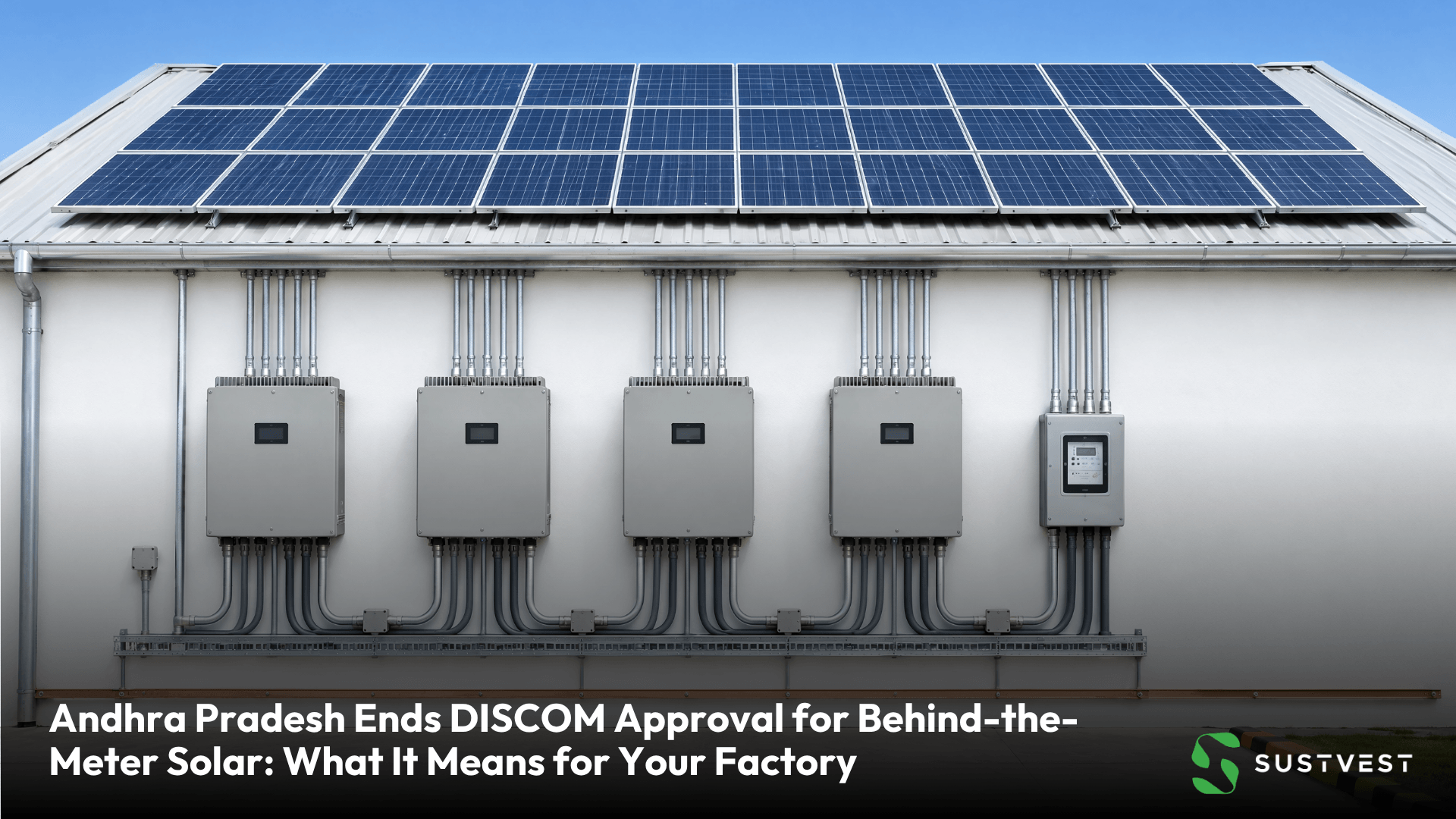
Andhra Pradesh Ends DISCOM Approval for Behind-the-Meter Solar: What It Means for Your Factory
If you run a factory in Andhra Pradesh, putting solar on your own roof just got simpler. The state regulator has said you no longer need prior permission, a feasibility approval or a line clearance from your DISCOM (distribution company) to connect a behind-the-meter rooftop solar plant to your own wiring.
You still have to tell the DISCOM first. You still cannot push power into the grid. But the slow approval queue that held up many C&I (commercial and industrial) projects is gone, and third-party financed plants are spared two extra charges. Here is what changed, what did not, and what it means for your next solar decision.
What did APERC decide on behind-the-meter rooftop solar?
APERC (Andhra Pradesh Electricity Regulatory Commission) issued practice directions on 18 August 2026 saying consumers do not need prior permission, feasibility approval or line clearance from the DISCOM to connect a behind-the-meter captive solar plant to their own installation. The directions cover how these plants are set up, interconnected, synchronised and operated.
The document is titled APERC Practice Directions on Behind-the-Meter Captive Generating Plants under Regulation 4 of 2023 (Proceedings No. Engg/AD(Tr.)/Consultant/08/2026). It was sent to APTRANSCO and all three state DISCOMs: APEPDCL, APSPDCL and APCPDCL.
The commission based its view on Section 9(1) of the Electricity Act, 2003. In simple terms: what sits on your side of the billing meter is your installation, and the DISCOM does not get to approve it in advance.
What does "behind the meter" mean for a factory?
A behind-the-meter solar plant feeds your own load directly, on your side of the DISCOM's billing meter, instead of exporting power to the grid. Every unit it makes is a unit your factory does not buy from the DISCOM.
This is different from net metering or gross metering, where your solar plant is set up to send power into the grid and the DISCOM credits or pays you for it. If you want a refresher on those options, see our guide to net metering vs net billing vs gross metering.
For most factories that run through the day, behind-the-meter is a natural fit. Solar peaks around midday, which is exactly when machines, compressors and air conditioning are running.
Why did APERC step in?
Consumers in the APEPDCL (Eastern Power Distribution Company of Andhra Pradesh) area complained about delays and approval hurdles for synchronising rooftop plants, and APEPDCL itself asked the commission for clarity. Energetica India reported that the DISCOM had raised concerns about grid safety, protection coordination, multiple metering points and revenue loss from third-party financed plants.
According to the order, APEPDCL asked four questions:
- Must a consumer use a single interconnection point, or can the DISCOM charge for multiple points?
- At what voltage level should plants connect?
- What penalty applies to unauthorised synchronisation?
- Do cross-subsidy and additional surcharges apply to third-party owned rooftop plants on a consumer's premises?
The commission answered all four, mostly in the consumer's favour.
Do I still need to inform the DISCOM before connecting solar?
Yes. Prior intimation to the DISCOM is mandatory before you synchronise the plant with the grid or run it in off-grid islanding mode. The order is careful to say this intimation "shall not be construed as a requirement to obtain prior approval."
The intimation should include:
- the installed capacity of the plant;
- a single-line diagram (the electrical drawing showing how the plant connects to your system);
- other relevant technical particulars.
The order does not set a fixed number of days' notice. Skipping the intimation is not a small slip, though. Installing without it is treated as a violation of the commission's regulations and can be dealt with under Sections 142 and 146 of the Electricity Act, 2003, which carry penalties.
Can a behind-the-meter plant export power to the grid?
No. The consumer must ensure no power is injected into the grid, whether the grid is live or not. This is the trade-off for skipping the approval process.
In practice, this shapes how you size and control the plant:
- Size to your daytime load. Any solar beyond what your factory uses at that moment has nowhere to go. Our rooftop solar sizing guide for factories explains how to read your load curve.
- Plan for holidays and shutdowns. On a Sunday or during maintenance, load drops but the sun does not. The plant's controls must cut output so nothing flows back.
- Think about storage. A battery can soak up midday surplus and release it later. Adding battery energy storage is one way to use more of what the roof produces without exporting.
Can I connect solar at more than one point in my factory?
Yes. APERC said a consumer "cannot be required to adopt a single interconnection point" and may design a number of internal interconnections or inverters at the voltage level they choose. The commission said voltage level is an engineering matter and cannot be prescribed uniformly.
This matters for large or spread-out sites. A factory with several sheds, each with its own distribution board, can connect a solar block to each one instead of running long cables to a single point.
There is one condition. Where there are multiple inverters, the data from all of them must be integrated and sent to the DISCOM or SLDC (State Load Despatch Centre) as required. A good solar plant monitoring system that pulls every inverter onto one platform makes this simple.
All connections must still meet the applicable technical and safety standards of the CEA (Central Electricity Authority). If you connect a plant to your load through a dedicated line, that line must comply with Section 54 of the Electricity Act.
Do third-party financed rooftop plants pay cross-subsidy surcharge in Andhra Pradesh?
No. APERC said consumers with behind-the-meter installations, whether self-financed or third-party financed, "shall not be required to pay cross-subsidy and additional surcharges." This is the biggest commercial point in the order.
Cross-subsidy surcharge (CSS) and additional surcharge are charges usually paid by consumers who buy power from someone other than their DISCOM. They are a major reason rooftop solar and open access solar end up with very different economics.
Under a third-party model, a developer funds, builds, owns and runs the plant on your roof and sells you the power at a fixed tariff. That is how the OPEX solar model, also called RESCO (Renewable Energy Service Company), works. APERC has now confirmed that in Andhra Pradesh this model does not attract CSS or additional surcharge when the plant is behind the meter. Mercom India also highlighted this point in its report on the order.
What charges can the DISCOM still collect?
Consumers must still pay the charges the commission has set under their consumer undertaking, and DISCOMs may propose service charges in their tariff filings. The order says DISCOMs can include such charges in their Retail Supply Tariff filings, "supported by proper justification."
So the door is not fully shut. Any new charge would have to go through a public tariff process before APERC. If one is approved, it would likely change project economics, so it is worth watching the next tariff filings.
| Item | What the APERC order says |
|---|---|
| DISCOM prior permission, feasibility, line clearance | Not required |
| Prior intimation to DISCOM | Mandatory, with capacity, single-line diagram and technical details |
| Export to grid | Not allowed, whether the grid is live or not |
| Multiple interconnection points | Allowed; inverter data must be shared with DISCOM or SLDC as required |
| Cross-subsidy and additional surcharge | Not payable, including for third-party financed plants |
| Other charges | Commission-set charges still apply; DISCOMs may seek service charges via tariff filings |
| Penalty for no intimation | Sections 142 and 146, Electricity Act, 2003 |
Should an Andhra Pradesh factory choose behind-the-meter solar now?
For a factory with steady daytime load, behind-the-meter solar is now likely the quickest and cleanest route to rooftop solar in Andhra Pradesh. Fewer approvals usually mean shorter timelines, and the surcharge ruling protects zero-investment models.
A quick way to decide:
- Check your daytime load. Look at what your plant draws between 9 am and 4 pm on working days and on holidays.
- Size to the low point, or add storage. Since export is not allowed, the plant should rarely make more than you use.
- Pick an ownership model. If you want to own the asset and claim the full savings, CAPEX rooftop solar lets you buy the plant outright. If you would rather keep cash for your core business, an OPEX/RESCO agreement gives you lower-cost power with zero upfront cost.
- File the intimation properly. Make sure your developer prepares the single-line diagram and technical details and sends them before the plant is switched on.
- Watch the tariff filings. Any new DISCOM service charge would show up there first.
As a rough guide to output, MNRE's rooftop solar FAQ says 1 kWp of solar can generate 4 to 5.5 units on a clear sunny day. A 100 kWp plant would therefore make roughly 400 to 550 units on a good day, all of which a behind-the-meter design must use on site.
FAQ
Do I need DISCOM approval to install rooftop solar in Andhra Pradesh?
For behind-the-meter captive plants, no. APERC's August 2026 practice directions say prior permission, feasibility approval and line clearance are not required. You must still inform the DISCOM before you synchronise the plant.
Can my behind-the-meter plant send surplus power to the grid?
No. The order requires that no power is injected into the grid, whether the grid is live or not. Size the plant to your daytime load or add battery storage.
Does a RESCO or OPEX rooftop plant pay cross-subsidy surcharge in Andhra Pradesh?
Not if it is behind the meter. APERC said self-financed and third-party financed behind-the-meter plants do not pay cross-subsidy or additional surcharges.
What happens if I connect without informing the DISCOM?
It is treated as a violation of APERC's regulations and can be dealt with under Sections 142 and 146 of the Electricity Act, 2003.
Can I connect solar to several distribution boards in my factory?
Yes. APERC allows multiple internal interconnections and inverters, as long as they meet technical and safety standards and the inverter data is shared with the DISCOM or SLDC as required.
About SustVest
SustVest (SolarGridX Ventures Pvt Ltd) is a rooftop solar developer in India, ranked #5 in the CRISIL Top-10 for 2026. We run 80+ distributed solar plants (about 30 MW) across 13 states for factories, hospitals, hotels and institutions, mostly under a zero upfront OPEX/RESCO model where we fund, build, own and maintain the plant. Talk to our team about rooftop solar for your factory.
Sources
- APERC, Practice Directions on Behind-the-Meter Captive Generating Plants under Regulation 4 of 2023, 18 August 2026
- Energetica India, APERC Clears Path for Behind-the-Meter Rooftop Solar with Zero Grid Injection, 21 August 2026
- Mercom India, APERC Allows Multiple Interconnections for Behind-the-Meter Rooftop Solar, 19 August 2026
- MNRE, FAQ: Solar Rooftop System (via PIB)