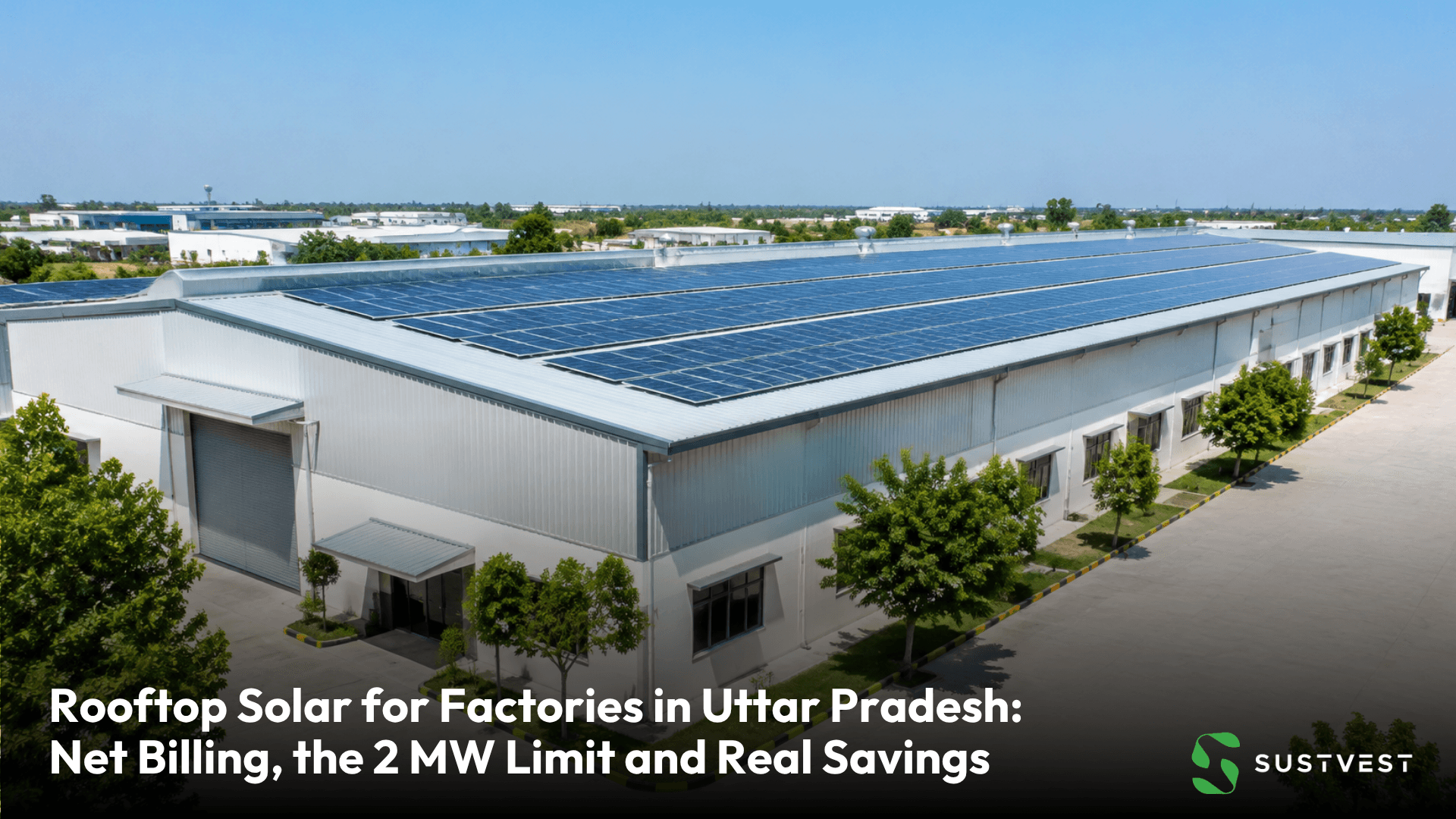
Rooftop Solar for Factories in Uttar Pradesh: Net Billing, the 2 MW Limit and Real Savings
Uttar Pradesh (UP) factories pay a lot for grid power, and many of them sit under large, flat, sunny roofs. That makes rooftop solar one of the simplest cost cuts available to a UP manufacturer today.
The catch is the rulebook. UP gives industrial and commercial users net billing, not net metering, and that single detail decides how big your plant should be. This guide explains the rules in plain words, shows where the savings come from, and lists what to check before you sign.
Fresh Mercom India research on Uttar Pradesh rooftop demand (9 November 2026) notes that buyers in the state now want different things: urban users chase bill savings, while sites facing outages are asking for backup power. Factories need to be clear about which of those two goals they are paying for.
Can factories in Uttar Pradesh install rooftop solar?
Yes. Industrial and commercial consumers in UP can install grid connected rooftop solar under the state's rooftop regulations, with exported power settled through net billing.
The Uttar Pradesh Solar Energy Policy 2022 states that, as per the RSPV (Rooftop Solar PV) Regulations 2019 issued by UPERC (Uttar Pradesh Electricity Regulatory Commission), "Net billing facility will be provided to industrial and commercial consumers", and that UPERC will set the tariff at which the discom (distribution company) buys the power.
The policy runs for five years, or until the government notifies a new policy, whichever comes first. It sets a state target of 22,000 MW of solar by 2026 to 27, including 4,500 MW of residential rooftop and 1,500 MW of rooftop on non residential institutions.
What is net billing, and how is it different from net metering?
Under net billing, the units your plant exports to the grid are paid at a fixed purchase rate set by the regulator, while every unit you import is billed at your normal tariff. Under net metering, exported units simply cancel out imported units one for one.
That difference matters because your grid tariff is usually much higher than the export rate. A unit you use yourself saves you the full grid price. A unit you export earns only the lower purchase rate.
A UPERC consultation paper on net metering sets out the current arrangement clearly:
- Net metering: only for metered agricultural (LMV-5) and domestic (LMV-1) consumers.
- Gross metering: available to all consumer categories.
- Net billing (net feed in): available to all consumer categories, added through the First Amendment notified on 1 June 2022.
The same paper proposed extending net metering to some public and educational institutions. It did not propose net metering for factories or shops. For a full comparison of the three options, read our guide on net metering vs net billing vs gross metering.
What rate does a UP discom pay for exported solar units?
UPERC sets the rate. Its Third Amendment to the rooftop regulations, issued on 3 June 2025 and in force from 5 July 2025, links the payment for injected solar power to recent utility scale solar prices.
According to a TeamLease RegTech summary of the UPERC Third Amendment, the discom pays a "Solar Injection Compensation" equal to the weighted average tariff of large (5 MW and above) competitively bid solar projects from the previous financial year, plus a 25% incentive. If no such bidding took place, the last applicable gross metering tariff applies.
Large solar parks sell power far more cheaply than a factory buys it from the grid, so this compensation is likely to sit well below your own grid tariff even after the 25% top up. Check the current figure with your discom before you size the plant.
How big can a rooftop solar plant be in Uttar Pradesh?
Up to 2 MW per site, and no more than your connected or contracted demand. The discom can also limit capacity based on the local distribution transformer.
The UP Solar Energy Policy 2022 allows rooftop plants of a maximum 2 MW capacity under the RSPV Regulations 2019, and says capacity additions are allowed by the discom as per the installed distribution transformer capacity. The rooftop regulation quoted in the UPERC consultation paper adds that capacity "shall not exceed 100% of the connected/ contracted demand of the consumer", within a range of 1 kWp to 2 MWp.
| Rule | What it means for a factory |
|---|---|
| Net billing for industrial and commercial users | Exported units earn a regulated purchase rate, not your full tariff |
| Maximum 2 MW per rooftop plant | Large campuses may need several roofs or another route for more power |
| Capped at 100% of connected or contracted demand | Your sanctioned load sets the ceiling, even if your roof is bigger |
| Transformer capacity check by the discom | Approval can depend on the local network, so apply early |
The ceiling is not the target. Under net billing, the best size is usually the one that your factory can consume almost entirely during daylight hours. Our rooftop solar sizing guide for factories walks through the four limits that decide this.
How much can a UP factory save with rooftop solar?
A lot, as long as you use the power yourself. Speakers at Mercom's Lucknow C&I (commercial and industrial) Clean Energy Meet put rooftop solar's cost at about ₹2 to ₹2.10 per unit, against a landed grid tariff of about ₹7.2 to ₹7.9 per unit for UP industry.
Those figures come from a Mercom India report on rooftop savings for UP industries (22 October 2026). They are industry estimates, not a regulator's order, but they show the size of the gap. On those numbers, every solar unit you consume yourself is roughly ₹5.1 to ₹5.9 cheaper than a grid unit, which is a saving of about 71% to 75% on that unit.
The same panel shared three more useful reality checks:
- Diesel is the most expensive power on site. Diesel generation was put at ₹25 to ₹27 per unit, so cutting generator hours is a big win where outages are common.
- Batteries change the maths. Renewables plus storage was put at about ₹13.5 per unit, of which about ₹8 is the battery. That is cheaper than diesel but far dearer than solar used directly.
- Real output is lower than the label. Actual generation may be 10% to 15% below the panel's standard test rating, so ask for realistic yield estimates.
Your exact saving depends on your tariff category, demand charges and time of day pattern. Start by learning how to read your factory's electricity bill line by line.
Should a UP factory add battery storage to rooftop solar?
Only if backup or diesel savings is a real goal. For pure bill savings, solar used directly in daylight is far cheaper than solar stored in a battery.
The case for storage is strongest where the grid fails often and diesel generators run for hours. There, a battery can cut fuel costs and smooth supply to critical lines. If that sounds like your site, look at battery storage for commercial and industrial sites as a separate business case, with its own payback.
Should I buy the plant or choose zero investment solar?
Both work in UP. The right choice depends on whether you want to spend capital and manage an asset, or simply buy cheaper power.
Mercom's Lucknow panel noted that companies generally prefer CAPEX (capital expenditure) for projects below 5 MW. If your balance sheet allows it, you can buy the solar plant outright and keep the full saving, along with the maintenance work and the performance risk.
If you would rather keep cash for production, the OPEX solar model lets a RESCO (Renewable Energy Service Company) fund, build, own and maintain the plant on your roof. You pay only for the units generated, at a tariff below your grid rate. The developer also carries the maintenance and performance risk, which matters for a plant that will run for decades.
What should a UP factory check before going solar?
Check five things: your sanctioned load, your daytime consumption, your roof, the current export rate and your discom's approval process.
- Sanctioned load and contract demand. This sets your legal ceiling.
- Daytime load profile. Use 12 months of bills and, if possible, 15 minute meter data. Size the plant to what you actually use between morning and late afternoon.
- Roof condition. A plant will sit on the roof for decades, so fix leaks and weak sheets first.
- Export compensation. Ask your discom for the current Solar Injection Compensation rate and treat exported units as a bonus, not the core of the business case.
- Approval timeline. Transformer capacity checks can slow approvals, so start the application early.
FAQ
Is net metering allowed for factories in Uttar Pradesh?
No. Under the current UPERC arrangement, net metering is limited to metered domestic and agricultural consumers. Factories and commercial users get net billing or gross metering.
What is the maximum rooftop solar capacity for a factory in UP?
Up to 2 MW per rooftop plant, and no more than 100% of your connected or contracted demand. The discom can also limit it based on transformer capacity.
How are exported solar units paid in Uttar Pradesh?
Through Solar Injection Compensation, set at the weighted average tariff of large competitively bid solar projects from the previous financial year plus a 25% incentive, under UPERC's Third Amendment in force from 5 July 2025.
Can a UP factory get rooftop solar with zero upfront cost?
Yes. Under the OPEX or RESCO model, a developer funds, builds, owns and maintains the plant, and the factory pays a per unit tariff that is lower than its grid tariff.
About SustVest
SustVest (SolarGridX Ventures Pvt Ltd) is a rooftop solar developer in India, ranked #5 in the CRISIL Top 10 for 2026, running 80+ distributed solar plants of about 30 MW across 13 states for factories, hospitals, hotels and institutions. Under our OPEX/RESCO model we fund, build, own and maintain your rooftop plant, so you pay a lower per unit tariff with zero upfront cost. Talk to SustVest about rooftop solar for your UP factory.
Sources
- UPNEDA: Uttar Pradesh Solar Energy Policy 2022
- UPERC: Consultation paper, Provisions for Net Metering Arrangement in view of Uttar Pradesh Solar Policy
- TeamLease RegTech: UPERC Rooftop Solar PV Regulations 2019, Third Amendment (14 July 2025)
- Mercom India: Rooftop Solar Offers Significant Savings Potential for Uttar Pradesh Industries (22 October 2026)
- Mercom India: Uttar Pradesh Rooftop Solar Demand Diverges Across Consumer Segments (9 November 2026)