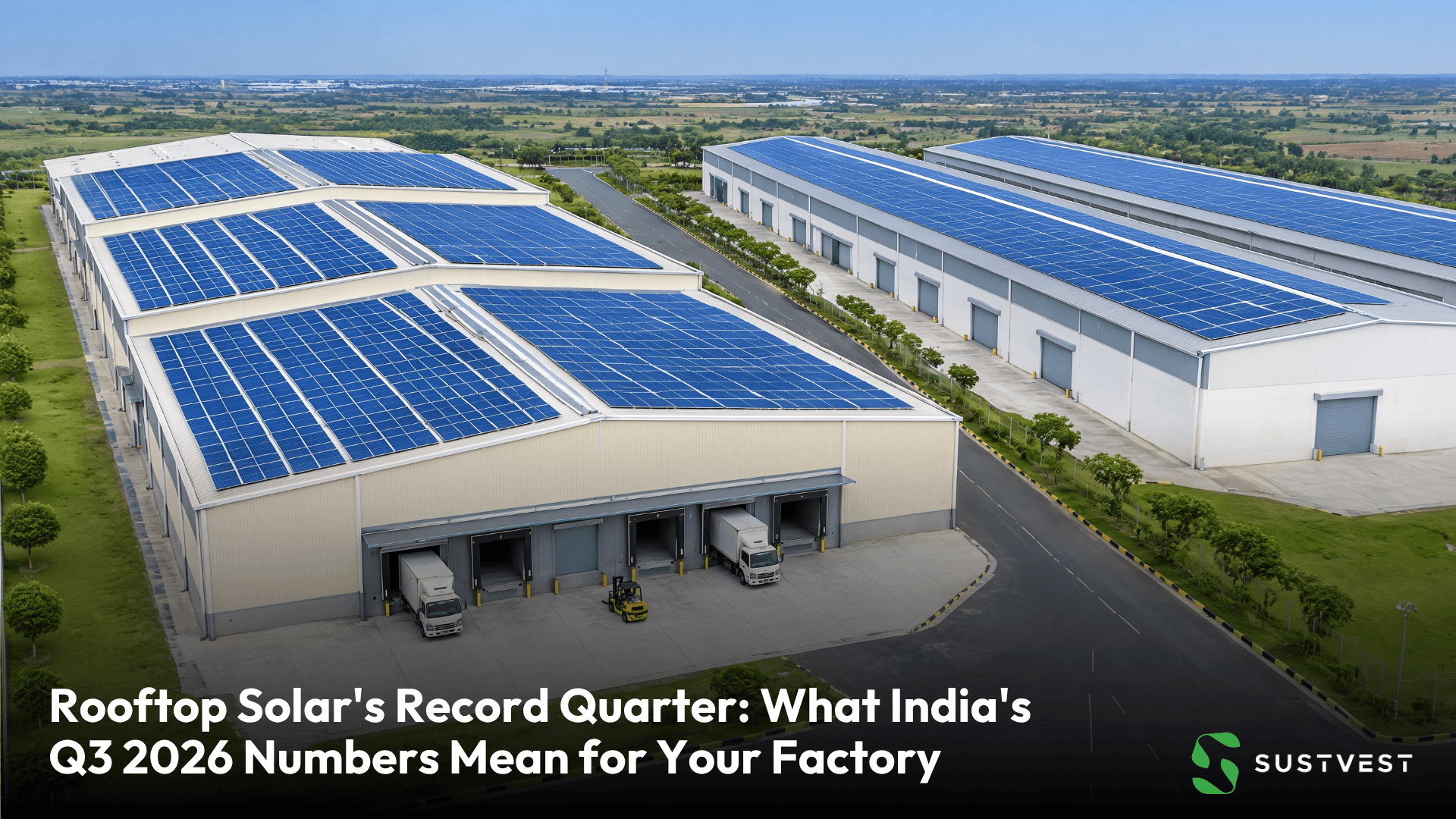
Rooftop Solar's Record Quarter: What India's Q3 2026 Numbers Mean for Your Factory
India's rooftop solar market just had its biggest quarter on record. Rooftop plants made up 42% of all new solar capacity added in July to September 2026, the highest share ever, according to Mercom India's Q3 2026 solar market update.
For a factory owner or CFO (Chief Financial Officer), the headline is less important than what sits behind it. This post explains what the numbers say, why rooftop is growing while big solar parks slowed, and what it means if you are planning a plant for your own roof.
How much rooftop solar did India add in Q3 2026?
India added 4.7 GW (gigawatts) of rooftop solar in Q3 2026. That is up 22% from 3.8 GW in Q2 2026 and up 122% from 2.1 GW in Q3 2025, as reported in Mercom's 9M 2026 market report.
Total solar additions in the quarter were nearly 11 GW. Rooftop's record 42% share means close to half of all new solar in India went onto roofs, not into solar parks.
The trend holds across the year too:
- Share of 9M 2026 additions: rooftop was 29.1% of all solar added in January to September 2026, against 18.5% in the same period of 2025 (Mercom).
- Volume: JMK Research data reported by PV Tech puts January to September 2026 rooftop additions at about 9.8 GW.
- Installed base: grid-connected rooftop capacity reached 34.97 GW by the end of October 2026, based on MNRE (Ministry of New and Renewable Energy) figures cited by SolarQuarter.
Different trackers use different methods, so their numbers do not match exactly. The direction is the same in all of them: rooftop is growing fast.
Why did rooftop solar grow while large solar parks slowed?
Rooftop grew because it avoids most of the bottlenecks that slowed big projects. Large-scale solar additions fell 24% quarter on quarter to 6.3 GW in Q3 2026, according to Mercom.
Mercom links the large-scale slowdown to transmission bottlenecks, higher costs and delays in land, grid connectivity and power offtake. A rooftop plant needs none of these at scale:
- No land to buy. The roof is already there.
- No long transmission line. Power is used on site, behind your meter.
- No buyer to find. The factory under the roof is the buyer.
That simplicity is why rooftop keeps moving even when the utility-scale pipeline gets stuck.
Is the rooftop boom coming from homes or from factories?
Much of the recent jump comes from homes. Mercom says the PM Surya Ghar scheme has pushed residential rooftop ahead of its March 2027 deadline, while electricity cost savings keep driving commercial and industrial (C&I) adoption.
The scale of the household push is large. Mercom reports that PM Surya Ghar has reached 67% of its target, is nearing 20 GW of installed capacity, and has seen ₹374.07 billion in subsidies disbursed.
So read the 42% figure with care. It is not a pure factory number. Public trackers do not split Q3 rooftop additions between homes and businesses, and we have not found a reliable split to quote.
What it does tell you is that the rooftop supply chain, installer base and discom (distribution company) approval processes are handling far more volume than a year ago. That matters for C&I buyers in the ways below.
What does rooftop's record quarter mean for my factory?
It means rooftop solar is now a mainstream, proven way to cut power costs, not an experiment. It also means you should plan carefully, because a busy market brings both better options and more variable quality.
Three practical effects are likely:
- More choice of developers and installers. A growing market draws in new players. Some are strong; some are new to large industrial roofs. Use a structured process for how to choose a rooftop solar developer in India before you sign.
- Busier discoms. Net metering and connection applications are rising with household demand. Approval times can stretch in some circles, so start the paperwork early and keep your load and meter details ready.
- Rising competition for good crews. Experienced installation and maintenance teams are in demand. Ask who will look after your plant in year five, not just who will build it.
Should my factory choose rooftop solar or open access now?
For most factories, rooftop is the first step and open access is a top-up. Rooftop power is generated and used on site, so it avoids most grid charges and state surcharges that apply to power wheeled through the grid.
Open access can supply far more power than your roof can, but it depends on state rules, charges and approvals that change often. The Q3 data shows the utility-scale side is facing delays in connectivity and offtake, which can also affect projects built for open access buyers.
If you want a full comparison of size limits, charges and control, see our guide to rooftop solar vs open access solar for factories.
How should a factory pay for rooftop solar in 2026?
You have two main routes: own the plant (CAPEX) or buy its power (OPEX). The right one depends on your cash, tax position and appetite for running an asset.
| Question | CAPEX (you own the plant) | OPEX / RESCO (developer owns it) |
|---|---|---|
| Upfront cost | You pay for the full plant | Zero upfront cost |
| What you pay over time | Your own maintenance and repairs | A fixed per-unit tariff for the power you use |
| Who maintains it | You, or a contractor you hire | The developer, as part of the deal |
| Performance risk | Yours | Mostly the developer's, since it is paid per unit generated |
| Best for | Firms with spare cash and tax capacity | Firms that want savings without tying up capital |
With zero investment rooftop solar under the OPEX model, a RESCO (Renewable Energy Service Company) funds, builds, owns and runs the plant, and you pay only for the units you consume. If you prefer to own the asset, CAPEX rooftop solar lets you buy the plant outright and keep all the savings.
Power prices are another reason to lock in a solar tariff. Spot prices swing sharply, as we covered in what the October spike in spot power prices means for your factory.
What should I check before signing with a rooftop solar developer in a busy market?
Check the developer's track record with plants like yours, who maintains the plant, and how performance is measured. In a fast-growing market, these three checks separate a 25-year partner from a one-time installer.
- Track record: ask for running C&I plants of similar size, in your state, that you can visit or call.
- Maintenance plan: ask how often panels are cleaned, how faults are fixed and how fast. A clear solar O&M (operations and maintenance) plan protects your savings for decades.
- Performance data: ask what generation data you will see, how often, and what happens if the plant under-performs.
- Exit and transfer terms: under OPEX, check what happens if you move, expand or sell the building.
Will rooftop solar keep growing in 2027?
Growth is likely to continue, but the mix may shift. The PM Surya Ghar household push is tied to a March 2027 deadline, per Mercom, so residential volumes could change after that date.
C&I demand rests on a different driver: the gap between grid tariffs and the cost of solar power. As long as that gap stays wide, factories are expected to keep adding rooftop plants. State rules on net metering, banking and battery storage will shape how big each plant can be, so check your state's latest regulations before you size a system.
FAQ
How much rooftop solar did India add in Q3 2026?
India added 4.7 GW of rooftop solar in Q3 2026, up 22% from Q2 2026 and up 122% from Q3 2025, according to Mercom India.
What share of India's new solar was rooftop in Q3 2026?
Rooftop made up a record 42% of all solar capacity added in Q3 2026, per Mercom India. Total solar additions in the quarter were nearly 11 GW.
How much grid-connected rooftop solar does India have?
India had 34.97 GW of grid-connected rooftop solar by the end of October 2026, based on MNRE figures cited by SolarQuarter.
Is the rooftop growth mainly from factories?
No. A large part comes from homes under the PM Surya Ghar scheme. Commercial and industrial demand is also growing, driven by electricity cost savings, but public data does not give a clear split for Q3 2026.
Can my factory get rooftop solar without paying upfront?
Yes. Under the OPEX or RESCO model, a developer funds, builds, owns and maintains the plant, and your factory pays a per-unit tariff for the solar power it uses.
About SustVest
SustVest (SolarGridX Ventures Pvt Ltd) is a rooftop solar developer in India, ranked #5 in the CRISIL Top-10 for 2026. We run 80+ distributed solar plants (about 30 MW) across 13 states for factories, hospitals, hotels, tea estates and institutions, mostly under a zero-upfront OPEX model where we fund, build, own and maintain the plant. Talk to SustVest about rooftop solar for your factory.
Sources
- Mercom India: India's Solar Capacity Rises 21% YoY in 9M (12 November 2026)
- Mercom India: Q3 and 9M 2026 India Solar Market Update
- SolarQuarter: India's Solar Capacity Crosses 174.5 GW, citing MNRE (12 November 2026)
- MNRE: Physical Progress of renewable energy capacity
- PV Tech: India adds 35.2GW of solar capacity in nine months, JMK Research (12 October 2026)
- Mercom India: PM Surya Ghar Achieves 67% of Target, Nears 20 GW Capacity (13 November 2026)