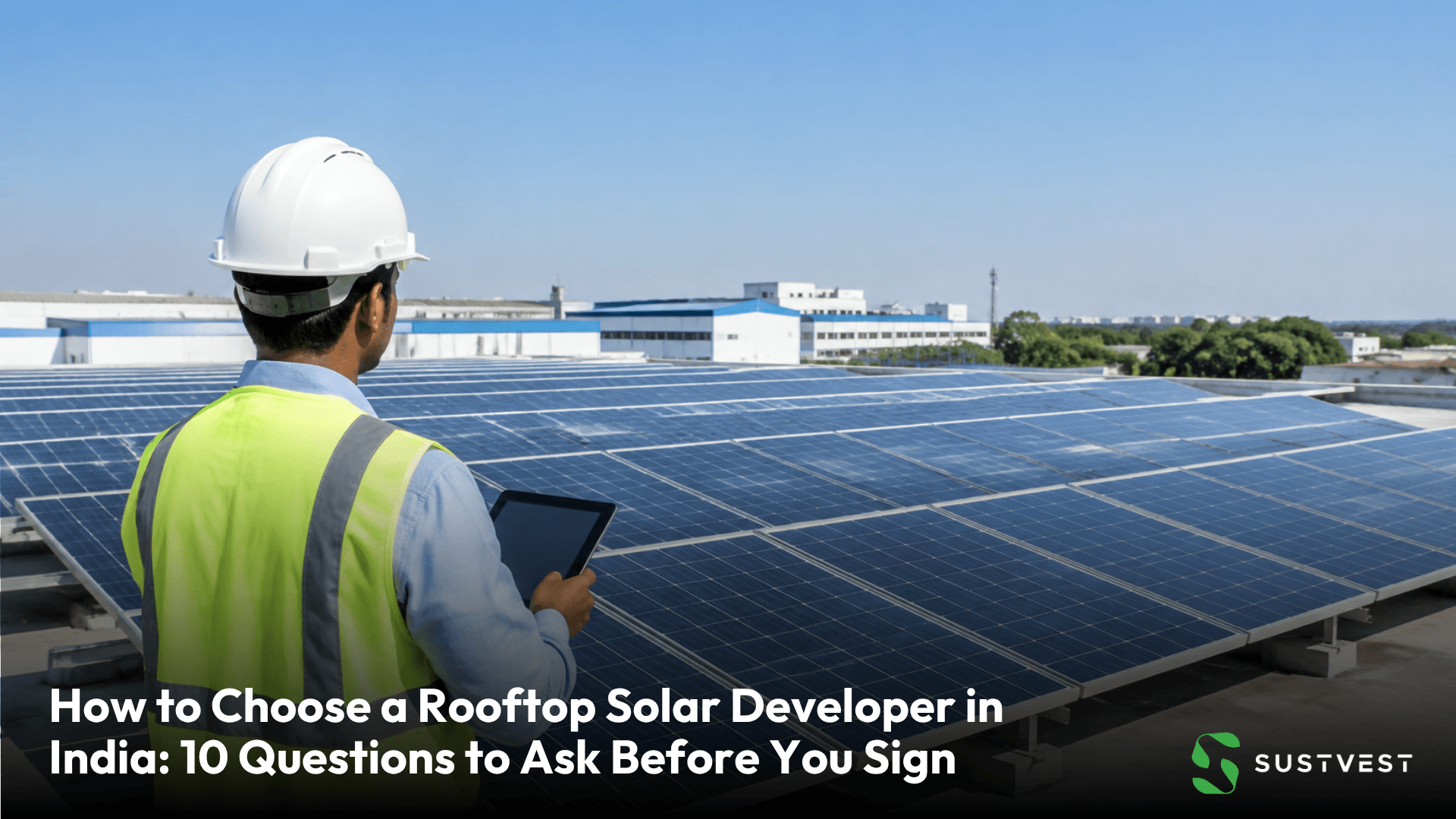
How to Choose a Rooftop Solar Developer in India: 10 Questions to Ask Before You Sign
Choosing a rooftop solar developer is not like buying a machine. The plant will sit on your roof and feed your factory for many years, and the company behind it will be your partner for all of them.
Get the choice right and solar quietly cuts your power bill every month. Get it wrong and you inherit poor generation, slow repairs and a contract that is hard to exit. These 10 questions help owners, CFOs (Chief Financial Officers) and plant heads separate strong developers from weak ones.
What does a rooftop solar developer actually do?
A rooftop solar developer designs, builds and often funds and owns a solar plant on your roof. Under the CAPEX (capital expenditure) model, you pay for the plant and own it. Under the OPEX (operating expenditure) or RESCO (Renewable Energy Service Company) model, the developer pays for, owns and maintains the plant, and you buy the power at an agreed per-unit tariff.
Owning is still the most common route. Installations under the capital expenditure model made up 84% of India's rooftop additions in Q2 2026, according to Mercom India's rooftop market report. Either way, the developer's quality decides how much you save.
1. How many plants does the developer own and operate today?
Ask for operating plants, not just installed megawatts. A developer that runs its own plants for years has every reason to build them well, because poor generation hurts its own income.
Ask for a list of live plants in your sector and state, and call two or three of those clients. Independent rankings help too. The Crisil Bridge to India rooftop map ranks the largest project developers in the country, and you can see the June 2026 list in our summary of India's top 10 solar developers.
2. Will the developer fund the plant, or only build it?
This tells you which business model you are buying. If you want zero investment rooftop solar, the developer must have the balance sheet and lenders to fund your plant and carry it for the full contract term.
If you would rather buy the solar plant outright, you need a developer with a strong in-house EPC (Engineering, Procurement and Construction) team. Many good companies offer both. Ask which one they recommend for you, and why.
3. Is all the equipment BIS-registered?
It must be. Under MNRE's (Ministry of New and Renewable Energy) Solar Systems, Devices and Components Goods Order, 2025, solar PV modules, inverters and storage batteries must meet the latest BIS (Bureau of Indian Standards) norms and carry the standard mark, as Power Line reported. The same order sets minimum module efficiency at 18% for mono-crystalline and thin-film modules and 17% for poly-crystalline modules.
For inverters, MNRE's interim rules for large units referred to Indian standards including IS 16221 for inverter safety and IS 16169 for anti-islanding protection, according to Energetica India. Ask for the make, model and certificates of every major component before you sign, not after the trucks arrive.
4. Who checks whether my roof can carry the plant?
A serious developer checks your roof before quoting a final price. That means a site survey, a structural check of the sheets, purlins and columns, and a plan for leaks, walkways and fire safety.
Older industrial sheds need extra care. Ask whether the structural check is done by a qualified engineer and whether the report will be shared with you. Our factory roof solar readiness checklist lists what that review should cover.
5. How did they estimate my solar generation, and what is guaranteed?
Ask how the generation estimate was made and whether any part of it is guaranteed. A good proposal shows yearly units, the assumptions behind them (shading, tilt, losses) and how output will decline with age.
Solar modules lose a little output every year. Across nearly 2,000 measured rates, NREL's analytical review found a median degradation of 0.5% per year, and NREL notes that a long tail of lower-reliability products pushes the average to 0.8% per year. Be wary of a proposal that assumes no decline at all, or one that is far more optimistic than others for the same roof.
6. Who handles approvals and net metering with the discom?
The developer should. Getting a rooftop plant connected means applications, inspections and meter changes with your discom (distribution company), and delays here can push back your savings by months.
The rules are set partly by the centre and partly by each state. The Ministry of Power's 2021 amendment to the Electricity (Rights of Consumers) Rules allowed net metering for loads up to 500 kW or the sanctioned load, whichever is lower, with gross metering beyond that, as Renewable Watch reported. State regulators then add their own limits, charges and procedures, and these keep changing. Maharashtra, for example, has proposed mandatory battery storage for new rooftop plants above 100 kW, according to SolarQuarter.
Ask the developer which metering route they plan for your site, what the current state rules allow, and how many approvals they have completed with your discom.
7. What does operations and maintenance include?
O&M (operations and maintenance) is where long-term savings are won or lost. Ask exactly what is covered: module cleaning frequency, preventive checks, inverter repairs, spare parts, response time for faults and who pays for what.
Under an OPEX contract, the developer usually carries O&M because it is selling you units, so poor upkeep costs it money. Under CAPEX, you need a separate solar O&M contract with clear service levels. Either way, get the scope in writing.
8. How will I see how my plant is performing?
You should be able to see generation every day, not just on the monthly bill. Ask whether the developer offers solar plant monitoring with remote data, alerts for faults and regular performance reports.
Monitoring matters because small problems hide easily. A tripped inverter string or a dirty section of panels can quietly cut output for weeks if nobody is watching the data.
9. What does the contract say about tariff, term and exit?
Read the contract as carefully as the price. Under an OPEX model, the PPA (Power Purchase Agreement) decides the tariff, any yearly escalation, minimum offtake, what happens during roof repairs, and the cost of ending the deal early.
Ask for the draft PPA early and go through it with your finance and legal teams. Our guide to rooftop solar PPA clauses to check before signing walks through the 12 terms that matter most.
10. What happens at the end of the contract, or if I move?
Ask what happens to the plant when the contract ends. Some OPEX contracts transfer the plant to you, others let you buy it at a set price, and others have the developer remove it.
Also ask what happens if you sell the building, shut a unit or need to rebuild the roof. A strong developer will have clear, written answers. A vague answer here is a red flag.
How do I compare two solar proposals side by side?
Compare them on the same basis. Put the key points into one table so price does not hide weak terms.
| What to compare | What a strong proposal shows | Red flag |
|---|---|---|
| Track record | Live plants you can visit, client references | Only installed MW, no operating plants |
| Equipment | Named makes and models | "Tier 1 equivalent" with no model numbers |
| Generation | Yearly units with assumptions and yearly decline | No degradation, or numbers far above others |
| Approvals | Developer handles discom work, clear timeline | Approvals left to you |
| O&M and monitoring | Written scope, response times, live data | "Maintenance as required" |
| Contract | Clear tariff, term, exit and end-of-term terms | Exit costs or roof clauses left vague |
FAQ
What is the difference between a solar developer and a solar EPC company?
An EPC company builds the plant and hands it over to you. A developer can also fund, own and run the plant for years and sell you the power under an OPEX or RESCO model.
Is a zero investment solar plant lower quality than one I buy?
It should not be. Under OPEX the developer earns only from the units the plant produces, so it has a strong reason to use good equipment and maintain it well.
How much does solar panel output fall each year?
NREL's review of nearly 2,000 measured rates found a median decline of 0.5% per year. A good proposal builds this decline into its generation estimate.
Do solar panels and inverters need BIS certification in India?
Yes. MNRE's Solar Systems, Devices and Components Goods Order, 2025 covers solar PV modules, inverters and storage batteries, which must meet BIS norms and carry the standard mark.
Who gets the net metering approval for a rooftop plant?
Usually the developer handles the application and paperwork with your discom on your behalf. Confirm this in the proposal, along with the expected timeline.
About SustVest
SustVest (SolarGridX Ventures Pvt Ltd) is a rooftop solar developer in India and a CRISIL Top-10 rooftop solar project developer (#5 in 2026). We run 80+ distributed solar plants (about 30 MW) across 13 states for factories, hospitals, hotels, tea estates and institutions, funding, building, owning and maintaining most of them under the OPEX/RESCO model at zero upfront cost, with our own EPC and procurement team for CAPEX projects. Comparing solar proposals? Ask SustVest for a proposal you can check against these 10 questions.
Sources
- Mercom India: India added 6.6 GW of rooftop solar capacity in 1H 2026 (27 August 2026)
- Power Line: MNRE notifies updated quality control order for solar PV products (30 January 2025)
- Energetica India: MNRE extends certification deadline for high capacity solar inverters (August 2025)
- NREL: Photovoltaic Degradation Rates, An Analytical Review (Progress in Photovoltaics, 2013)
- NREL: Photovoltaic Lifetime Project
- Renewable Watch: Ministry of Power approves net metering for rooftop systems up to 500 kW (30 June 2021)
- SolarQuarter: MERC proposes new rooftop renewable rules with mandatory ESS (22 September 2026)