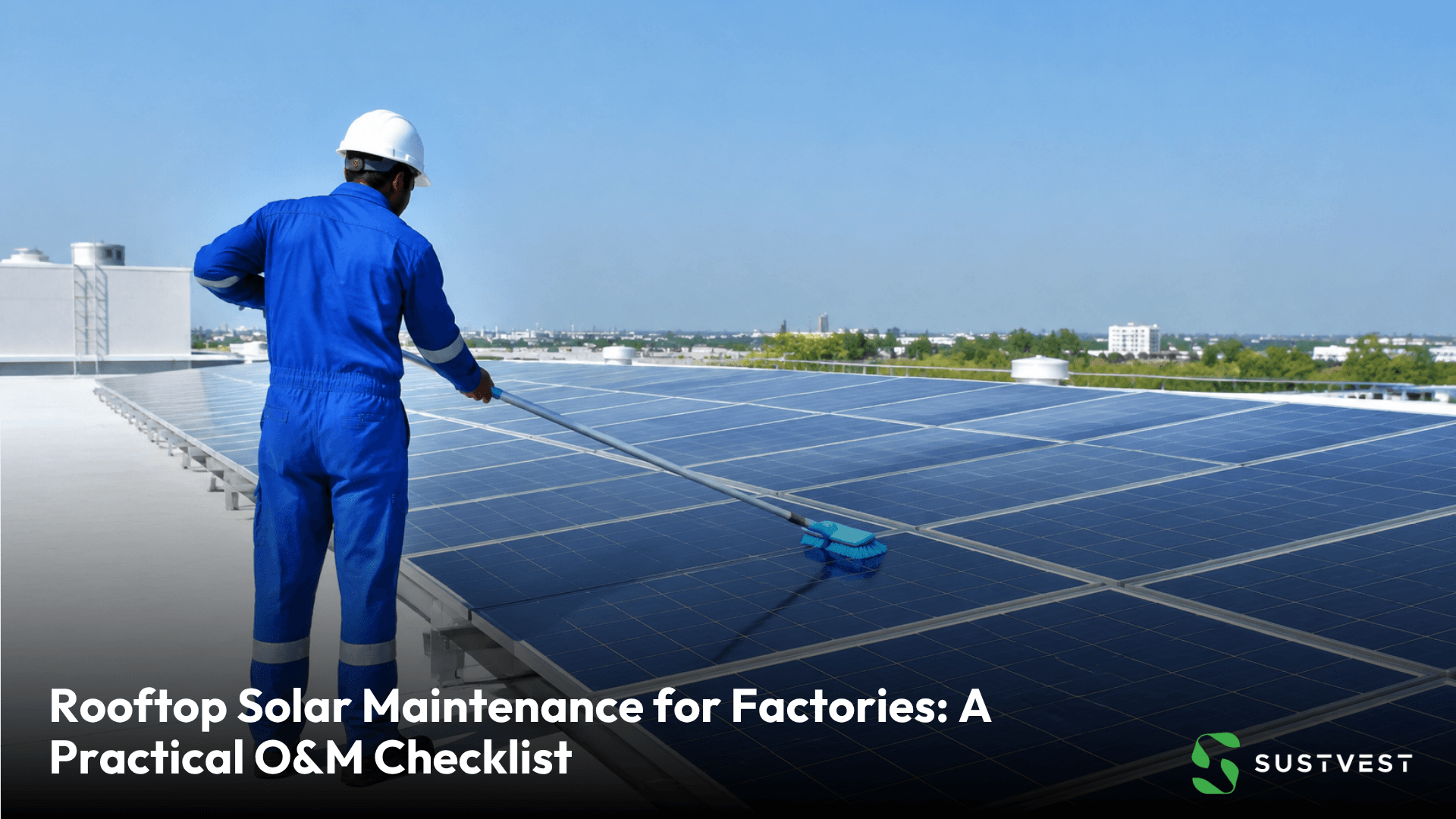
Rooftop Solar Maintenance for Factories: A Practical O&M Checklist
A rooftop solar plant has no moving parts, so many factory owners assume it looks after itself. It does not. Dust, loose cables, tired inverters and blocked drains quietly eat into output, and nobody notices until the savings come in lower than promised.
Good O&M (operations and maintenance) is what keeps a plant producing the units it was sold on, year after year. This guide explains what solar maintenance involves, how often each task should happen, and what skipping it costs. It is written for plant heads, facility managers and CFOs who want a clear checklist, not jargon.
Does a rooftop solar plant really need maintenance?
Yes. A solar plant needs regular cleaning, inspection and monitoring to keep generating at its expected level. Without it, losses build up slowly and stay hidden.
The US National Renewable Energy Laboratory (NREL) built an entire best practices guide for PV system O&M around two kinds of work: preventive maintenance, done on a schedule to stop problems, and corrective maintenance, done to fix faults once they appear. Its fact sheet estimates O&M costs at around 0.5% of the system's initial cost per year for large systems and 1% for small systems.
That is a small price next to the cost of lost generation. On a factory roof, every unit the plant fails to produce is a unit you buy back from the grid at full tariff.
How much output do dirty solar panels lose?
More than most people expect. In a study of a plant in Mumbai, losses to dust rose from 0.4% of output with daily cleaning to about 6% with monthly cleaning.
The figures come from a CSTEP (Center for Study of Science, Technology and Policy) report on module reliability (April 2018), which modelled soiling loss as a share of DC (direct current) output for different cleaning cycles:
| Cleaning frequency | Soiling loss (share of DC output) |
|---|---|
| Once a day | 0.40% |
| Once in 7 days | 1.46% |
| Once in 15 days | 3.03% |
| Once a month | 6.01% |
In the same study, the plant's annual AC output was 1,566.34 MWh with daily cleaning and 1,478.06 MWh with monthly cleaning. That gap of about 88 MWh a year came from dust alone. The report cites IIT Bombay's estimate that each day added to the cleaning cycle raises soiling loss in steps of about 0.4%, and warns that losses "could be much higher in dusty regions".
Two caveats keep this honest. The study modelled one site, and it could not offset monsoon rain, so its authors call the loss a slight over estimate. Industrial areas near highways, cement units or open land can be far dustier than Mumbai.
How often should factory solar panels be cleaned?
There is no single right answer. The best cleaning interval depends on how fast dust builds up on your roof and what each cleaning round costs.
A recent Energetica India article on solar cleaning schedules (17 October 2026) points out that most Indian plants still clean on a fixed calendar, weekly, fortnightly or monthly, whatever the actual dust level. Its author suggests treating any national soiling figure as a reason to measure your own plant, not as a planning number.
A practical approach for a factory roof:
- Start with a fixed schedule, for example every one to two weeks in the dry season, and less often during steady monsoon rain.
- Compare output just before and just after cleaning. The difference tells you how much dust was costing you.
- Adjust the interval until the value of the recovered units roughly matches the cost of a cleaning round.
- Use soft brushes and clean water. Hard water, detergents and abrasive tools can leave residue or scratch the glass.
- Keep safe walkways. Cleaners should never step on modules or on fragile roof sheets.
What does a full solar O&M checklist include?
Cleaning is only one part. A complete O&M plan covers the modules, the electricals, the structure, the roof and the data.
Modules
- Regular cleaning, as above.
- Visual checks for cracked glass, browning, bubbles or burn marks.
- Thermal (infrared) scans to find hot spots that the eye cannot see.
- Removal of bird droppings, leaves and shade from new obstructions.
Inverters and electricals
- Check inverter error logs and alarms.
- Clean inverter air filters and keep ventilation clear.
- Inspect cables, connectors and junction boxes for loose joints, heat damage or rodent bites.
- Test earthing and lightning protection, especially before the monsoon.
- Check protection devices and the net or export meter.
Structure and roof
- Check bolts and clamps for corrosion and tightness.
- Inspect roof penetrations and sheets for leaks after heavy rain.
- Keep gutters and drains clear so water does not pool around mounts.
If your building is older, run through our old factory roof solar readiness checklist before the plant goes in, because roof problems are far cheaper to fix first.
Why does solar plant monitoring matter?
Monitoring tells you a problem exists before your electricity bill does. Without data, a tripped inverter string or a failed fuse can go unnoticed for weeks.
A good setup tracks generation every few minutes, compares it with sunlight and expected yield, and sends an alert when output drops. That lets the O&M team move from scheduled visits to targeted fixes. Ask any vendor to show you a live example of solar plant monitoring before you sign, and make sure you get access to the data too.
What should a monthly solar O&M report include?
A useful monthly report tells you what the plant produced, what it should have produced, and what was done about the gap.
- Generation: units produced this month, compared with the expected yield and the same month last year.
- Availability: hours or days when any inverter or string was down, and why.
- Work done: cleaning dates, inspections, faults found and faults fixed.
- Open issues: anything pending, such as spare parts on order or roof repairs needed.
- Savings: solar units consumed on site, so finance can track the real saving against the grid bill.
If your vendor cannot send a report like this every month, treat it as a warning sign about how the plant is being run.
How fast do solar panels lose output with age?
Slowly, if the modules are good and the plant is well kept. The CSTEP study assumed modules fall to 97% of their rating by the end of the first year and then lose 0.67% a year after that.
On that pattern, a module would still deliver about 81% of its rating in year 25. The same CSTEP analysis found that its model plant would stop being profitable if degradation went above about 2% a year, and would not be viable at all above 4% a year. Degradation is partly about module quality and partly about care: hot spots, water ingress and damaged cables speed it up.
Who should handle O&M: you or your solar developer?
It depends on who owns the plant. If you own it, O&M is your job or your contractor's. If a developer owns it, O&M is usually theirs.
When you buy the solar plant outright, you either build an in house team or sign an annual maintenance contract. Write clear terms: cleaning frequency, response times for faults, spare parts, reporting and a generation or availability commitment.
Under the OPEX solar model, the developer owns the plant and earns only on the units it generates, so it has a direct reason to keep output high. Even then, check the contract. Our guide on what to check in a rooftop solar PPA covers the O&M and performance clauses to look for, and our list of questions to ask a rooftop solar developer includes how they run maintenance.
Whichever route you choose, see what a structured solar O&M service covers so you know what good looks like.
FAQ
How often should rooftop solar panels be cleaned in India?
It depends on local dust. A CSTEP study in Mumbai found soiling loss of 1.46% with weekly cleaning and 6.01% with monthly cleaning. Start with a one to two week schedule and adjust using before and after output data.
How much does solar O&M cost?
NREL estimates O&M at around 0.5% of the system's initial cost per year for large systems and 1% for small systems. Actual costs vary with site, labour rates and scope.
Who maintains the plant under a RESCO or OPEX model?
Usually the developer, because it owns the plant and is paid per unit generated. The PPA should state cleaning, fault response and performance commitments.
What is the most common sign that a solar plant needs attention?
A drop in generation compared with similar sunny days. Monitoring alerts, inverter error codes and visible dirt or damage are the usual early warnings.
About SustVest
SustVest (SolarGridX Ventures Pvt Ltd) is a rooftop solar developer in India, ranked #5 in the CRISIL Top 10 for 2026, running 80+ distributed solar plants of about 30 MW across 13 states for factories, hospitals, hotels, tea estates and institutions. Under our OPEX/RESCO model we fund, build, own and maintain your rooftop plant, so you get a lower per unit tariff with zero upfront cost. Talk to SustVest about a well maintained rooftop plant for your site.
Sources
- CSTEP: Effect of Module Reliability on Techno-Economics of a Utility Scale Solar Photovoltaic Plant in India (April 2018)
- NREL: New Best-Practices Guide for Photovoltaic System Operations and Maintenance (fact sheet, May 2017)
- NREL via OSTI: Best Practices for Operation and Maintenance of Photovoltaic and Energy Storage Systems, 3rd Edition
- Energetica India: Why Most Indian Plants Still Wash on a Schedule That Ignores Their Dust Curve (17 October 2026)