Solar & Renewables for Data Centres in India (2026)
Data centres are increasingly important electricity consumers in India. Their electricity demand runs around the clock, 365 days a year, with very low tolerance for interruption. As the sector scales and green-energy expectations grow — through customer sustainability commitments and state-specific policy requirements — how a data centre sources its power has become a core strategic question, not an afterthought. But the renewable playbook for a data centre is genuinely different from that of a factory or warehouse, and it's worth being clear-eyed about what works.
Data centres have very high, round-the-clock (24x7) electricity demand, which means rooftop solar alone generally cannot meet a large facility's full requirements — a data centre's roof can host only part of the power it needs, and only during daylight. For large facilities, green open access (often via group captive) can provide renewable electricity at a scale beyond what on-site rooftop solar can generally supply, and operators may combine off-site renewable procurement with battery storage and sometimes solar-wind hybrids to help match supply with their round-the-clock demand. Rooftop solar on the facility itself plays a supporting role (offsetting some daytime consumption), but it is not the main lever for a large data centre. The honest framing is: rooftop where it fits, open access for scale, and storage or hybrids for the round-the-clock matching that can be particularly relevant for data centres. As always, the right mix and its economics depend on the facility, location, and state regulations.
Here's how renewable power actually works for a data centre, and why the approach differs from other industries.
Why is rooftop solar usually insufficient on its own for a large data centre?
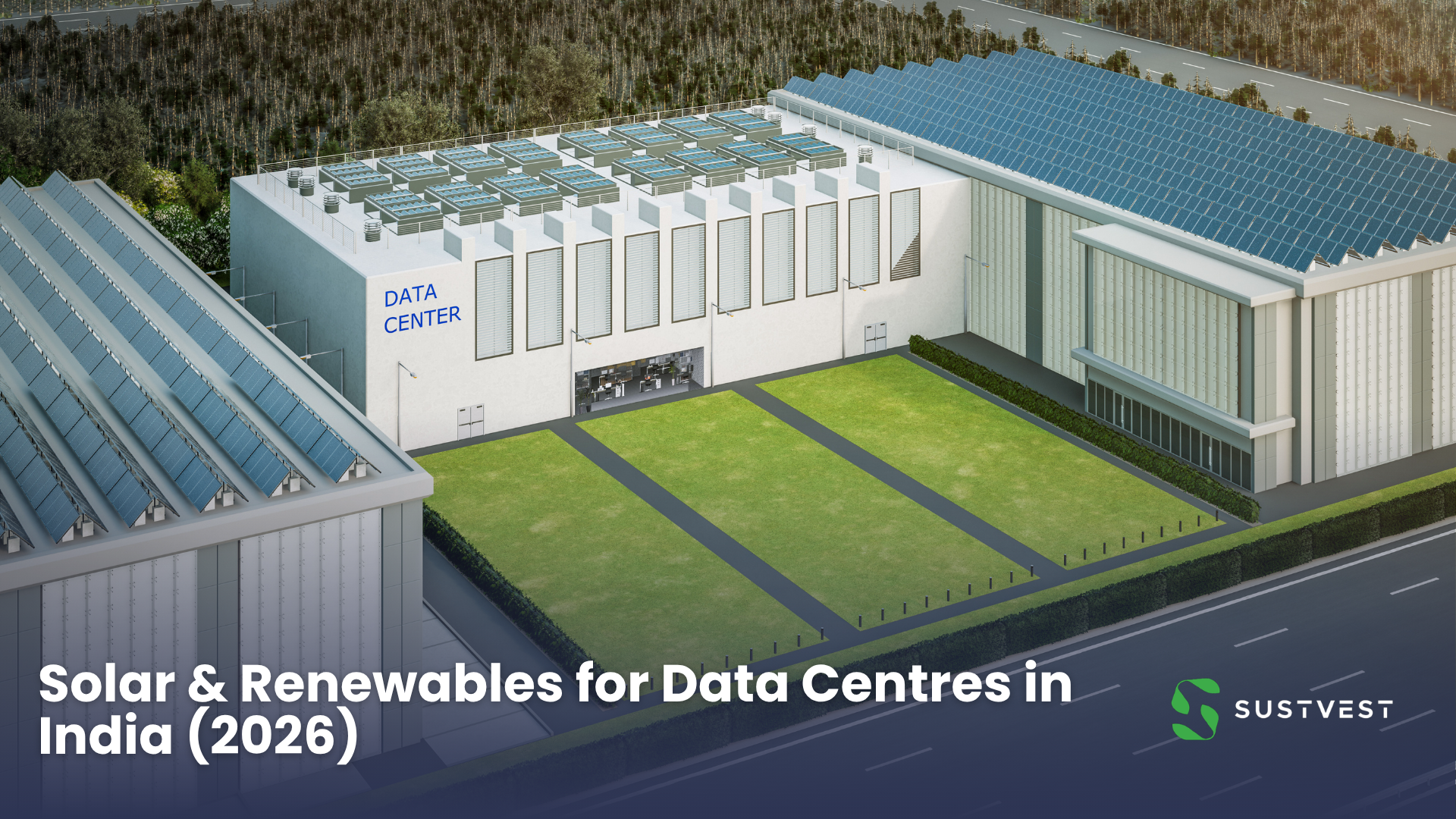
Because a data centre's power density is high and its usable roof area is small relative to its load. Where a factory or warehouse often has a large roof over a comparatively modest electrical load — making rooftop solar a strong fit — a data centre tends to be the opposite: a relatively compact building packed with servers and cooling, drawing a large, continuous load. How much solar a given data centre roof can host depends on its usable roof area, building design, and installed capacity, but for a large facility the roof may cover only part of the facility's electricity demand; the actual contribution depends on the usable roof area, system capacity, and load profile.
Two further features make rooftop insufficient on its own for a large data centre:
The load is 24x7, solar is daytime-only. Even a sizeable rooftop array only generates during daylight, while a data centre's demand is roughly flat around the clock — including overnight, when solar produces nothing. Covering a data centre's load with renewables is fundamentally a round-the-clock problem, not a daytime one.
Cooling is a large, continuous load. Cooling can account for a significant share of a data centre's electricity demand and operates alongside the IT load. Power usage effectiveness (PUE), calculated as total facility energy divided by IT equipment energy, is a commonly used measure of overall infrastructure energy efficiency.
This doesn't make rooftop solar pointless for a data centre — it can still offset some daytime electricity consumption and potentially reduce grid purchases, subject to the applicable connection arrangements and charges. But it means rooftop is a supporting measure for a large data centre, not the foundation of its renewable strategy. Being honest about that upfront matters, because content that implies "put solar on your data centre roof and go green" misrepresents the actual engineering and economics. (For a smaller data centre, rooftop's relative contribution can be higher — it depends on the building and load profile.)
How do data centres in India actually source renewable power?
One important route is green open access — renewable power from large off-site solar, wind, or hybrid plants, delivered through the grid. Depending on the project, procurement may be structured as group captive and paired with storage. For large facilities, green open access can provide renewable electricity at a scale beyond what on-site rooftop solar can generally supply. Depending on the project, operators may combine off-site renewable procurement with storage or solar-wind hybrids. The main routes:
Green open access PPAs. A data centre contracts for renewable power from a large off-site plant and has it wheeled to the facility through the grid. This can provide access to renewable generation at a scale that may exceed what the facility can accommodate on its own roof, depending on its electricity demand and procurement requirements. We cover how this works, and the state-specific charges involved, in rooftop solar vs green open access.
Group captive structures. Group-captive structures are one option available to large data centre operators seeking to procure off-site renewable electricity. Group-captive structures may reduce certain open-access charges (such as cross-subsidy surcharge) when the applicable ownership and electricity-consumption requirements are met. The actual benefit depends on the project's structure, applicable central and state regulations, and the charges in force for the relevant consumer and location.
Solar-plus-storage and solar-wind hybrids. Because a data centre needs power around the clock, solar-wind hybrids and battery storage are among the options operators can evaluate when seeking a more consistent renewable supply. Their suitability depends on the load profile, generation mix, grid arrangements, and required level of supply matching.
On-site rooftop solar. As a supporting layer, behind-the-meter rooftop solar offsets some daytime consumption.
Publicly reported agreements illustrate the use of off-site renewables by Indian data-centre operators. In April 2026, ST Telemedia Global Data Centres India expanded its arrangement with CleanMax through an additional 21 MWp of solar capacity, taking the reported total hybrid renewable-energy partnership to 130 MW across Tamil Nadu and Maharashtra. The agreement illustrates how data-centre operators can procure renewable electricity at scale through off-site arrangements.
What is "round-the-clock" (RTC) or 24x7 clean energy, and why does it matter for data centres?
Round-the-clock (RTC) clean-energy matching aims to match a facility's electricity consumption with eligible clean-energy generation in each hour under a defined accounting framework, rather than relying only on annual totals — and this can be particularly relevant for data centres because they typically have substantial electricity demand throughout the day and night. A facility can be "100% renewable" on an annual-matching basis while still drawing grid (often fossil-based) power at night, when its solar isn't generating. For a data centre — whose customers increasingly scrutinise sustainability claims, and whose load is substantial across day and night — a more demanding target is a higher degree of hourly matching between electricity consumption and clean-energy generation.
Achieving a high degree of hourly matching is hard precisely because solar is intermittent and daytime-only. It's why the data-centre renewable discussion leans on storage (to shift electricity across time) and hybrids (solar + wind for complementary generation) rather than solar alone — though these are not the only tools, and grid electricity, diversified renewable portfolios, and other contractual arrangements can also contribute. Round-the-clock renewable supply is an evolving area in India. Interest in higher levels of hourly renewable matching is influenced by project economics, customer commitments, and the availability of suitable generation, storage, and procurement arrangements.
Why are data centres going renewable in India?
Two forces: the sheer scale of their power cost, and hardening green expectations from customers and regulators.
Power is a core cost. Electricity is one of the largest operating costs for a data centre, so renewable procurement at a competitive landed cost directly affects competitiveness — not just sustainability.
Customer and hyperscaler commitments. The largest data centre tenants (global cloud and technology companies) have their own renewable and net-zero commitments. For operators serving customers with formal renewable-energy or carbon-reduction commitments, the ability to document renewable procurement and its contribution to those targets can be commercially important.
State policy requirements. Renewable-energy requirements can vary by state and policy framework. For example, Maharashtra's revised Integrated Data Centre Park Policy was reported in June 2026 to reduce the green-power requirement for core data-centre operations from 100% to 51%; and Andhra Pradesh's IT Minister stated in September 2026 that at least 70% of the energy used by data centres must come from renewable sources. The formal policy or regulatory instrument, its commencement date, and its applicability should be verified before treating either as an operative legal mandate. Operators should check the latest notified policy and any transition provisions before making investment decisions.
Reliability economics. Data centres cannot tolerate outages, so they already invest heavily in backup. A well-designed renewable-plus-storage strategy can align with reliability goals, though protecting uptime remains a dedicated engineering requirement in its own right.
What should a data centre operator check when planning renewable supply?
Because the data-centre renewable question is dominated by open access, storage, and state regulation, the planning is more complex than a standard rooftop decision. Key things to work through:
Your state's open-access charges and rules. The landed cost of open-access renewable power is highly state-specific (wheeling, cross-subsidy surcharge, banking, additional surcharge). This often determines whether a given location's renewable economics are attractive.
Group captive vs third-party PPA. Whether a group-captive structure materially improves your economics depends on the state's charges and your ability to meet the captive conditions.
Round-the-clock matching goals. Decide what level of hourly/RTC matching you (or your customers) actually require — it drives how much storage and hybridisation you need, and the cost.
PPA terms. Open-access/renewable PPAs are long-term contracts; the tariff, escalation, change-in-law, and exit terms matter, as we cover in our PPA terms checklist.
Rooftop where it fits. Use available roof area for behind-the-meter solar as a supporting measure, sized to daytime load.
Reliability integration. Ensure any renewable/storage strategy is designed around the facility's uptime and power-quality requirements, not in tension with them.
This is a facility- and state-specific modelling exercise. The reliable answer comes from modelling your actual load, location, and the applicable charges — not a generic benchmark.
The bottom line for data centre operators
Data centres are a genuinely different renewable proposition from the rest of C&I. For large data centres, rooftop solar will generally play a supporting role, because usable roof area and daytime-only generation limit its ability to meet the facility's full electricity demand. The real levers are green open access for scale and, where appropriate, storage and renewable hybrids to help improve the match between supply and around-the-clock demand. With power a core cost and green supply increasingly relevant to hyperscaler customers and some state regulators, getting the renewable strategy right is central to a data centre's competitiveness. The honest approach is to treat it as what it is: a state-specific, open-access-and-storage-led question, modelled on the facility — with rooftop solar as a useful complement, not the headline.
SustVest develops commercial and industrial rooftop solar under OPEX and CAPEX models, with in-house monitoring and O&M. We help buyers assess the realistic contribution of on-site solar alongside their wider renewable-procurement options. For a large, round-the-clock facility such as a data centre, the right approach depends on the site's electricity demand, usable roof area, and broader power-procurement requirements — and we'll give you a straight assessment of where on-site solar fits. Ranked among India's Top 10 rooftop solar project developers in CRISIL Intelligence's CY2025 assessment (India Solar Rooftop Map, December 2025), with 86+ projects delivered across 13+ states (company-reported figures). Book a free site assessment.
Frequently Asked Questions
Can a data centre run on rooftop solar? Not usually as the sole power source for a large data centre. Rooftop solar can offset part of a facility's electricity consumption, but its contribution depends on usable roof area, installed capacity, and the facility's load profile. Because data centres operate around the clock while solar generation is intermittent and daytime-only, larger facilities generally need additional power sources — such as green open access, often paired with storage — to meet their electricity requirements.
How do data centres in India use renewable energy? Primarily through green open access — contracting for renewable power from large off-site solar, wind, or hybrid plants delivered via the grid, often structured as group captive where the applicable conditions are met. Operators may pair off-site renewable procurement with battery storage and solar-wind hybrids to help supply electricity across the day and night. On-site rooftop solar can support daytime consumption.
What is round-the-clock (RTC) or 24x7 clean energy? Round-the-clock clean-energy matching aims to match a facility's electricity consumption with eligible clean-energy generation in each hour under a defined accounting framework, rather than relying only on annual totals. It matters for data centres because their load is roughly constant day and night, so annual-average "100% renewable" claims can still coincide with grid draw at night. Achieving a higher degree of hourly matching generally involves storage and often solar-wind hybrids — it's an evolving and more demanding standard.
Why are data centres in India switching to renewables? Two main reasons: electricity is one of a data centre's largest costs, so competitively-priced renewable power improves the bottom line; and for operators serving customers with formal renewable-energy or carbon-reduction commitments (such as global cloud and technology companies), the ability to document renewable procurement can be commercially important. Some states have also announced or revised renewable-energy expectations for data centres; operators should verify the applicable notified policy and its scope.
Is battery storage necessary for a renewable-powered data centre? Battery storage can play an important role in supplying renewable electricity during periods when solar or wind generation is insufficient. However, it is not universally required for every renewable procurement arrangement. The need for storage, and its appropriate size, depends on the facility's load profile, renewable supply mix, grid arrangements, and target for hourly clean-energy matching.
Does SustVest provide solar for data centres? SustVest develops commercial and industrial rooftop solar under OPEX and CAPEX models, with in-house monitoring and O&M, and helps buyers assess the realistic contribution of on-site solar alongside other renewable procurement options. For large, round-the-clock facilities such as data centres, the appropriate approach depends on the site's electricity demand, usable roof area, and wider power-procurement requirements.
Sources
Ministry of Power / PIB — Green Energy Open Access Rules, 2022 (national green open access framework): https://www.pib.gov.in/Pressreleaseshare.aspx?PRID=1842737&lang=2®=48 — applicable state regulations and captive-consumption requirements to be checked separately
Data Center Dynamics (DCD) — ST Telemedia Global Data Centres India / CleanMax solar PPA (April 2026): additional 21 MWp solar; reported ~130 MW total hybrid renewable-energy capacity across Tamil Nadu and Maharashtra: https://www.datacenterdynamics.com/en/news/stt-gdc-signs-solar-ppa-in-india/
Google Sustainability — 24/7 Carbon-Free Energy — methodology for hourly/round-the-clock matching: https://sustainability.google/stories/24x7/
Hindustan Times (Mumbai) — Maharashtra's revised Integrated Data Centre Park Policy, reported June 2026 (green-power requirement for core operations reduced from 100% to 51%): https://www.hindustantimes.com/cities/mumbai-news/state-expands-data-centre-policy-s-scope-incentives-101781378129874.html — confirm against the official government resolution before relying on precise legal scope
The New Indian Express — Andhra Pradesh IT Minister's September 25, 2026 statement on a minimum 70% renewable-energy requirement for data centres: https://www.newindianexpress.com/states/andhra-pradesh/2026/Sep/25/andhra-sets-70-percent-renewable-energy-mandate-for-data-centres — confirm against the official policy/instrument for legal status and applicability
SustVest — CY2025 rooftop solar developer ranking (lists SustVest among India's Top 10): https://sustvest.com/blog/indias-rooftop-solar-market-hit-276-gw-what-investors-should-know ; rooftop solar + monitoring/O&M delivery; 86+ projects, 13+ states (company-reported figures). Not a CRISIL endorsement.
Green Energy Open Access Rules / group captive; net-billing economics; BESS — see linked SustVest posts (open-access, BESS, net-metering-vs-net-billing); charges are state-specific