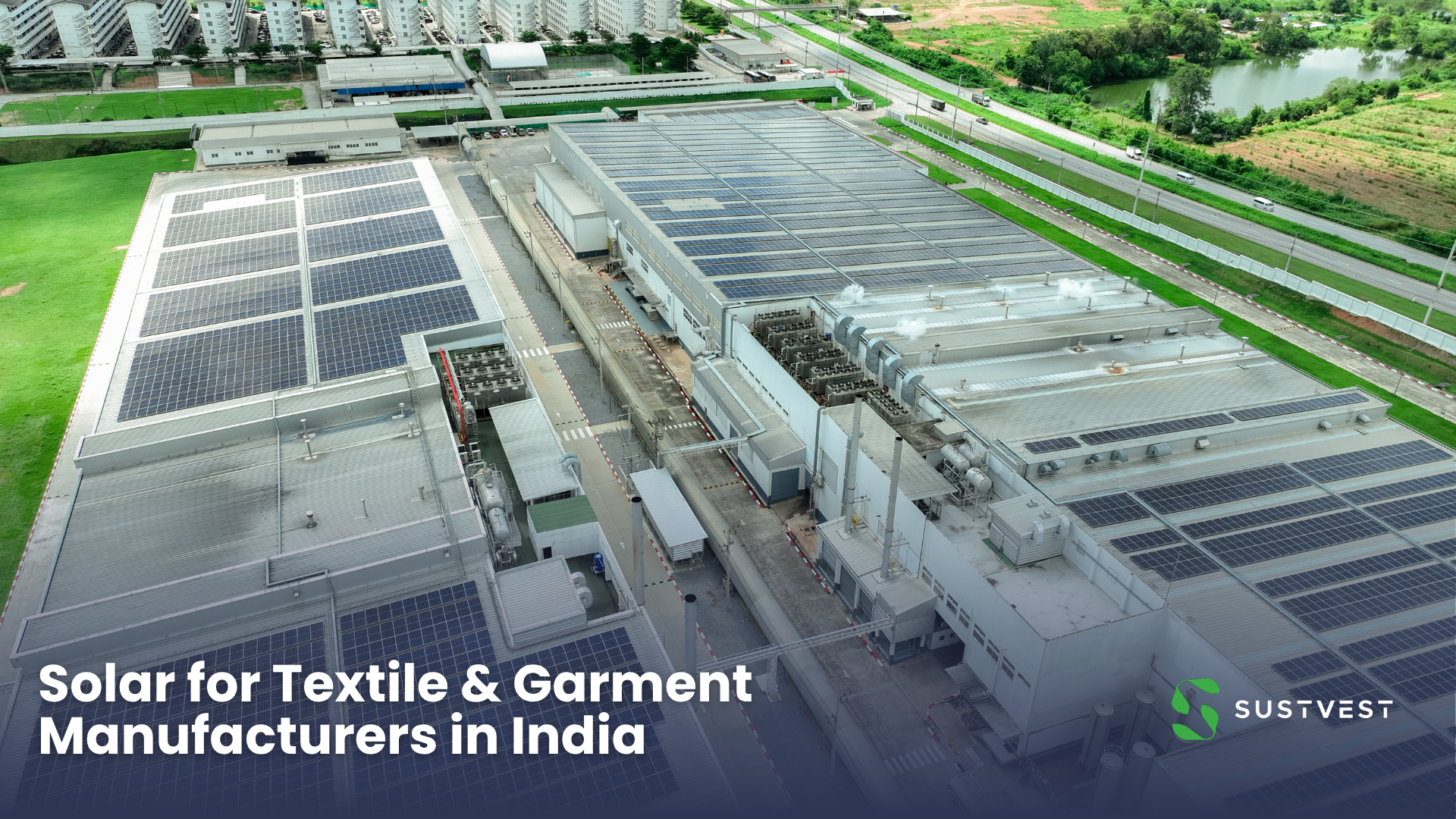
Solar for Textile & Garment Manufacturers in India
Textiles is one of India's largest and most energy-intensive industries — and one of the stronger industrial applications for rooftop solar. Spinning, weaving, dyeing, and finishing run on power-hungry machinery, and for many textile manufacturers electricity is a significant operating cost that can rank among the largest after raw materials. At the same time, garment and textile exporters face mounting sustainability expectations from international buyers. That combination — high energy cost plus buyer-driven sustainability pressure — is why solar is increasingly being evaluated as both a cost and a sustainability lever by textile manufacturers.
Textile and garment manufacturers are strong candidates for rooftop solar because they run energy-intensive processes (spinning, weaving, dyeing, finishing, and — in garment units — sewing, cutting, and finishing) with substantial daytime electricity demand, aligning well with solar generation. The electricity profile differs by subsector: spinning and weaving mills can have large, near-continuous motor loads; processing units combine electrical and thermal demand; garment factories tend to have more shift-based loads from sewing, cutting, lighting, and HVAC. Where the load aligns with daytime generation, a well-sized system can achieve high self-consumption and displace grid power at industrial tariffs. For exporters, solar carries a second benefit: it produces renewable-energy data that can support the growing sustainability requirements of international brands and buyers. As always, the actual savings depend on your load, tariff, and roof — so the reliable numbers come from modelling your specific facility, not a headline figure.
Here's why the fit is strong and how to approach it.
Why is textile manufacturing such a good fit for rooftop solar?
Because textile processes are electricity-intensive and much of the load runs during daylight hours — so a high share of solar generation can be consumed on site rather than exported. Spinning, weaving, knitting, and finishing machinery draw substantial power through production shifts, and much of that runs in daytime hours when solar output peaks — though operating hours and load profiles vary by plant (some spinning and composite mills run around the clock). Where generation aligns with consumption, that alignment drives value: where exported power is credited below the retail rate, the facilities that use most of what they generate benefit most, as we explain in net metering vs net billing.
Three sector characteristics reinforce the fit:
Electricity is a large share of operating cost. For many textile manufacturers, power is a significant cost that can rank among the largest after raw material, so displacing grid units with solar has a direct effect on competitiveness — especially where margins are tight.
Large factory roofs. Textile sheds and mills often have extensive roof area relative to load, giving room for a meaningful system (subject, as always, to a structural assessment).
Diesel dependence during outages. Where a facility uses diesel generation during grid outages, appropriately designed battery storage can potentially reduce generator runtime and associated fuel consumption — subject to the site's electrical architecture and backup requirements — and since diesel power is considerably more expensive than grid or solar, the value per unit displaced can be higher.
The same principle from our manufacturing solar guide applies: the value comes from matching generation to on-site consumption, sized to your actual load rather than to the roof.
What's different about textiles compared with other industries?
Two things: the process-heat requirement in dyeing and finishing, and the export-sustainability pressure on garment units. Both shape how a mill should think about solar.
Process heat. Unlike a purely electrical operation, textile dyeing and finishing need significant thermal energy — hot water and steam, typically produced by boilers. Rooftop solar PV addresses your electricity load (motors, machinery, lighting, compressed air), not directly your thermal load. This matters for expectations: solar PV can substantially cut your electricity bill, but the boiler/steam side is a separate decarbonisation question (solar thermal, suitable electrification options, biomass, and efficiency measures may address that separately). A realistic solar plan sizes PV to the electrical load and treats process heat as a distinct track. Being clear on this distinction upfront avoids over-promising what a PV system alone can deliver.
Export sustainability pressure. Garment and textile exporters increasingly face renewable-energy and emissions expectations from international brands and buyers, which we discuss further below. This is a relevant driver for export-facing units, although the specific requirements vary by buyer and programme.
How does solar help textile exporters meet buyer sustainability requirements?
Some international apparel brands and buyers include renewable-energy, emissions, or environmental-data expectations in their supplier programmes, and on-site solar can provide measured renewable-generation data that may support those requirements. Many large brands have public renewable-electricity and decarbonisation commitments, and some extend emissions-data and renewable-energy expectations to their manufacturing suppliers. For an Indian garment exporter, being able to demonstrate on-site renewable generation may help meet a brand's sustainability programme — subject to the buyer's specific methodology and contractual requirements.
A few points to keep this accurate and useful:
Generation data supports a claim; it isn't automatically the claim. Metered solar data proves how much you generated. Making a specific renewable-energy claim for a brand's programme also depends on the contractual and reporting arrangements and how the renewable attributes are treated. Robust monitoring provides an important evidence base, alongside those arrangements.
It's a buyer-driven expectation, not (for finished garments) a direct carbon regulation. EU mechanisms such as the Carbon Border Adjustment Mechanism (CBAM) currently cover specific sectors (cement, steel, aluminium, fertilisers, electricity, hydrogen) — not finished garments. EU textile sustainability and product rules are, however, evolving: textile apparel is a priority product group under the EU's Ecodesign for Sustainable Products Regulation (ESPR), with the European Commission currently targeting adoption of the textile-specific delegated act in Q4 2027, and the associated Digital Product Passport requirements still being developed. So today's pressure on textile exporters comes mainly through brand and buyer requirements and value-chain data requests, with EU product/sustainability rules a developing factor.
Timing matters. As buyer requirements and sustainability-reporting expectations continue to evolve, and a rooftop project takes time from assessment to commissioning, exporters considering solar for sustainability reasons may benefit from starting early enough to have operational generation and supporting data available when required.
This dual driver — cost plus buyer sustainability — mirrors what we cover for the automotive and auto-component sector, where supply-chain sustainability expectations are a similar force.
What determines the savings for a textile mill?
The savings depend on your tariff, self-consumption share, roof, and sizing — not a single national figure. The levers that actually move the outcome:
Your electricity tariff. The applicable tariff structure determines the value of each unit of grid electricity displaced by solar — mills on industrial/HT tariffs typically pay a meaningful rate per unit.
Self-consumption share. The proportion of solar you use on site (rather than export) is one of the most important drivers of value. Textiles' daytime-heavy load tends to support high self-consumption when the system is sized to the load.
Roof and land. Large mill roofs suit rooftop solar; some units in space-constrained hubs also consider ground-mounted or hybrid layouts as load grows. A structural assessment comes first.
Diesel displacement. Where solar (with storage) reduces expensive diesel runtime, the value per displaced unit can be higher.
Demand charges. For mills with significant demand charges, pairing solar with battery storage can help manage peaks where the tariff structure rewards it.
Because these vary so much between mills, the only reliable way to know your savings is to model your actual load profile and tariff — which is why a credible proposal starts with your consumption data, not a per-square-foot estimate. We explain how project cost itself is built up in our rooftop solar cost guide.
Can rooftop solar meet a textile mill's full power demand?
Often not on its own — larger, multi-shift mills usually consume more than their roof can generate, so rooftop is frequently combined with open access for higher renewable shares. Rooftop solar is often the most direct on-site renewable option: self-consumed behind-the-meter generation generally avoids the wheeling and transmission charges associated with procuring power through open access. But a large spinning or composite mill running around the clock can consume far more than its roof produces, so covering a bigger share of demand — or meeting an export buyer's renewable target — often means adding off-site renewable power.
That's where green open access comes in: renewable power from a large off-site plant, delivered through the grid, sometimes via a group-captive structure. Textile manufacturers in states such as Tamil Nadu, Gujarat, and Maharashtra may also evaluate open access for larger renewable requirements, although the economics depend heavily on state-specific charges, banking provisions, and regulations. The common approach: optimise rooftop first, then layer open access (and storage where it fits) for a larger renewable share.
Should a textile manufacturer use OPEX or CAPEX for solar?
Either works; the choice depends on your balance sheet, tax position, and appetite for owning the asset — and for margin-sensitive textile units, the funding model matters. Under CAPEX, you fund and own the system and retain its ownership economics; under OPEX/RESCO, the developer typically finances and owns the system and you pay for the electricity generated under a long-term agreement, generally without funding the full project cost upfront. We compare the two in OPEX vs CAPEX solar for business.
For textile businesses where margins and working capital are important considerations, OPEX/RESCO is often attractive because it delivers savings without tying up capital — though mills with capital to deploy and a strong tax position may prefer CAPEX for the higher lifetime returns ownership can bring. Both models can provide operational generation data, but the contractual treatment of renewable attributes and reporting rights (which matters for export sustainability reporting) should be confirmed for the specific project. Multi-unit textile groups sometimes use both.
The bottom line for textile and garment manufacturers
Textiles is close to a model case for rooftop solar: energy-intensive, daytime-heavy processes that align well with solar generation, large factory roofs, and — for exporters — a real sustainability incentive on top of the cost saving. The important nuances are to size PV to your electrical load (treating process heat for dyeing and finishing as a separate track), to model your actual mill rather than trust a headline savings figure, and to start early if you're driven by buyer sustainability deadlines. For a margin-sensitive, export-exposed industry, solar is increasingly one of the clearer levers on both cost and competitiveness — but the right system is the one designed around your specific mill.
SustVest designs rooftop solar for textile mills, garment units, and processing plants under OPEX and CAPEX models — sized to your actual load, with in-house monitoring that produces metered generation data for buyer and ESG reporting, and battery storage where peak demand justifies it. Ranked #8 in CRISIL Intelligence's CY2025 Top 10 rooftop solar project-developer ranking (India Solar Rooftop Map, December 2025), with 84+ projects delivered across 13+ states (company-reported figures). Book a free site assessment to see what your mill's roof and load can deliver.
Frequently Asked Questions
Is rooftop solar worth it for a textile mill? Textile manufacturing is a strong fit for rooftop solar because energy-intensive processes (spinning, weaving, dyeing, finishing) have substantial daytime demand that aligns with solar generation, supporting high self-consumption. Electricity can be one of the largest operating costs after raw materials, depending on the textile subsector and facility, so displacing grid units has a direct effect. The actual savings depend on your tariff, self-consumption, roof, and sizing, so they should be modelled for the specific mill.
Can solar power the dyeing and finishing process in a textile plant? Rooftop solar PV addresses a mill's electricity load — motors, machinery, lighting, compressed air — not directly its thermal load. Dyeing and many finishing processes require significant thermal energy (hot water and steam), usually from boilers, which is a separate decarbonisation question addressed by solar thermal, suitable electrification, biomass, or efficiency measures. A realistic solar plan sizes PV to the electrical load and treats process heat as a distinct track.
How does solar help textile and garment exporters? Some international apparel brands set renewable-energy and emissions expectations in their supplier programmes, and on-site solar produces metered renewable-generation data that may support those requirements, subject to the buyer's methodology. For finished garments, these requirements are generally buyer- or programme-driven rather than a direct CBAM obligation, since textiles are not currently within CBAM's covered sectors. Separately, textile apparel is a priority product group under the EU's Ecodesign for Sustainable Products Regulation, with textile-specific requirements and Digital Product Passport provisions still under development.
How much can solar save a textile manufacturer? There is no single figure — savings depend on your electricity tariff, self-consumption share, roof, and system sizing. Energy-intensive mills on industrial tariffs generally see solar displace meaningful grid cost. The reliable way to estimate savings is to model your actual load profile and tariff rather than rely on a per-square-foot or percentage rule of thumb.
Can rooftop solar meet all of a textile mill's electricity needs? Often not for larger, multi-shift mills, whose electricity requirements can exceed what the available rooftop can economically generate. Rooftop is the on-site foundation; mills wanting a higher renewable share typically add green open access (sometimes via group captive), starting with rooftop and layering off-site renewable power for the rest. The economics of open access are state-specific.
Should a textile mill choose OPEX or CAPEX for solar? Both work. Under OPEX/RESCO, the developer typically finances and owns the system and you pay for the electricity under a long-term agreement, generally without funding the full project cost upfront — often attractive for margin-sensitive textile units. CAPEX (you fund and own the system) suits mills with capital and a tax position that can use the benefits. Both models can provide operational generation data, but the contractual treatment of renewable attributes and reporting rights should be confirmed for the specific project.
Sources
BEE / Government of India — India's textile sector energy profile: spinning, weaving, processing, and finishing require both process heat and power; textiles among high-energy-consumption industries
European Commission — CBAM definitive regime / CBAM sectors (covered sectors do not include finished garments); ESPR Working Plan 2025–2030 and Textile Apparel Digital Product Passport (textile delegated act targeted for Q4 2027; DPP requirements under development)
Ministry of Power / MNRE — Green Energy Open Access Rules, 2022 and amendments (off-site renewable procurement; state-specific charges)
International apparel brand supplier programmes — some brands/buyers include environmental, emissions, or renewable-energy expectations in supplier programmes (buyer-driven; kept generic rather than brand-specific)
CRISIL Intelligence — India Solar Rooftop Map, December 2025 (SustVest #8 in the CY2025 project-developer ranking by capacity installed)
SustVest — rooftop solar delivery for C&I including textiles/manufacturing; 84+ projects, 13+ states (company-reported figures)