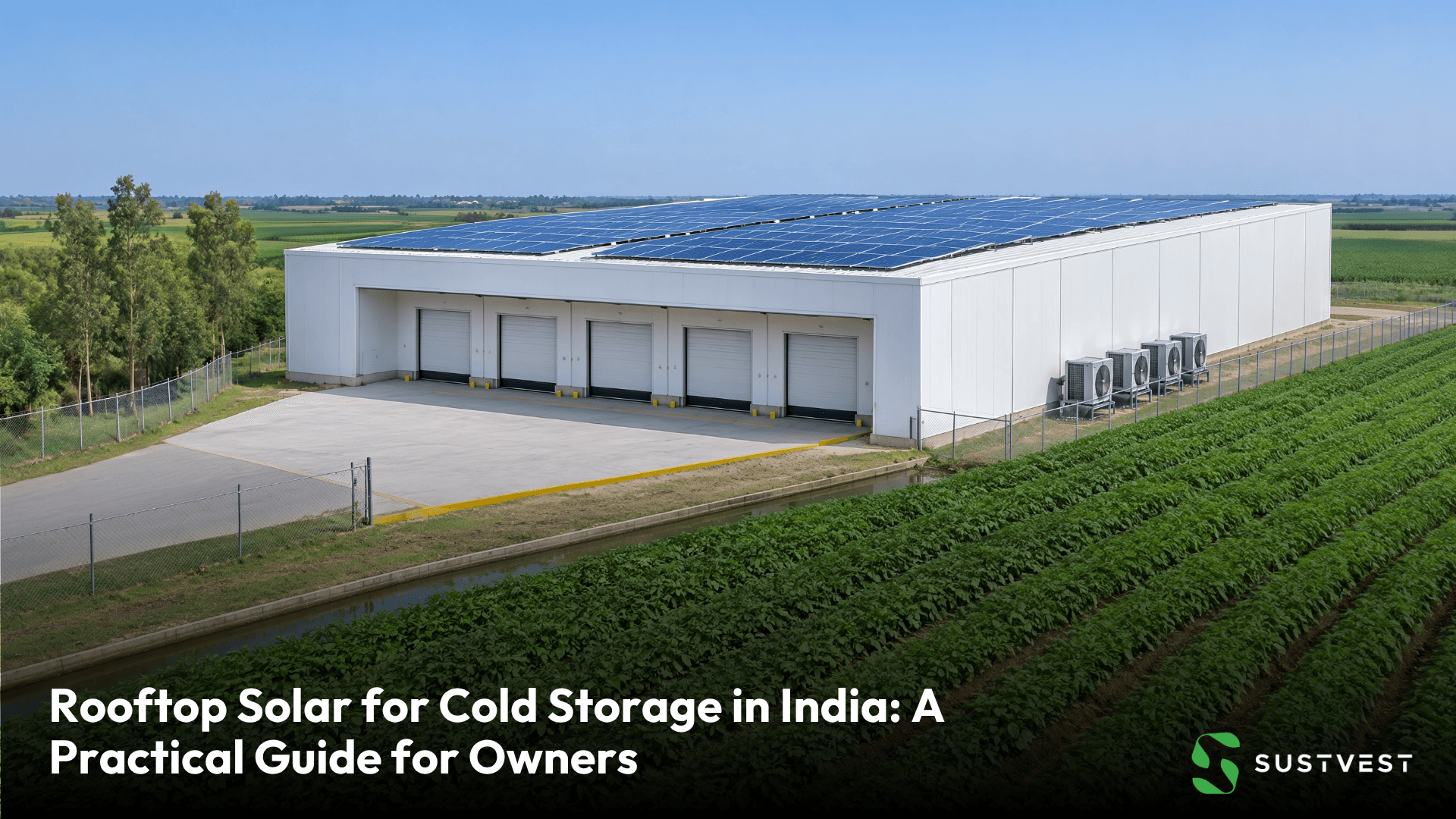
Rooftop Solar for Cold Storage in India: A Practical Guide for Owners
A cold storage never really switches off. Compressors, fans and condensers run for months at a stretch to hold the temperature steady, and the power bill is one of the biggest costs of running the business.
That makes cold storage a natural fit for rooftop solar. The large, flat roofs sit idle, the load runs through the sunny hours, and every unit of solar you use is a unit you do not buy from the grid. This guide is for cold storage owners, partners and plant managers who want a clear, practical view.
Is rooftop solar a good fit for a cold storage business?
Yes, for most grid-connected cold storages. They have big roofs, a heavy daytime refrigeration load, and they run for long seasons, so solar power is used on site instead of being exported at a low rate.
India has a lot of this capacity. As of 30 June 2025, the country had 8,815 cold storages with a combined capacity of 402.18 lakh tonnes, according to a PIB (Press Information Bureau) backgrounder. Most of these are bulk stores with wide, flat roofs.
The fit is strongest when three things are true:
- The store runs during the day for most of the year, so solar output matches the load.
- The roof is sound and large enough for a meaningful plant.
- The store is on a stable grid connection, since a standard rooftop plant works alongside the grid, not instead of it.
Why are cold storage power bills so high?
Cold storage bills are high because refrigeration runs around the clock for long periods, and older plants use more energy for the same cooling. The load does not stop at night or on Sundays.
The NCCD (National Centre for Cold-chain Development) report on energy transition in the cold chain notes that bulk cold storage in India is mostly built on ammonia-based refrigeration, and says this segment offers significant room to cut energy use through efficient technology and renewable energy.
Where grid supply is weak, many stores also run diesel generators. A CLASP and Efficiency for Access assessment of India's cold chain market says rural power supply remains intermittent while cold chain systems need uninterrupted supply. Diesel is usually the most expensive power a store uses.
How much of a cold storage's power can rooftop solar cover?
Rooftop solar can usually cover a share of daytime consumption, not the full 24-hour load. Solar generates only while the sun is up, so night-time cooling still comes from the grid unless you add storage.
The exact share depends on four limits, and your plant size is set by whichever one bites first:
- Daytime load: how many units your compressors and fans use between morning and evening.
- Usable roof area: after leaving space for vents, condensers, walkways and shadows.
- Sanctioned load or contract demand: discoms (distribution companies) usually cap rooftop size against this.
- State rules: net metering, net billing or gross metering limits, which differ by state.
We explain this method step by step in our guide on how to size rooftop solar for a factory. The same logic applies to a cold storage.
What about the off-season when the chambers are empty?
Plan for the off-season before you size the plant. If the store's load falls sharply for part of the year, a plant sized for peak season will export more power in the lean months, and exported units are often worth less than units you use yourself.
Utilisation varies a lot by state. NCCD reports average 2024 utilisation of 90% to 100% in Uttar Pradesh, 60% to 70% in West Bengal and 70% to 80% in Gujarat. Potatoes dominate the sector, occupying over 75% of cold storage capacity, per the same NCCD report, so many stores follow the potato cycle.
Practical steps:
- Collect 12 months of electricity bills, not just peak-season bills.
- Size the plant for the load you have in most months, not the highest month.
- Check your state's export rules. Where export is paid at a low rate, a slightly smaller plant often gives better returns.
- If your discom charges Time of Day tariffs, check how they change the value of solar units. Our post on Time of Day tariffs and rooftop solar covers this.
Can solar keep my cold storage running during a power cut?
Not on its own. A standard grid-tied rooftop plant shuts down during a grid outage for safety, so it will not keep compressors running in a power cut.
To use solar during outages, you need a battery system or a hybrid setup designed to run critical loads. A battery energy storage system (BESS) can store daytime solar and support cooling loads for a limited time, and can also cut diesel use. Sizing it for a refrigeration load needs a careful study, because compressor start-up currents are high.
For most stores, the simplest path is a grid-tied plant first to cut the daily bill, with storage studied as a second step.
Is my cold storage roof strong enough for solar panels?
Most modern insulated-panel and metal-sheet roofs can take a well-designed solar plant, but this must be checked, not assumed. A structural check looks at the roof sheet, purlins, fixing method, age and wind zone.
Cold storage roofs have a few special points:
- Insulation must not be punctured carelessly. Penetrations can cause leaks and thermal loss. Prefer clamp-based or non-penetrating mounting where the sheet allows it.
- Condensers and evaporative coolers on or near the roof need clear access and should not be shaded or blocked.
- Roof replacement timing matters. If the roof will need replacing within a few years, do it before the solar goes on.
Our rooftop solar readiness checklist for old roofs walks through each check.
Should a cold storage buy the solar plant or choose zero upfront OPEX?
It depends on your cash flow and how you want to spend capital. Cold storage is capital heavy already, so many owners prefer to keep cash for chambers, equipment and working capital.
| Point | Buy the plant (CAPEX) | Zero upfront (OPEX / RESCO) |
|---|---|---|
| Upfront cost | Full plant cost from your funds or a loan | None |
| Monthly payment | None after purchase, apart from upkeep | A fixed per-unit tariff for the solar power you use |
| Maintenance and repairs | Your responsibility | The developer's responsibility |
| Fit with seasonal business | You carry the risk of low-use months | You pay only for units used, subject to contract terms |
| Capital for core business | Reduced | Kept free for chambers and equipment |
Under the OPEX solar model, a RESCO (Renewable Energy Service Company) funds, builds, owns and maintains the rooftop plant, and you pay a per-unit tariff that is set below your grid tariff. For a seasonal business, read the minimum offtake and deemed generation clauses carefully, since they decide what you pay in lean months.
Are there government subsidies for solar on cold storages?
There is no dedicated national rooftop solar subsidy for commercial cold storages that we could verify. Cold storage projects themselves can get capital support, and policy is pushing the sector toward cleaner energy.
Under the Capital Investment Subsidy Scheme for Cold Storages and Horticulture Products, a credit-linked back-ended subsidy of 35% of project cost is available in general areas and 50% in North-Eastern, hilly and scheduled areas, for cold storages of 5,000 to 20,000 tonnes, according to the PIB backgrounder.
NCCD says the NHB (National Horticulture Board) and MIDH (Mission for Integrated Development of Horticulture) are pivotal in promoting infrastructure that uses energy-efficient and renewable technologies, but also notes that renewable energy adoption in the sector remains gradual. If you are building or expanding a store, ask your scheme adviser whether solar can be included in the project cost.
What should I check before signing a solar deal for my cold storage?
Check five things: the sizing basis, the roof plan, the tariff and offtake terms, the maintenance plan, and the monitoring you will get.
- Sizing basis: was the plant sized on 12 months of bills, including the off-season?
- Roof plan: who checked the structure, and how will panels be fixed without harming insulation?
- Tariff and offtake: is the per-unit rate fixed or escalating, and what happens in low-use months?
- Maintenance: who cleans panels and how often, especially in dusty farm areas?
- Monitoring: will you see live generation? Solar plant monitoring lets you spot faults and dust losses early.
FAQ
Can a cold storage run fully on rooftop solar?
Usually not. Rooftop solar covers part of the daytime load. Night-time cooling still needs grid power or a battery system.
Does rooftop solar work during power cuts at a cold storage?
A standard grid-tied plant switches off during a grid outage. You need a battery or hybrid system to use solar during power cuts.
How many cold storages are there in India?
India had 8,815 cold storages with a combined capacity of 402.18 lakh tonnes as of 30 June 2025, according to PIB.
How should a seasonal cold storage size its solar plant?
Use 12 months of electricity bills and size for the load in most months, not the peak month, so that little power is exported at low rates in the off-season.
Can a cold storage get rooftop solar with zero investment?
Yes. Under the OPEX or RESCO model, a developer funds, builds, owns and maintains the plant, and the cold storage pays a per-unit tariff for the solar power it uses.
About SustVest
SustVest (SolarGridX Ventures Pvt Ltd) is a rooftop solar developer in India, ranked #5 in the CRISIL Top-10 for 2026. We run 80+ distributed solar plants (about 30 MW) across 13 states for factories, hospitals, hotels, tea estates and institutions, mostly under a zero-upfront OPEX model where we fund, build, own and maintain the plant. Talk to SustVest about rooftop solar for your cold storage.