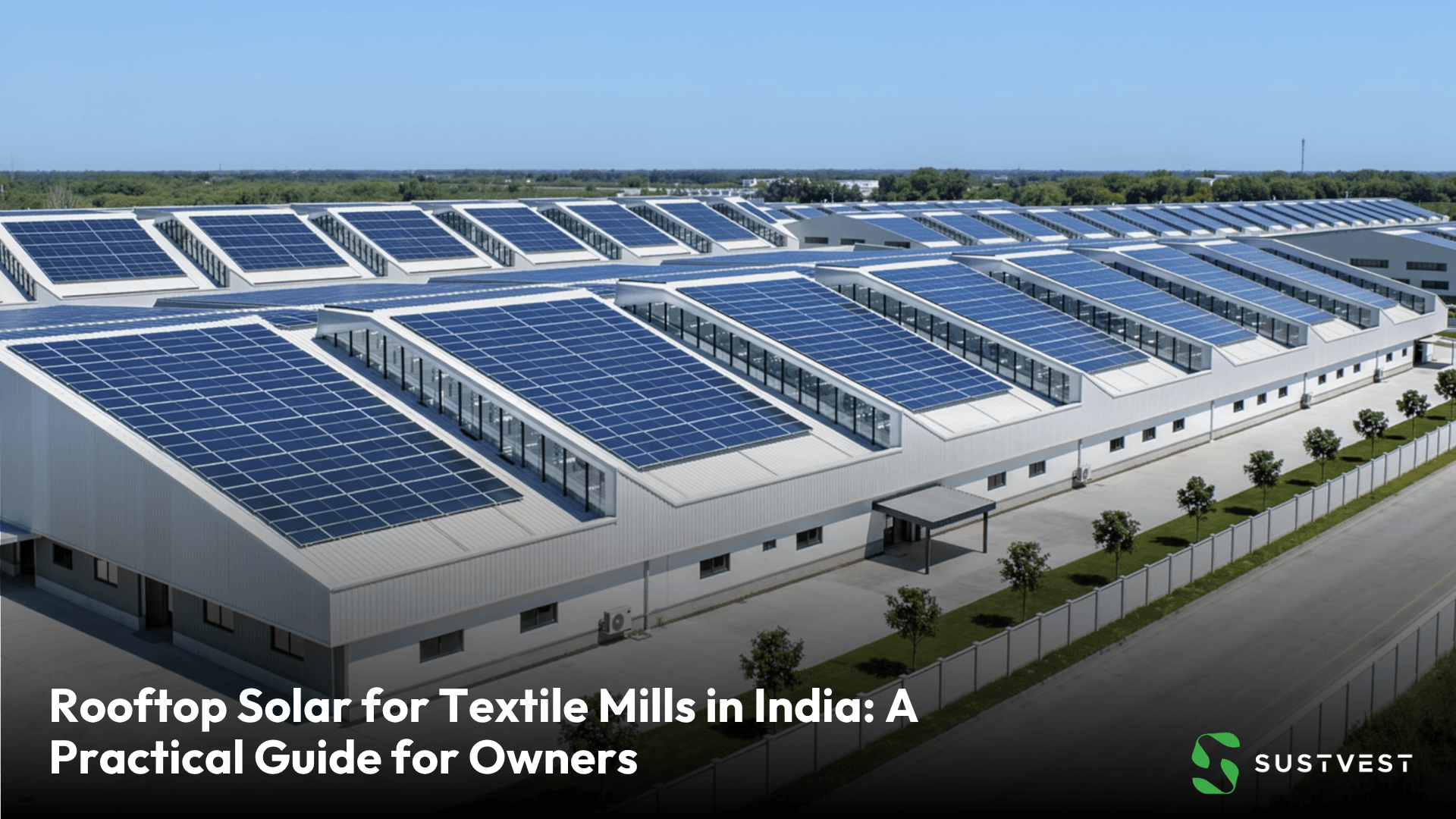
Rooftop Solar for Textile Mills in India: A Practical Guide for Owners
A textile mill lives on electricity. Spinning frames, looms, humidification plants and compressors run shift after shift, and the power bill is one of the few costs an owner can actually control. Rooftop solar is one of the most direct ways to do it.
This guide is for owners, CFOs and plant heads of spinning mills, weaving units, processing houses and garment factories. It covers where solar fits in a textile load, what a mill roof needs, how to size the plant, and how to choose between paying upfront and paying per unit.
Why should a textile mill consider rooftop solar?
Because textiles are energy-hungry and most of that energy is grid electricity bought at industrial tariffs. Rooftop solar replaces part of that daytime grid power with cheaper power made on your own roof.
The sector's footprint is large. The textile sector accounts for more than 4% of India's industrial energy consumption and 5% of its industrial emissions, according to JMK Research's study of green power procurement in the textile sector. The same study finds that SMEs (small and medium enterprises) make up about 75% of the market and a similar share of the sector's energy use, and that many of them are adopting renewable energy through rooftop solar and captive open access.
Energy use is also rising faster than revenue in parts of the industry. An ICRA ESG Ratings study reported by Outlook Business found that the energy needed to earn each crore of revenue rose by 6% to 8% between FY2023 and FY2025 across 19 textile companies. When each rupee of sales needs more power, every unit you save counts.
How much green power do textile companies use today?
Still a small share, especially in yarn and fabric. The same ICRA study found that renewable energy's share in the sampled companies' total energy use rose from about 14% in FY2023 to nearly 18% in FY2025.
The split by segment tells the real story:
| Segment (ICRA sample) | Renewable share, FY2023 | Renewable share, FY2025 |
|---|---|---|
| Apparel | 26% | 28% |
| Integrated textile companies | 17% | 21% |
| Yarn and fabric | 3% | 8% |
Yarn and fabric makers, the most power-intensive part of the chain, have the lowest green share. That gap is the opportunity: the segment that uses the most power has the most room to switch part of it to solar.
Which parts of a textile mill can solar power?
Solar powers whatever is running in daylight hours. In a textile unit that usually means a big, steady base load, which is the best possible match for a rooftop plant.
- Spinning: ring frames, carding, blow room and the humidification plant often run round the clock, so daytime solar is used fully on site.
- Weaving and knitting: looms and knitting machines draw steady power during day shifts.
- Processing and dyeing: pumps, stenters and dryers use electricity alongside steam from boilers. Solar offsets the electrical part, not the heat.
- Garmenting: sewing lines, lighting, air handling and pressing are largely daytime loads.
- Utilities: air compressors and chillers are large, constant loads that solar can offset.
Solar cannot run the mill at night. A 24-hour spinning unit will still buy most of its night-time power from the grid, which is why sizing to your daytime load matters so much.
Is a textile mill roof suitable for solar panels?
Usually yes, but textile roofs have quirks that a good developer checks before quoting. The big factors are roof shape, roof strength and dust.
Sawtooth or north-light roofs. Many older mills have sawtooth roofs with glazed north-facing slopes to let in daylight. Panels go on the solid south-facing slopes, so usable area is smaller than the floor plan suggests. A shade study tells you how much of each slope gets clean sun.
Old sheets and purlins. Asbestos or ageing metal sheets may need replacing before panels go up. A structural check confirms the purlins can carry the extra load for 25 years. Ask for this check in writing before any panel goes up.
Cotton dust and lint. Fibre dust from exhaust vents can settle on panels near the roof outlets. Placing panels away from vents and setting a regular cleaning cycle protects output.
Fire safety. Mills store cotton, yarn and fabric, all of which burn easily. Cable routing, inverter placement and fire-rated components need extra care, and the design should keep clear fire-fighting access on the roof.
How do you size a rooftop solar plant for a textile unit?
Size it to the smallest of four limits: your daytime load, your usable roof area, your sanctioned load or contract demand, and your state's rooftop rules. The smallest one decides the plant size.
For a textile unit, daytime load is rarely the limit, because spinning and weaving loads are heavy and steady. Roof area and state rules are usually what cap the plant. We explain the full method in our guide on how to size rooftop solar for a factory.
Start with twelve months of electricity bills. They show your monthly units, your demand charges and, in many states, your Time of Day (ToD) pattern. Then map the daytime load hour by hour on a typical working day and on a Sunday. If the mill shuts on Sundays, a plant sized only for weekdays may export power on Sundays, and how that export is valued depends on your state's metering rules.
Do state rules matter for textile clusters?
Yes, a lot. Each state sets its own limits on rooftop plant size, metering method and banking, and textile clusters sit in states with very different rules.
Rooftop solar is gaining ground in textile clusters such as Surat, Tiruppur, Coimbatore and Ludhiana, as Textile Excellence reports. Gujarat alone has over 100 spinning mills concentrated in Surat, Ahmedabad and Rajkot, contributing nearly 25% of India's yarn production, according to Apparel Resources.
The same report shows why the route you choose matters. Gujarat's spinning mills that bought wind and solar power from off-site plants faced curtailment of 50% to 70% of renewable generation during peak periods over about 20 months, as grid authorities cited stability and transmission limits. A rooftop plant that feeds your own machines behind the meter does not travel over the transmission network, so it avoids that particular bottleneck, although it still has to follow the state's rooftop rules. If your mill is in Gujarat, read our explainer on Gujarat's rooftop solar rules for factories before you size the plant.
Should a textile mill choose CAPEX or OPEX solar?
Choose CAPEX if you have spare cash or cheap credit and want the largest long-term savings. Choose OPEX if you want lower power costs without spending capital that your mill needs for machines and working capital.
| Question | CAPEX (you own the plant) | OPEX / RESCO (developer owns the plant) |
|---|---|---|
| Upfront cost | You pay for the full plant | Zero upfront cost |
| What you pay after | Maintenance and repairs | A fixed per-unit tariff for solar power used |
| Who maintains the plant | You, or a contractor you hire | The developer |
| Performance risk | Yours | The developer's, since it is paid only for units produced |
| Best for | Cash-rich units wanting maximum savings | Units that want to keep capital for the core business |
Textile margins are often thin and capital goes first to machines, so many mills prefer zero investment rooftop solar under an OPEX or RESCO (Renewable Energy Service Company) model. The developer funds, builds, owns and maintains the plant, and the mill pays only for the units it uses.
If you would rather buy the solar plant outright, the GST on renewable energy devices was cut from 12% to 5% from 22 September 2025, as the Ministry of New and Renewable Energy announced on PIB. That lowers the upfront cost of an owned plant.
How do you keep a textile mill's solar plant performing?
Clean the panels often, watch the generation data daily, and fix faults fast. Dust is the main enemy on a textile roof.
- Cleaning: set a cleaning schedule matched to how quickly lint and dust build up near your vents, and increase it in dry months.
- Monitoring: track daily generation against expected output, so a tripped inverter or a dirty string is caught in hours, not weeks. Good solar plant monitoring sends alerts automatically.
- Inspections: check cables, connectors and earthing regularly, with extra attention to fire risk.
- Roof care: plan for sheet repairs so panels can be moved and refitted without damage.
Our rooftop solar maintenance checklist for factories lists the routine checks in detail. Under an OPEX deal, all of this is the developer's job.
What should a textile mill owner do first?
Gather your data and get a site survey. A good proposal can only be as good as the information behind it.
- Collect 12 months of electricity bills for each connection.
- Note shift timings and weekly offs, including Sundays and festival shutdowns.
- Find the roof drawings and the age of the sheets.
- Mark exhaust vents and humidification outlets on the roof plan.
- Decide your preferred model, CAPEX or OPEX, or ask for both quotes side by side.
- Ask each developer for its track record, shade study, generation estimate and maintenance plan.
FAQ
Can rooftop solar run a textile mill 24 hours a day?
No. A rooftop plant without batteries makes power only in daylight. A round-the-clock spinning mill will still buy night-time power from the grid, so solar is sized to cut daytime grid use.
Can solar panels go on a sawtooth textile mill roof?
Yes. Panels are usually fitted on the solid south-facing slopes, while the glazed north-light slopes are left clear. Usable area is smaller than the full roof, so a shade and layout study is needed.
Does cotton dust reduce solar output?
Yes. Dust and lint on panels block sunlight and lower generation. Keeping panels away from exhaust vents and cleaning them on a regular schedule protects output.
Can a small textile unit get solar with no upfront cost?
Yes, if it qualifies for an OPEX or RESCO deal. The developer funds and owns the plant, and the unit pays a per-unit tariff for the solar power it uses.
What is the GST rate on solar equipment for a mill buying a plant?
GST on renewable energy devices was cut from 12% to 5% with effect from 22 September 2025. Ask your EPC partner how GST is applied across goods and services in your contract.
About SustVest
SustVest (SolarGridX Ventures Pvt Ltd) is a rooftop solar developer in India, ranked in the CRISIL Top-10 (#5 in 2026), running 80+ distributed solar plants of about 30 MW across 13 states for factories, hospitals, hotels and institutions. Under our OPEX/RESCO model we fund, build, own and maintain the plant while you pay a lower per-unit tariff with zero upfront cost, and we also deliver CAPEX projects through our own EPC team. Ask our team for a rooftop solar proposal for your mill.
Sources
- JMK Research: Green Power Procurement in the Indian Textile Sector (November 2024)
- Outlook Business (PTI): RE adoption rises in Indian textile sector, ICRA ESG Ratings report (December 2025)
- Apparel Resources: Renewable power curbs hit Gujarat's textile spinning mills (April 2026)
- Textile Excellence: Can solar solve textiles' biggest MSME pain point?
- PIB (MNRE): GST on renewable energy devices rationalised to 5%