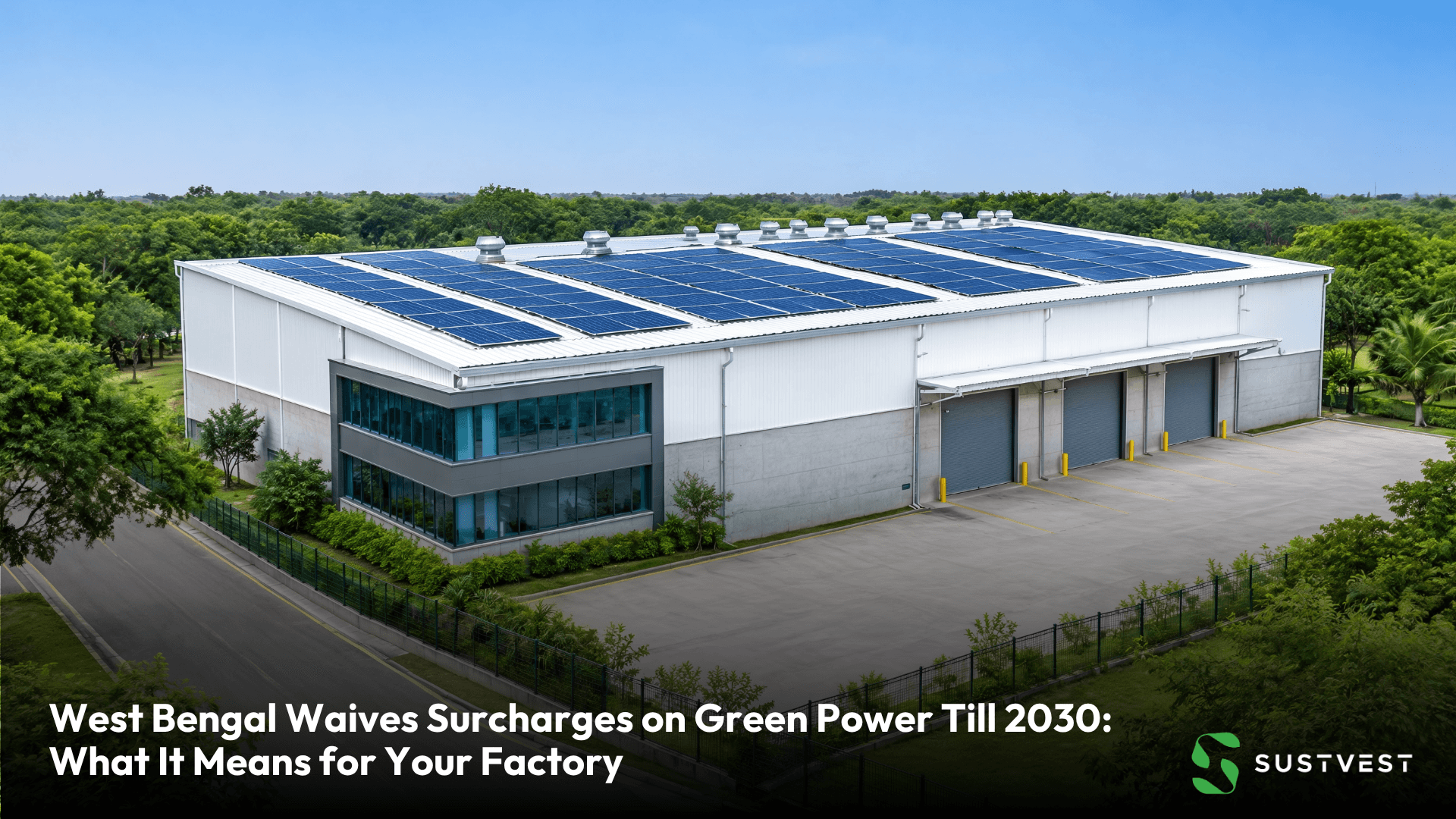
West Bengal Waives Surcharges on Green Power Till 2030: What It Means for Your Factory
West Bengal has just made green power cheaper to buy for its industries. The new West Bengal Investment Promotion Policy, 2026 waives the cross subsidy surcharge and additional surcharge on eligible green power until March 2030. For factories and large commercial sites in the state, that changes the maths of buying solar through the grid.
It also raises a practical question for owners, CFOs (Chief Financial Officers) and plant heads: if open access green power gets cheaper, is rooftop solar still the right first move? This guide explains what the policy says, who benefits, and how to plan.
What did West Bengal announce?
West Bengal's new investment policy waives two grid surcharges on green power bought from inside the state, until March 2030. Chief Minister Suvendu Adhikari unveiled the policy on 5 November 2026. According to KPMG's summary of the policy, it is effective from 9 May 2026.
The power-related headline is a "waiver/reduction of cross-subsidy surcharge and additional surcharge for eligible green power procurement arrangements", with benefits available until 31 March 2030 under prescribed conditions.
The policy also offers capital assistance of 100% to 120% of eligible fixed capital investment, electricity duty reimbursement and other incentives. Those matter, but this post focuses on the power bill.
What are cross subsidy surcharge and additional surcharge?
They are extra per-unit charges that a factory pays when it buys power from someone other than its discom (distribution company) through open access. Open access means using the grid to bring in power from a generator you choose, such as a solar park.
- Cross subsidy surcharge (CSS): compensates the discom for the cross subsidy it loses when a high-paying industrial consumer buys power elsewhere. Industrial and commercial tariffs in India usually help subsidise cheaper power for other consumer groups.
- Additional surcharge (AS): covers the discom's fixed costs for power it has contracted but can no longer sell to you.
Together, these two charges are often the biggest reason open access solar costs more than its headline tariff. Waiving them can make a real difference to the landed cost of green power.
Who qualifies for the West Bengal surcharge waiver?
As reported so far, the full waiver covers open access green power for consumers with a contract demand of 100 kW or more, where the power is generated inside West Bengal. Power Peak Digest reports these key terms:
- A complete waiver of cross subsidy surcharge and additional surcharge on green power sourced within West Bengal, until March 2030.
- Eligibility for open access green power at a contract demand of 100 kW or more, as long as the source is in the state.
- A 50% waiver on these surcharges for non-captive green power brought in from outside the state.
The 100 kW figure lines up with the national rules. The Green Energy Open Access Rules, 2022 cut the open access limit from 1 MW to 100 kW, capped increases in cross subsidy surcharge and removed additional surcharge for green open access. West Bengal's policy goes a step further on cross subsidy surcharge for in-state power.
One caution. KPMG notes that further operational guidelines and implementation procedures are expected. The exact conditions, the start date for each benefit and the treatment of existing contracts are likely to sit in those guidelines. Check them before you sign anything.
Does the waiver change anything for rooftop solar?
Not directly. Rooftop solar on your own premises is not an open access purchase, so these surcharges generally do not apply to it in the first place. The panels sit behind your meter, and the power never travels across the discom's network to reach you.
Other states write this exemption into their rooftop rules. Telangana's 2025 rooftop solar regulation, for example, exempts net and gross metering consumers from banking, wheeling, cross subsidy and additional surcharges. The waiver in West Bengal mainly narrows the gap between rooftop solar and open access solar. It does not remove rooftop's advantages.
We covered this trade-off in detail in our guide to rooftop solar vs open access solar for factories.
Rooftop solar vs green open access in West Bengal: how do they compare now?
After the policy, in-state green open access gets cheaper, but rooftop solar still wins on simplicity, control and grid charges. Here is how the options line up, based on the terms reported so far.
| Factor | Rooftop solar (on-site) | In-state green open access | Out-of-state green open access (non-captive) |
|---|---|---|---|
| Cross subsidy surcharge | Generally not applicable | Waived until March 2030 (as reported) | 50% waiver (as reported) |
| Additional surcharge | Generally not applicable | Waived until March 2030 (as reported) | 50% waiver (as reported) |
| Transmission and wheeling charges | None, power is used on-site | Payable | Payable |
| Minimum size | Limited by roof area and state rooftop rules | 100 kW contract demand | 100 kW contract demand |
| Approvals | Discom connection and metering | Open access approval, scheduling | Open access approval, inter-state scheduling |
| Policy risk after 2030 | Low, no surcharge exposure | Surcharges may return after March 2030 | Surcharges may return after March 2030 |
The last row matters most for long contracts. A solar PPA (Power Purchase Agreement) for open access often runs well beyond 2030. If the waiver ends on schedule, the surcharges are likely to return for the remaining years, unless the state extends it.
Should a West Bengal factory still start with rooftop solar?
For most sites, yes. Use the roof first, then look at open access for the load your roof cannot cover. The reasons are simple:
- No grid charges on rooftop units. Every unit made on your roof replaces a unit you would otherwise buy at your full industrial tariff.
- No dependence on a 2030 deadline. Rooftop savings do not hinge on a temporary waiver.
- Fewer moving parts. There is no open access scheduling, no deviation settlement and no third-party transmission approvals.
- You can do it with zero upfront cost. Under a zero investment rooftop solar (OPEX) model, the developer funds, builds and runs the plant, and you pay only for the units it produces.
Open access then becomes a top-up. Large plants with high daytime load, such as steel, paper, textile and food processing units, may find their roof covers only a small share of demand. For them, the waiver makes in-state green open access a much stronger second step than it was before.
To work out how much your roof can carry, see our simple rooftop solar sizing guide for factories.
What else in the policy affects a factory's power bill?
Electricity duty reimbursement is the other big lever. Per KPMG's summary of the policy:
- Manufacturing and other non-service units get 100% electricity duty reimbursement for up to 5 years.
- Service units, which the policy says include healthcare and tourism and hospitality, get it for 3 years, or 5 years in a priority area.
- Revived sick or closed units can get net metering benefits and special power subsidy support.
Separately, West Bengal's MSME (Micro, Small and Medium Enterprises) scheme, WBIS 2026, offers electricity duty waivers of 50% to 75% by zone for new manufacturing MSMEs that start production on or after 1 October 2026. These are two different schemes, so check which one applies to your unit.
Duty relief lowers the cost of grid power for eligible units. It is worth putting into your solar financial model, because it slightly changes the saving per unit that solar delivers. It is unlikely to change the basic case for solar, since the energy charge is still the largest part of most industrial bills.
What should a West Bengal factory do now?
Treat the waiver as a window to plan your full green power mix, not a reason to rush into a long open access contract. A practical checklist:
- Pull 12 months of bills. Note your contract demand, daytime load and energy charges. Our guide on how to read your factory's electricity bill shows what to look for.
- Size the roof first. Get a site survey and structural check. Rooftop units are the cheapest and most stable green units you can get.
- Check your contract demand. If it is 100 kW or more, you are likely eligible for green open access for the balance.
- Wait for the guidelines. Confirm how the waiver applies, from when, and what happens after 31 March 2030.
- Stress test any open access PPA. Model the years after 2030 with the surcharges back in. If the deal only works with the waiver, it carries risk.
- Choose the ownership model. Compare CAPEX rooftop solar, where you buy the plant outright, with OPEX, where you pay only per unit.
Open access applications for green power run through the national Green Open Access Registry portal, operated by Grid Controller of India Limited. The national rules say green open access approval should be granted within 15 days, or it is deemed granted.
What are the risks and unknowns?
The biggest unknowns are the detailed conditions and what happens after March 2030. Keep these in view:
- Guidelines are pending. The headline terms come from the policy launch and early reporting. Final rules could add conditions.
- The waiver is time-bound. It runs until March 2030. A 15 or 25 year open access contract will outlast it.
- Regulator orders still apply. Open access charges are set by the West Bengal Electricity Regulatory Commission (WBERC). How the policy is reflected in tariff orders is likely to shape the real benefit.
- Grid charges remain. Transmission and wheeling charges are not part of the reported waiver.
FAQ
Does the West Bengal surcharge waiver apply to rooftop solar?
Not directly. The waiver covers cross subsidy surcharge and additional surcharge on green power bought through open access. Rooftop solar used on your own premises is generally not an open access purchase, so these surcharges usually do not apply to it.
Until when is the green power surcharge waiver valid?
Until 31 March 2030, under conditions the state will prescribe. Plan any long contract for what happens after that date.
What is the minimum size to buy green power through open access?
The national Green Energy Open Access Rules, 2022 set the limit at 100 kW. West Bengal's waiver is reported to cover consumers with a contract demand of 100 kW or more.
Is out-of-state green power also covered?
Partly. Reports say non-captive green power from outside West Bengal gets a 50% waiver on these surcharges, while in-state green power gets a full waiver.
Should I choose rooftop solar or open access first?
For most factories, start with rooftop solar, because it carries no grid charges and does not depend on a temporary waiver. Then use green open access for the load your roof cannot cover.
About SustVest
SustVest (SolarGridX Ventures Pvt Ltd) is a rooftop solar developer in India, ranked #5 among India's top 10 rooftop solar developers (CRISIL, 2026). We run 80+ distributed solar plants (about 30 MW) across 13 states for factories, hospitals, hotels, tea estates and institutions, mostly under the OPEX/RESCO (Renewable Energy Service Company) model with zero upfront cost. Talk to our team about rooftop solar for your West Bengal site.
Sources
- KPMG Flash News: West Bengal Investment Promotion Policy 2026 (6 November 2026)
- Power Peak Digest: West Bengal offers 100% surcharge waiver for in-state green power (13 November 2026)
- The Week: Suvendu Adhikari unveils Bengal industrial policy (5 November 2026)
- KNN India: West Bengal approves WBIS 2026 MSME incentive scheme
- PIB, Ministry of Power: Green Energy Open Access Rules (19 July 2022)
- PIB, Ministry of Power: Green Energy Open Access Rules and GOAR portal (13 May 2023)
- Power Peak Digest: TGERC rooftop solar regulation 2025
- West Bengal Electricity Regulatory Commission