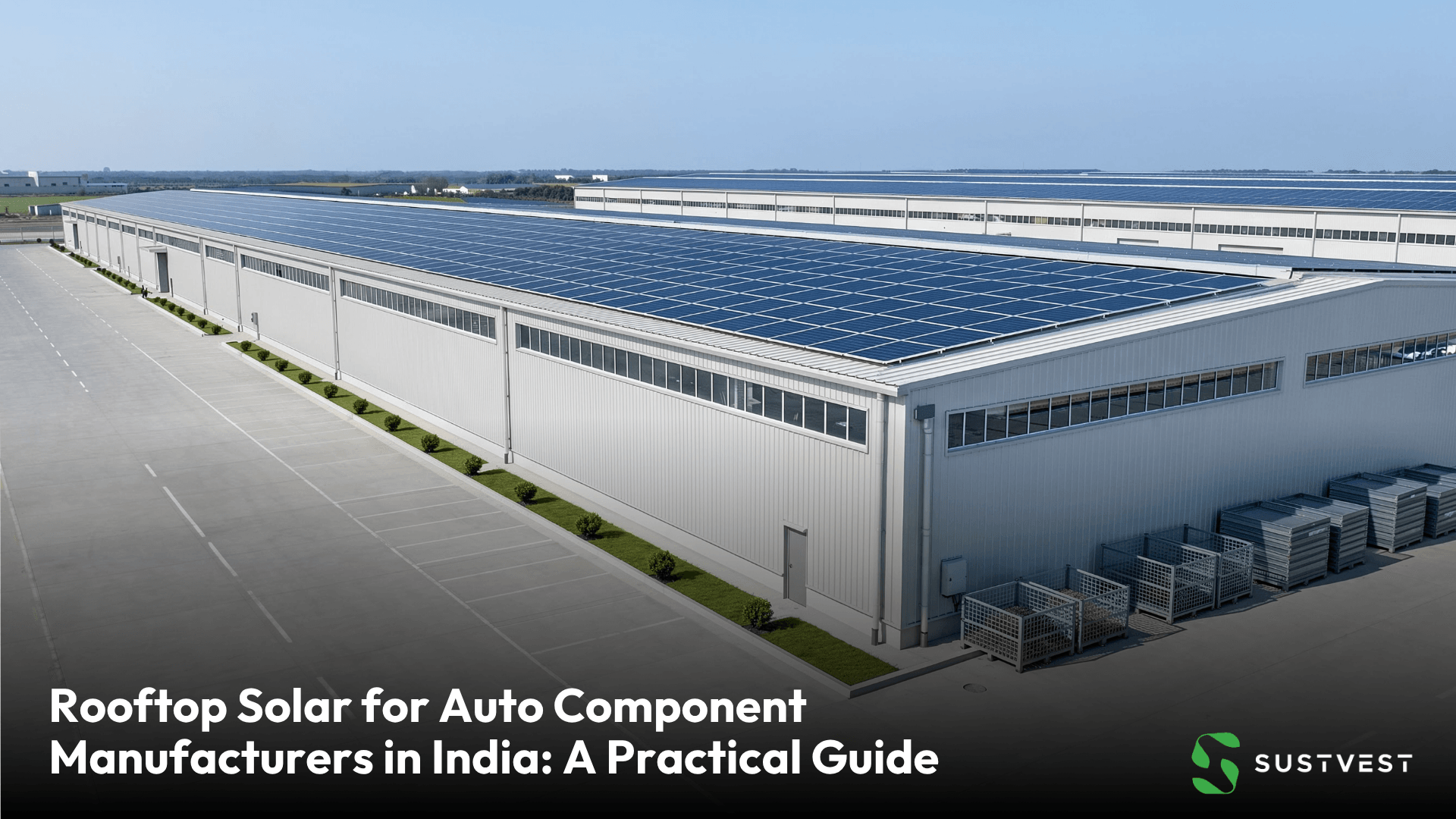
Rooftop Solar for Auto Component Manufacturers in India: A Practical Guide
Auto component plants are some of the best rooftop solar sites in India. They run machines through the daytime, sit under large metal-sheet sheds, and sell to carmakers who are starting to ask hard questions about the power behind every part. This guide explains what solar can do for a component plant, how to size it, and how to pay for it without tying up capital.
Why are auto component makers moving to rooftop solar?
Three reasons: power is a large running cost, the roof is free space, and customers are starting to ask about green power. A component plant that machines, presses, moulds, welds or paints parts buys most of its electricity during the day. Solar produces during the same hours, so almost every unit it makes replaces a unit bought from the grid.
The industry is also growing fast. India's auto component industry reached a turnover of ₹7.60 lakh crore in FY2025-26, up 12.7% on the year, and supplies to vehicle makers rose 16.3% to ₹6,62,893 crore, according to ACMA's FY2025-26 industry performance review. More output means more shifts, more machines and a bigger power bill, which makes the case for solar stronger each year.
Do carmakers really care about their suppliers' electricity?
Increasingly, yes, because most of a vehicle maker's emissions sit in its supply chain. A study by the Council on Energy, Environment and Water (CEEW) found that Scope 3 emissions (emissions from suppliers and other parts of the value chain) make up over 83% of the auto industry's emissions in India. The same study found that a switch to green electricity and low-carbon steel could cut the industry's manufacturing emissions by as much as 87% by 2050.
Reporting rules point the same way. Under a SEBI circular of 28 March 2025, the top 250 listed companies can report ESG (Environmental, Social and Governance) data for their value chain from FY2025-26. Value chain here means each supplier or customer that makes up 2% or more of the company's purchases or sales. For now this is voluntary, but a large listed carmaker that chooses to report will need numbers from its biggest suppliers.
What this means for you: a supplier that can show real solar generation data, plant by plant, is likely to find customer ESG questionnaires easier to answer. It is a practical edge, not a legal requirement.
What does an auto component plant's power use look like?
Mostly daytime, mostly steady, with a few heavy loads that set the peak. Typical loads include:
- CNC machining and turning centres: steady load across one to three shifts.
- Power presses and forging: high peaks, which drive your contract demand charges.
- Injection moulding and rubber parts: heaters and hydraulics that run for long hours.
- Heat treatment furnaces: large, often round-the-clock loads.
- Paint shops, compressors and lighting: the background load that never quite switches off.
Solar works best against the steady daytime base load. It cuts energy charges (the per-unit part of your bill) well, but it will not reliably cut demand charges, because a press can still spike on a cloudy afternoon. Read your bill with this split in mind before you size the plant.
How much rooftop solar does a component plant need?
The right size is usually the smallest of four limits: your daytime load, your usable roof area, your sanctioned load, and your state's rooftop rules. Most component plants run out of daytime load or state limits before they run out of roof. Our rooftop solar sizing guide for factories walks through each limit with simple worked steps.
Two plant-level tips from component sites:
- Size to the working week, not the peak day. If the plant runs six days with a lighter Sunday, check how your state treats surplus units on low-load days (net metering, net billing or none at all).
- Count every roof. Many component makers run several sheds, stores and canteens on one campus. Each roof adds capacity, even if no single shed is large.
Growth often comes later. From SustVest's own project records: an auto components plant in Patiala now runs about 5 MWp across two phases, a 2,490 kWp first phase commissioned in March 2025 and a 2,525 kWp second phase commissioned in December 2025. Plan the first phase so the second can tie in cleanly, with spare space at the main panel and a cable route already mapped.
Are metal-sheet factory roofs suitable for solar?
Usually yes, but the roof must be checked before the panels go up. Most component plants sit under pre-engineered metal sheet roofs. These suit solar well: the panels are light, the mounting clamps onto the seams, and the roof needs no drilling into the main structure when the right clamps are used.
The checks that matter:
- Sheet age and corrosion: a roof due for replacement in a few years should be replaced first, because solar plants run for decades.
- Purlin strength: a structural engineer should confirm the frame can carry the extra load and wind force.
- Skylights and ventilators: these break up the usable area and must stay clear.
- Exhaust and dust: paint shop and foundry exhaust can soil panels faster, which raises cleaning needs.
For an older shed, run our roof readiness checklist for old factories before you call a developer.
Should a component maker buy the plant or use the OPEX model?
It depends on where your capital earns most. Under CAPEX rooftop solar, you buy the plant outright, own every unit it makes, and claim the tax benefits. Under the OPEX solar model, also called RESCO (Renewable Energy Service Company), a developer funds, builds, owns and maintains the plant, and you pay only for the units you use, at a tariff below your grid rate.
| Question | CAPEX (you buy) | OPEX / RESCO (developer owns) |
|---|---|---|
| Upfront cost | Full plant cost | Zero |
| Who maintains it | You, or an O&M contractor you hire | The developer |
| Performance risk | Yours | The developer's: you pay per unit generated |
| Best for | Cash-rich plants with low cost of capital | Plants that want capital for machines, tooling and capacity |
For many component makers, capital is better spent on a new CNC line or a customer's new platform than on a solar plant. That is why OPEX is popular in the sector. From SustVest's own project records: the 500 kWp rooftop plant for MAHLE in Chennai runs on the OPEX / RESCO model and was commissioned in July 2025. For a full side-by-side comparison, read our CAPEX vs OPEX rooftop solar guide.
How do you prove your solar generation to a customer?
With clean, plant-level data you can export on demand. A customer's sustainability team will want to know how many units your plant generated, over what period, and what share of your total power that was. Good solar plant monitoring records generation by inverter and by day, so those figures come straight from the system rather than from estimates.
Keep three numbers ready for each financial year:
- Total solar units generated and used on site.
- Total units bought from the grid (from your discom bills).
- Solar as a share of total consumption.
If you run several plants, keep the figures separate for each site. Carmakers often source a part from one specific plant, and they may ask for that plant's numbers.
What should a component maker check before signing with a solar developer?
Check the developer's track record with plants like yours, the equipment it uses, and how the contract handles your growth. Five practical questions:
- Has the developer built and run plants for other manufacturers, and can you speak to them?
- Who maintains the plant, how often are panels cleaned, and what happens when output drops?
- Can a second phase be added under the same agreement if your plant expands?
- What happens if you shift production, move a line or sell the unit?
- Will you get monthly generation reports you can share with customers?
FAQ
Is rooftop solar worth it for a single-shift component plant?
Often yes, because a single day shift still lines up with solar hours. The plant should be sized to the daytime load so that little power is exported at a low rate.
Can solar run a heat treatment furnace at night?
No. Rooftop solar only produces in daylight. Night loads still come from the grid unless you add battery storage, which is usually a separate decision.
Do carmakers require suppliers to use solar?
There is no general legal requirement. But SEBI now lets the top 250 listed companies report value chain ESG data on a voluntary basis from FY2025-26, and carmakers that do so will need data from their large suppliers.
Will panels on a metal shed roof cause leaks?
Not when they are mounted with seam clamps and checked by a structural engineer. A roof near the end of its life should be replaced before solar goes up.
Can we add more solar later if the plant expands?
Yes. Many plants add a second phase once the first proves itself. Leave space at the main panel and confirm the developer can extend the agreement.
About SustVest
SustVest is a rooftop solar developer in India, ranked in CRISIL's Top 10 rooftop solar developers (#5, 2026). It runs 80+ distributed solar plants (about 30 MW) across 13 states for factories, hospitals, hotels and institutions, mostly on a zero upfront OPEX model where SustVest funds, builds, owns and maintains the plant. Talk to SustVest about a rooftop solar plan for your component plant.