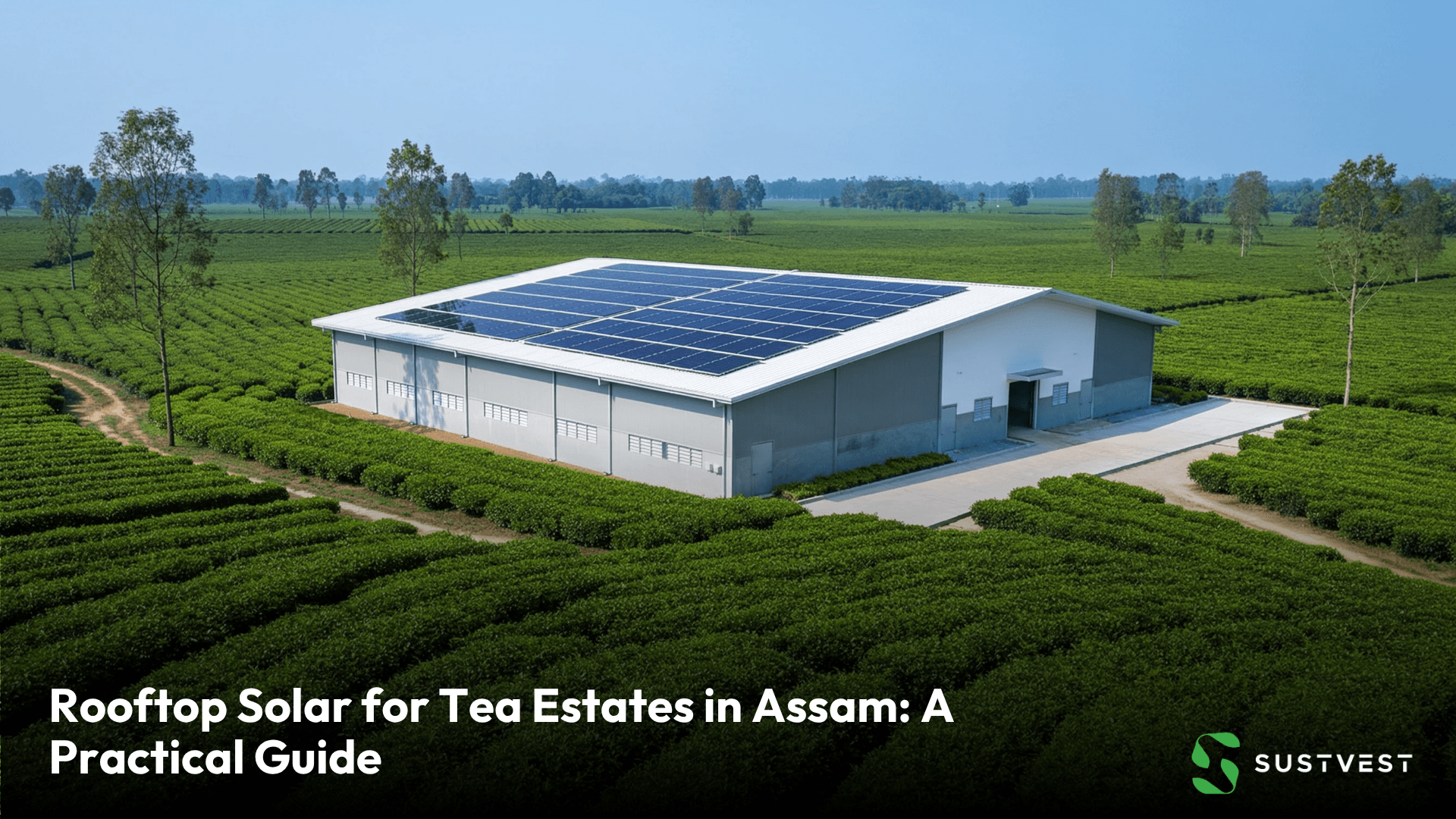
Rooftop Solar for Tea Estates in Assam: A Practical Guide
Rooftop solar is a good fit for most Assam tea factories: they run heavy electric loads in daylight during the manufacturing season, sit on large roofs and pay industrial power bills. Assam's current clean energy policy allows tea, coffee and rubber consumers to install rooftop plants of up to 1,000 kW on the AC side and bank energy on a yearly basis. With a zero-upfront OPEX model, an estate can start saving without spending its own capital.
This guide is for tea estate owners, managing agents and factory heads who want a clear, practical answer to one question: should our factory roofs carry solar, and how do we do it well?
Why does rooftop solar suit tea factories?
Tea factories use most of their electricity in the daytime, when solar panels produce. Withering fans, CTC (crush, tear, curl) machines, rollers, conveyors and sorting lines all run on grid power or diesel generators.
Energy is a real cost line. A Bureau of Energy Efficiency (BEE) study of the Jorhat tea cluster found that total energy cost was about 20% of production cost. The same study noted that factories in the cluster run in three shifts, that open-trough withering can take 10 to 16 hours, and that some units keep DG (diesel generator) sets as backup.
Two points matter for solar planning:
- Solar replaces grid and diesel electricity, not dryer heat. The BEE study names dryers as the biggest energy users, and most dryers burn coal, gas or other fuel. Rooftop solar cuts the electric part of the bill: fans, motors, lighting and processing lines.
- Roofs are already there. Factory sheds, withering houses, stores and staff buildings offer large, mostly shade-free roof areas spread across the estate.
What do Assam's rules allow for rooftop solar on tea estates?
The short answer: up to 1,000 kW per site for the tea category, with yearly energy banking, under AERC (Assam Electricity Regulatory Commission) rules.
The Assam Integrated Clean Energy Policy 2025 was notified by the state Power Department on 24 February 2025 and stays in force until 31 March 2030 unless replaced earlier. The key points for tea estates:
- Big target for business rooftops. The policy sets a target of 1,000 MW of rooftop solar in the industrial and commercial sector, within up to 1.9 GW of rooftop solar overall.
- Tea has its own category. For consumers in the tea, coffee and rubber category, rooftop capacity is limited to 1,000 kW on the AC side.
- Yearly banking for tea. The policy says energy banking is permitted on a yearly basis for all tea, coffee and rubber consumers (tariff category HT VI). Another clause describes banking on a monthly billing cycle, so confirm with APDCL (Assam Power Distribution Company Limited) how your connection will be billed before you size the plant.
- Several metering options. The state promotes rooftop plants through net metering, net billing, virtual net metering or group net metering, as per AERC rules. If you are unsure which suits you, see our explainer on net metering vs net billing vs gross metering.
- Local grid limit. APDCL allows rooftop capacity up to 80% of the capacity of the distribution transformer in the area, so a feeder that already has a lot of solar may need a check.
The technical rules sit in the AERC (Grid Interactive Solar PV Systems) Regulations, 2019, which AERC amended in June 2024. In August 2026, AERC also told APDCL to keep processing rooftop solar applications under the existing rules and not to delay or reject them, as reported by SolarQuarter. That was an interim order, so watch for the final outcome.
Why does yearly banking matter so much for tea?
Tea manufacturing is seasonal, and yearly banking lets solar units produced in lean months count against heavy-season use. Factory load rises sharply when leaf is coming in and falls in the off-season, while solar keeps producing all year.
With monthly settlement, surplus units from a quiet month can be lost or paid at a low rate. With yearly banking, the estate can size the plant closer to its annual consumption rather than its lowest month. This is likely to let many Assam tea estates justify a larger plant than a factory with the same peak load under monthly settlement. Get APDCL's confirmation in writing before you lock in the size.
How big should a tea factory's solar plant be?
Size each plant to the factory's annual daytime electricity use, its sanctioned load and its usable roof, and stay within the 1,000 kW AC limit per site. In practice that means four numbers:
- Twelve months of electricity bills for each connection, to see units used across both the manufacturing season and the off-season.
- Daytime share of load. Most withering, rolling and sorting happens in daylight, but check your shift pattern.
- Usable shade-free roof area on the factory, withering sheds and stores.
- Diesel use. Every unit of daytime diesel generation that solar can displace adds to the savings.
Many estates have more than one factory or several connections. From SustVest's own project records: we run 1,712 kWp across 4 tea estate sites in Assam for one client, an average of 428 kWp per site. Spreading capacity across sites lets each plant match its own factory load instead of forcing one oversized plant onto one roof.
Is an old tea factory roof strong enough for solar?
Often yes, but check before you sign. Many tea factory sheds are decades old, with corrugated metal or asbestos-cement sheets, timber or light steel trusses, and heavy monsoon rain every year.
Before any design work, look at:
- Sheet condition: rust, leaks and thin spots. Replace weak sheets before panels go up, not after.
- Structure: a structural engineer should confirm the trusses can carry the added load and the wind loads.
- Asbestos sheets: these need special care. Drilling and walking on them is a safety risk, so a fresh roof or a non-penetrating mounting is usually the better path.
- Drainage and humidity: panels and cable routes must not block gutters, and all electrical parts should be rated for Assam's damp climate.
Our old factory roof solar readiness checklist walks through each check and gives a simple ready, fix-first or not-suitable result.
Should a tea estate buy the plant or go zero upfront?
If the estate has spare capital and wants the highest lifetime savings, buying can win. If cash is better used in the gardens and factory, the zero-upfront OPEX model usually makes more sense.
| Question | CAPEX (you buy the plant) | OPEX / RESCO (developer owns it) |
|---|---|---|
| Upfront cost | Full plant cost paid by the estate | Zero; the developer funds the plant |
| What you pay | Your own maintenance and insurance | A fixed per-unit tariff for the solar power you use |
| Who maintains it | The estate, or a contractor you hire | The developer, for the full contract term |
| Performance risk | Stays with the estate | Sits with the developer, who is paid only for units produced |
| Best for | Estates with spare capital and in-house engineering | Estates that want savings without spending capital |
Under zero investment rooftop solar, also called the RESCO (Renewable Energy Service Company) model, the developer funds, builds, owns and maintains the plant, and the estate pays a lower per-unit tariff than its grid tariff. If you prefer to buy the solar plant outright, an EPC (engineering, procurement and construction) contract gives you full ownership from day one. Our CAPEX vs OPEX rooftop solar guide covers the decision in detail.
How do you keep a solar plant running on a remote estate?
Remote monitoring plus a local cleaning routine. Estates are often far from service centres, so problems must be spotted from a screen, not on a site visit.
- Monitoring: live solar plant monitoring flags an inverter fault or a dip in output the same day.
- Cleaning: dust settles on panels and cuts output. A trained estate team member can follow a simple washing schedule.
- Monsoon checks: inspect cable trays, earthing and roof fixings before and after the heavy rain months.
- Spare parts: agree in advance where spare fuses, connectors and inverter parts will be kept.
What are the steps to get started?
- Collect 12 months of electricity bills and DG diesel records for each factory connection.
- List every roof with its age, sheet type and rough area.
- Ask APDCL how banking will apply to your HT VI connection and which metering option fits.
- Get a site survey and structural check from the developer.
- Compare a CAPEX quote with an OPEX tariff offer on the same generation estimate.
- Read the PPA (power purchase agreement) carefully before signing, then apply for grid connection through APDCL.
FAQ
How much rooftop solar can a tea factory in Assam install?
Under the Assam Integrated Clean Energy Policy 2025, consumers in the tea, coffee and rubber category can install rooftop solar of up to 1,000 kW on the AC side per site, subject to AERC rules and local transformer capacity.
Can tea estates bank solar power in Assam?
Yes. The policy says energy banking is permitted on a yearly basis for tea, coffee and rubber consumers. Confirm the exact billing treatment for your connection with APDCL before sizing the plant.
Will rooftop solar run a tea factory's dryers?
Not directly in most cases. Most tea dryers burn fuel for heat. Rooftop solar powers the electric loads such as withering fans, CTC machines, rollers and sorting lines, and can cut daytime diesel generator use.
Can a tea estate get rooftop solar with no upfront cost?
Yes. Under the OPEX or RESCO model, a developer funds, builds, owns and maintains the plant, and the estate pays a per-unit tariff for the solar power it uses.
Are old tea factory roofs safe for solar panels?
Many are, after a structural check and repair of weak sheets. Asbestos-cement roofs need special care and often a new roof or non-penetrating mounting before panels go up.
About SustVest
SustVest is a rooftop solar developer in India and a CRISIL Top-10 rooftop solar developer, running 80+ distributed solar plants (about 30 MW) across 13 states for factories, hospitals, hotels, tea estates and institutions. Under our OPEX/RESCO model we fund, build, own and maintain the plant, so you pay a lower per-unit tariff with zero upfront cost. Talk to SustVest about solar for your tea estate.
Sources
- Government of Assam, Power Department: Assam Integrated Clean Energy Policy 2025 (via APDCL)
- Assam Electricity Regulatory Commission: Regulations list, including the Grid Interactive Solar PV Systems Regulations, 2019 and First Amendment, 2024
- Bureau of Energy Efficiency: Jorhat tea cluster, Situation Analysis for SME Sector
- SolarQuarter: AERC directs APDCL to continue rooftop solar applications under existing rules (August 2026)